

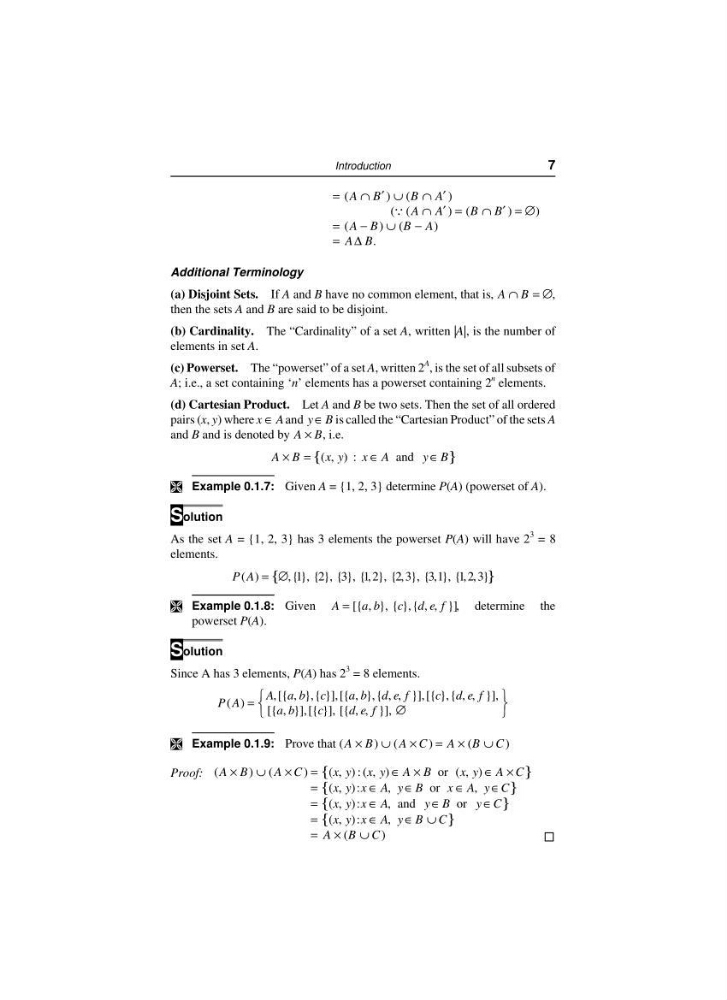
=
∩ ′ ∪
∩ ′
∩ ′ =
∩ ′ = ∅
=
−
∪
−
=
(
) (
)
( (
) (
)
)
(
) (
)
.
A B
B A
A A
B B
A B
B A
A B
Q
∆
Addi tional Ter mi nol ogy
(a) Disjoint Sets. If A and B have no common element, that is, A B
∩ = ∅,
then the sets A and B are said to be disjoint.
(b) Cardinality. The “Cardinality” of a set A, written |A|, is the number of
elements in set A.
(c) Powerset. The “powerset” of a set A, written 2
A
, is the set of all subsets of
A; i.e., a set containing ‘n’ elements has a powerset containing 2
n elements.
(d) Cartesian Product. Let A and B be two sets. Then the set of all ordered
pairs (x, y) where x A
∈ and y B
∈ is called the “Cartesian Product” of the sets A
and B and is denoted by A B
× , i.e.
{
}
A B
x y x A
y B
× =
∈
∈
( , ) :
and
Ì Exam ple 0.1.7: Given A = {1, 2, 3} determine P(A) (powerset of A).
Solu tion
As the set A = {1, 2, 3} has 3 elements the powerset P(A) will have 2
3 = 8
elements.
{
}
P A
( )
, { }, { }, { }, { , }, { , }, { , }, { , , }
= ∅ 1 2 3 1 2 2 3 3 1 1 2 3
Ì Exam ple 0.1.8: Given A
a b c d e f
= [{ , }, { }, { , , }], determine the
powerset P(A).
Solu tion
Since A has 3 elements, P(A) has 2
3 = 8 elements.
P A
A a b c
a b d e f
c d e f
( )
, [{ , }, { }], [{ , }, { , , }], [{ }, { , , }],
[
= { , }], [{ }], [{ , , }],
a b
c
d e f
∅
Ì Exam ple 0.1.9: Prove that (
) (
)
(
)
A B
A C
A B C
×
∪
×
= ×
∪
Proof:
{
}
(
) (
)
( , ) : ( , )
( , )
( , ) :
,
A B
A C
x y x y A B
x y A C
x y x A y
×
∪
×
=
∈ ×
∈ ×
=
∈
or
{
}
{
}
{
}
∈
∈
∈
=
∈
∈
∈
=
∈
∈ ∪
=
B
x A y C
x y x A
y B
y C
x y x A y B C
or
and
or
,
( , ) :
,
( , ) :
,
A B C
×
∪
(
)
¨
Introduction
7
∩ ′ ∪
∩ ′
∩ ′ =
∩ ′ = ∅
=
−
∪
−
=
(
) (
)
( (
) (
)
)
(
) (
)
.
A B
B A
A A
B B
A B
B A
A B
Q
∆
Addi tional Ter mi nol ogy
(a) Disjoint Sets. If A and B have no common element, that is, A B
∩ = ∅,
then the sets A and B are said to be disjoint.
(b) Cardinality. The “Cardinality” of a set A, written |A|, is the number of
elements in set A.
(c) Powerset. The “powerset” of a set A, written 2
A
, is the set of all subsets of
A; i.e., a set containing ‘n’ elements has a powerset containing 2
n elements.
(d) Cartesian Product. Let A and B be two sets. Then the set of all ordered
pairs (x, y) where x A
∈ and y B
∈ is called the “Cartesian Product” of the sets A
and B and is denoted by A B
× , i.e.
{
}
A B
x y x A
y B
× =
∈
∈
( , ) :
and
Ì Exam ple 0.1.7: Given A = {1, 2, 3} determine P(A) (powerset of A).
Solu tion
As the set A = {1, 2, 3} has 3 elements the powerset P(A) will have 2
3 = 8
elements.
{
}
P A
( )
, { }, { }, { }, { , }, { , }, { , }, { , , }
= ∅ 1 2 3 1 2 2 3 3 1 1 2 3
Ì Exam ple 0.1.8: Given A
a b c d e f
= [{ , }, { }, { , , }], determine the
powerset P(A).
Solu tion
Since A has 3 elements, P(A) has 2
3 = 8 elements.
P A
A a b c
a b d e f
c d e f
( )
, [{ , }, { }], [{ , }, { , , }], [{ }, { , , }],
[
= { , }], [{ }], [{ , , }],
a b
c
d e f
∅
Ì Exam ple 0.1.9: Prove that (
) (
)
(
)
A B
A C
A B C
×
∪
×
= ×
∪
Proof:
{
}
(
) (
)
( , ) : ( , )
( , )
( , ) :
,
A B
A C
x y x y A B
x y A C
x y x A y
×
∪
×
=
∈ ×
∈ ×
=
∈
or
{
}
{
}
{
}
∈
∈
∈
=
∈
∈
∈
=
∈
∈ ∪
=
B
x A y C
x y x A
y B
y C
x y x A y B C
or
and
or
,
( , ) :
,
( , ) :
,
A B C
×
∪
(
)
¨
Introduction
7