

3. For each transition rule of M of the form
δ(q r ,a)=q p ,
find the sets to which q r and q p belong. If q r ∈ {q i ,q j ,…,q k } and q p ∈
{q l ,q m ,…, q n }, add to a rule
4. The initial state is that state of whose label includes the 0.
5. is the set of all the states whose label contains i such that q i ∈ F.
Example 2.16
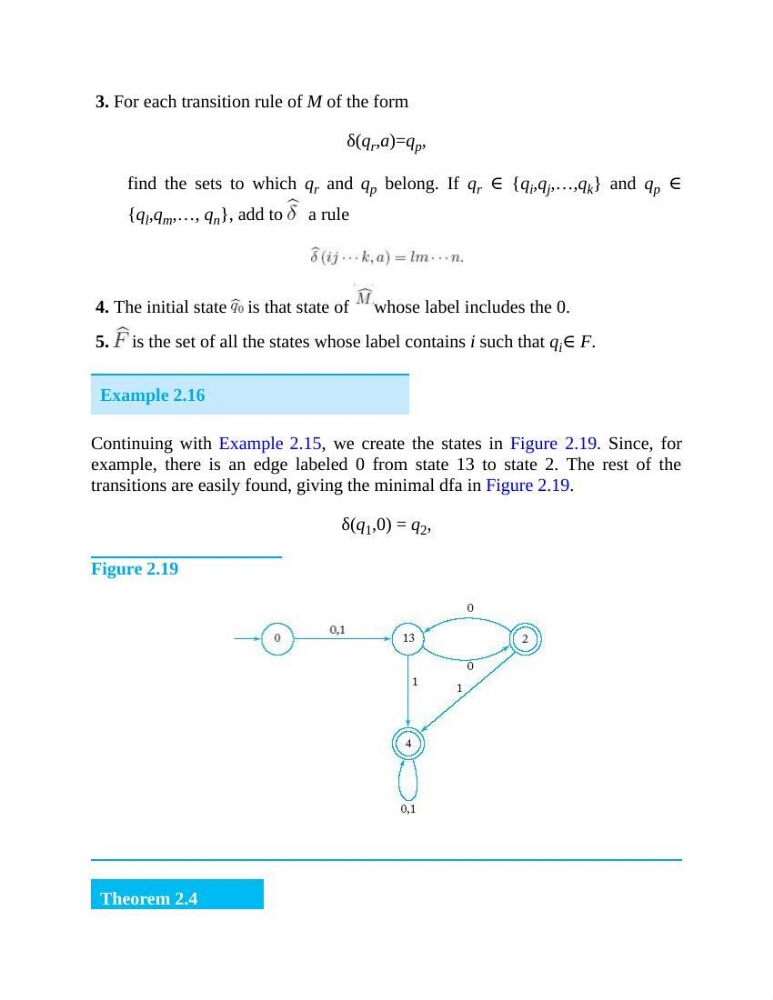
Continuing with Example 2.15, we create the states in Figure 2.19. Since, for
example, there is an edge labeled 0 from state 13 to state 2. The rest of the
transitions are easily found, giving the minimal dfa in Figure 2.19.
δ(q 1 ,0) = q 2 ,
Figure 2.19
Theorem 2.4
δ(q r ,a)=q p ,
find the sets to which q r and q p belong. If q r ∈ {q i ,q j ,…,q k } and q p ∈
{q l ,q m ,…, q n }, add to a rule
4. The initial state is that state of whose label includes the 0.
5. is the set of all the states whose label contains i such that q i ∈ F.
Example 2.16
Continuing with Example 2.15, we create the states in Figure 2.19. Since, for
example, there is an edge labeled 0 from state 13 to state 2. The rest of the
transitions are easily found, giving the minimal dfa in Figure 2.19.
δ(q 1 ,0) = q 2 ,
Figure 2.19
Theorem 2.4