

θ: Q × ∑ → Γ is the output function,
q 0 ∈ Q is the initial state of M.
The machine starts in state q 0 at which time all input is available for processing.
If at time t n the Mealy machine is in state q i , the current input symbol is a, and
δ(q i , a) = q j , θ(q i , a) = b, the machine will enter state q j and produce output b. It
is assumed the entire process is terminated when the end of the input is reached.
Note that there are no final states associated with a transducer.
Transition graphs are as useful here as they are for finite accepters. In fact,
the only difference is that now the transition edges are labeled with a/b, where a
is the current input symbol and b is the output produced by the transition.
Example A.1
The fst with Q = {q 0 , q i }, ∑ = {0,1}, = {a, b, c}, initial state q 0 , and
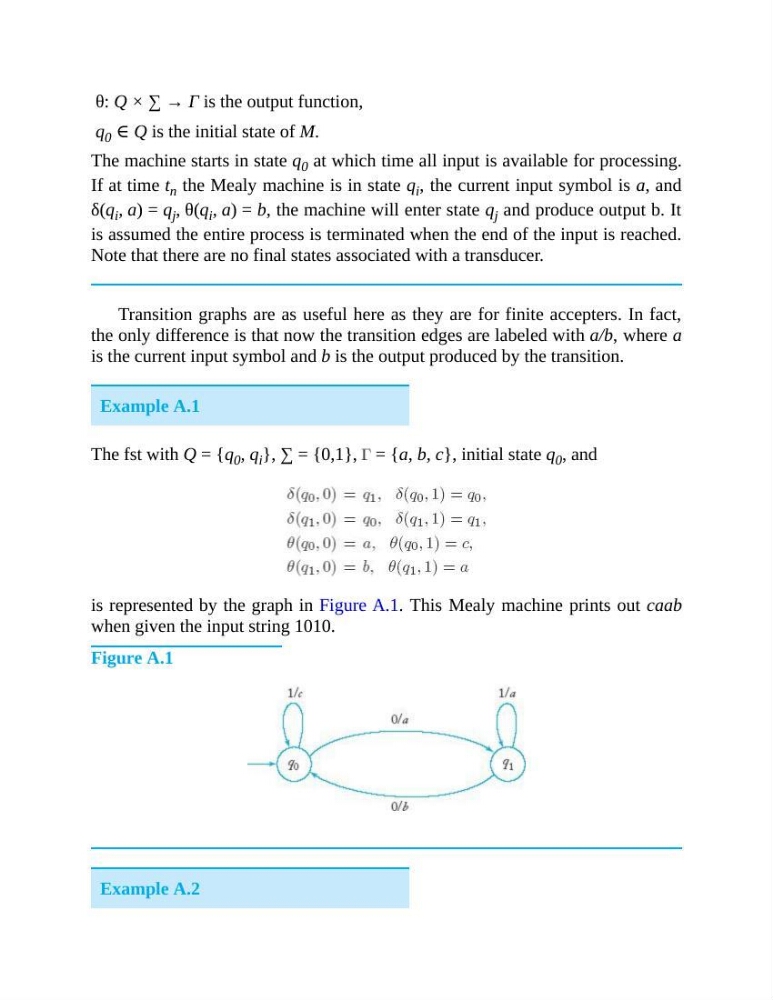
is represented by the graph in Figure A.1. This Mealy machine prints out caab
when given the input string 1010.
Figure A.1
Example A.2
q 0 ∈ Q is the initial state of M.
The machine starts in state q 0 at which time all input is available for processing.
If at time t n the Mealy machine is in state q i , the current input symbol is a, and
δ(q i , a) = q j , θ(q i , a) = b, the machine will enter state q j and produce output b. It
is assumed the entire process is terminated when the end of the input is reached.
Note that there are no final states associated with a transducer.
Transition graphs are as useful here as they are for finite accepters. In fact,
the only difference is that now the transition edges are labeled with a/b, where a
is the current input symbol and b is the output produced by the transition.
Example A.1
The fst with Q = {q 0 , q i }, ∑ = {0,1}, = {a, b, c}, initial state q 0 , and
is represented by the graph in Figure A.1. This Mealy machine prints out caab
when given the input string 1010.
Figure A.1
Example A.2