

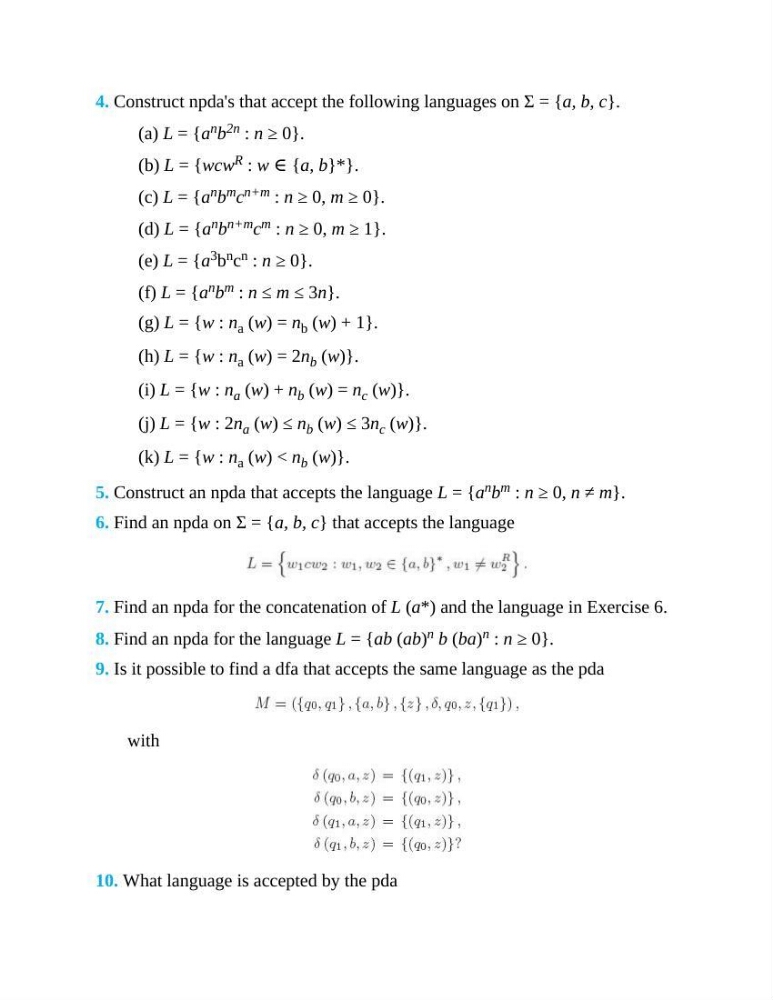
4. Construct npda's that accept the following languages on Σ = {a, b, c}.
(a) L = {a n b 2n : n ≥ 0}.
(b) L = {wcw R : w ∈ {a, b}*}.
(c) L = {a n b m c n+m : n ≥ 0, m ≥ 0}.
(d) L = {a n b n+m c m : n ≥ 0, m ≥ 1}.
(e) L = {a 3 b n c n : n ≥ 0}.
(f) L = {a n b m : n ≤ m ≤ 3n}.
(g) L = {w : n a (w) = n b (w) + 1}.
(h) L = {w : n a (w) = 2n b (w)}.
(i) L = {w : n a (w) + n b (w) = n c (w)}.
(j) L = {w : 2n a (w) ≤ n b (w) ≤ 3n c (w)}.
(k) L = {w : n a (w) < n b (w)}.
5. Construct an npda that accepts the language L = {a n b m : n ≥ 0, n ≠ m}.
6. Find an npda on Σ = {a, b, c} that accepts the language
7. Find an npda for the concatenation of L (a*) and the language in Exercise 6.
8. Find an npda for the language L = {ab (ab) n b (ba) n : n ≥ 0}.
9. Is it possible to find a dfa that accepts the same language as the pda
with
10. What language is accepted by the pda
(a) L = {a n b 2n : n ≥ 0}.
(b) L = {wcw R : w ∈ {a, b}*}.
(c) L = {a n b m c n+m : n ≥ 0, m ≥ 0}.
(d) L = {a n b n+m c m : n ≥ 0, m ≥ 1}.
(e) L = {a 3 b n c n : n ≥ 0}.
(f) L = {a n b m : n ≤ m ≤ 3n}.
(g) L = {w : n a (w) = n b (w) + 1}.
(h) L = {w : n a (w) = 2n b (w)}.
(i) L = {w : n a (w) + n b (w) = n c (w)}.
(j) L = {w : 2n a (w) ≤ n b (w) ≤ 3n c (w)}.
(k) L = {w : n a (w) < n b (w)}.
5. Construct an npda that accepts the language L = {a n b m : n ≥ 0, n ≠ m}.
6. Find an npda on Σ = {a, b, c} that accepts the language
7. Find an npda for the concatenation of L (a*) and the language in Exercise 6.
8. Find an npda for the language L = {ab (ab) n b (ba) n : n ≥ 0}.
9. Is it possible to find a dfa that accepts the same language as the pda
with
10. What language is accepted by the pda