

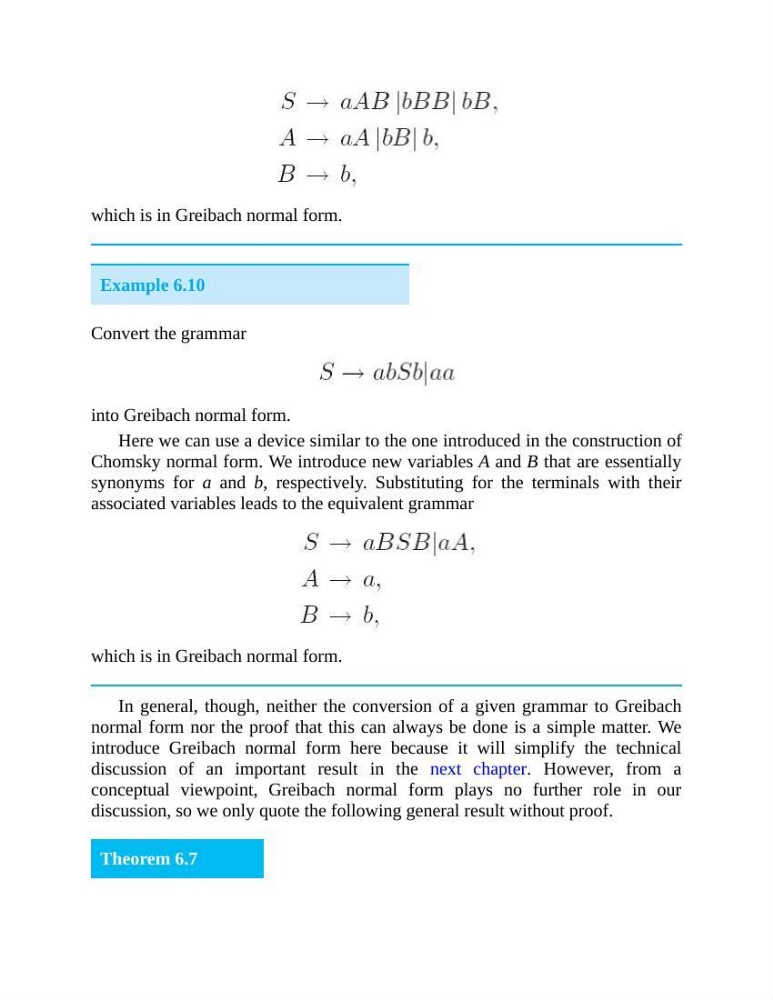
which is in Greibach normal form.
Example 6.10
Convert the grammar
into Greibach normal form.
Here we can use a device similar to the one introduced in the construction of
Chomsky normal form. We introduce new variables A and B that are essentially
synonyms for a and b, respectively. Substituting for the terminals with their
associated variables leads to the equivalent grammar
which is in Greibach normal form.
In general, though, neither the conversion of a given grammar to Greibach
normal form nor the proof that this can always be done is a simple matter. We
introduce Greibach normal form here because it will simplify the technical
discussion of an important result in the next chapter. However, from a
conceptual viewpoint, Greibach normal form plays no further role in our
discussion, so we only quote the following general result without proof.
Theorem 6.7
Example 6.10
Convert the grammar
into Greibach normal form.
Here we can use a device similar to the one introduced in the construction of
Chomsky normal form. We introduce new variables A and B that are essentially
synonyms for a and b, respectively. Substituting for the terminals with their
associated variables leads to the equivalent grammar
which is in Greibach normal form.
In general, though, neither the conversion of a given grammar to Greibach
normal form nor the proof that this can always be done is a simple matter. We
introduce Greibach normal form here because it will simplify the technical
discussion of an important result in the next chapter. However, from a
conceptual viewpoint, Greibach normal form plays no further role in our
discussion, so we only quote the following general result without proof.
Theorem 6.7