

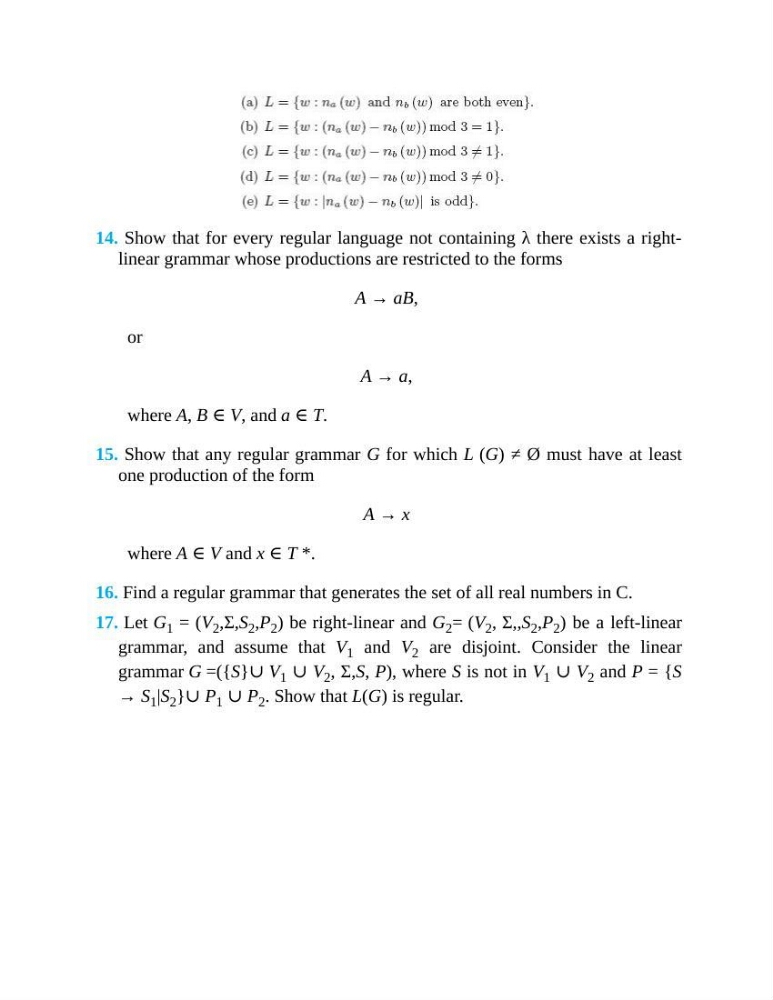
14. Show that for every regular language not containing λ there exists a rightlinear grammar whose productions are restricted to the forms
A → aB,
or
A → a,
where A, B ∈ V, and a ∈ T.
15. Show that any regular grammar G for which L (G) ≠ Ø must have at least
one production of the form
A → x
where A ∈ V and x ∈ T *.
16. Find a regular grammar that generates the set of all real numbers in C.
17. Let G 1 = (V 2 ,Σ,S 2 ,P 2 ) be right-linear and G 2 = (V 2 , Σ,,S 2 ,P 2 ) be a left-linear
grammar, and assume that V 1 and V 2 are disjoint. Consider the linear
grammar G =({S}∪ V 1 ∪ V 2 , Σ,S, P), where S is not in V 1 ∪ V 2 and P = {S
→ S 1 |S 2 }∪ P 1 ∪ P 2 . Show that L(G) is regular.
A → aB,
or
A → a,
where A, B ∈ V, and a ∈ T.
15. Show that any regular grammar G for which L (G) ≠ Ø must have at least
one production of the form
A → x
where A ∈ V and x ∈ T *.
16. Find a regular grammar that generates the set of all real numbers in C.
17. Let G 1 = (V 2 ,Σ,S 2 ,P 2 ) be right-linear and G 2 = (V 2 , Σ,,S 2 ,P 2 ) be a left-linear
grammar, and assume that V 1 and V 2 are disjoint. Consider the linear
grammar G =({S}∪ V 1 ∪ V 2 , Σ,S, P), where S is not in V 1 ∪ V 2 and P = {S
→ S 1 |S 2 }∪ P 1 ∪ P 2 . Show that L(G) is regular.