

2 Time Axis Design as an EcoDesign Method
21
2.3 Time Axis Design
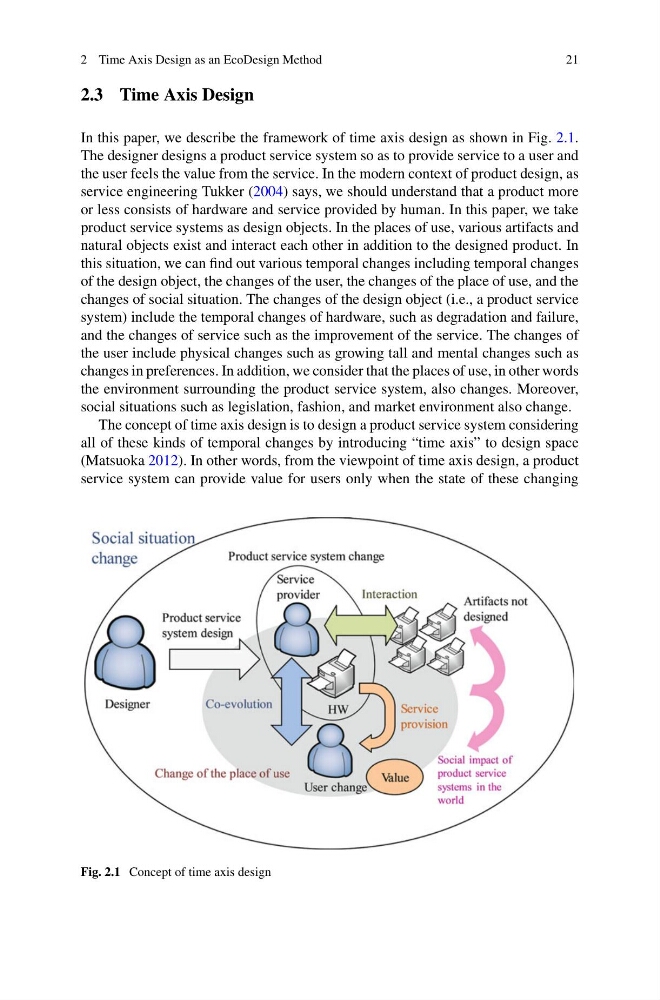
In this paper, we describe the framework of time axis design as shown in Fig. 2.1.
The designer designs a product service system so as to provide service to a user and
the user feels the value from the service. In the modern context of product design, as
service engineering Tukker (2004) says, we should understand that a product more
or less consists of hardware and service provided by human. In this paper, we take
product service systems as design objects. In the places of use, various artifacts and
natural objects exist and interact each other in addition to the designed product. In
this situation, we can find out various temporal changes including temporal changes
of the design object, the changes of the user, the changes of the place of use, and the
changes of social situation. The changes of the design object (i.e., a product service
system) include the temporal changes of hardware, such as degradation and failure,
and the changes of service such as the improvement of the service. The changes of
the user include physical changes such as growing tall and mental changes such as
changes in preferences. In addition, we consider that the places of use, in other words
the environment surrounding the product service system, also changes. Moreover,
social situations such as legislation, fashion, and market environment also change.
The concept of time axis design is to design a product service system considering
all of these kinds of temporal changes by introducing “time axis” to design space
(Matsuoka 2012). In other words, from the viewpoint of time axis design, a product
service system can provide value for users only when the state of these changing
Fig. 2.1 Concept of time axis design
21
2.3 Time Axis Design
In this paper, we describe the framework of time axis design as shown in Fig. 2.1.
The designer designs a product service system so as to provide service to a user and
the user feels the value from the service. In the modern context of product design, as
service engineering Tukker (2004) says, we should understand that a product more
or less consists of hardware and service provided by human. In this paper, we take
product service systems as design objects. In the places of use, various artifacts and
natural objects exist and interact each other in addition to the designed product. In
this situation, we can find out various temporal changes including temporal changes
of the design object, the changes of the user, the changes of the place of use, and the
changes of social situation. The changes of the design object (i.e., a product service
system) include the temporal changes of hardware, such as degradation and failure,
and the changes of service such as the improvement of the service. The changes of
the user include physical changes such as growing tall and mental changes such as
changes in preferences. In addition, we consider that the places of use, in other words
the environment surrounding the product service system, also changes. Moreover,
social situations such as legislation, fashion, and market environment also change.
The concept of time axis design is to design a product service system considering
all of these kinds of temporal changes by introducing “time axis” to design space
(Matsuoka 2012). In other words, from the viewpoint of time axis design, a product
service system can provide value for users only when the state of these changing
Fig. 2.1 Concept of time axis design