

6
U. Edilson
(International Federation of Interior Architects/Interior Designers) (Japan Design
Foundation 1989).
Through the analysis of each design work, we found the frequency of contents
characteristics that varied between two or more times. These characteristics are: (1)
innovative use natural resources (water and fire), (2) sharing and leasing (new way of
consumption of natural resources), (3) natural resources information (environmental
concern, learning with nature), (4) natural resources education (discovering natural
resources), (5) emotionally design (user’s internal feeling, re-think the nature) and
(6) multi-functional (mixing natural resources). Each design work was judged with
values 0 and 1. To validate the analysis, three experts in ecodesign, four researchers
and two lectures in the industrial design carefully reviewed the environmental aspects
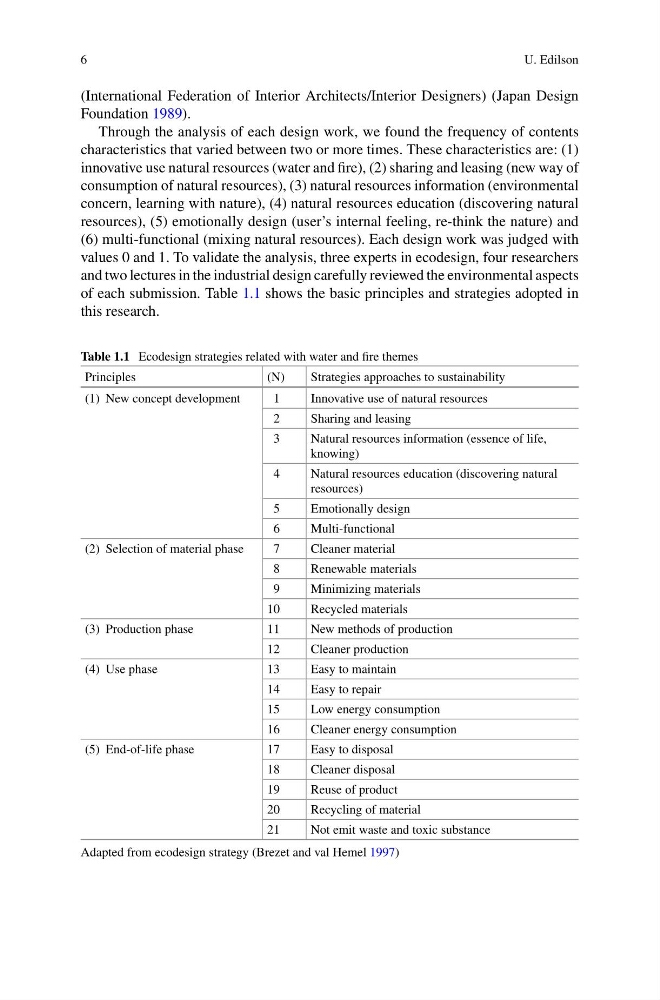
of each submission. Table 1.1 shows the basic principles and strategies adopted in
this research.
Table 1.1 Ecodesign strategies related with water and fire themes
Principles
(N)
Strategies approaches to sustainability
(1) New concept development
1
Innovative use of natural resources
2
Sharing and leasing
3
Natural resources information (essence of life,
knowing)
4
Natural resources education (discovering natural
resources)
5
Emotionally design
6
Multi-functional
(2) Selection of material phase
7
Cleaner material
8
Renewable materials
9
Minimizing materials
10
Recycled materials
(3) Production phase
11
New methods of production
12
Cleaner production
(4) Use phase
13
Easy to maintain
14
Easy to repair
15
Low energy consumption
16
Cleaner energy consumption
(5) End-of-life phase
17
Easy to disposal
18
Cleaner disposal
19
Reuse of product
20
Recycling of material
21
Not emit waste and toxic substance
Adapted from ecodesign strategy (Brezet and val Hemel 1997)
U. Edilson
(International Federation of Interior Architects/Interior Designers) (Japan Design
Foundation 1989).
Through the analysis of each design work, we found the frequency of contents
characteristics that varied between two or more times. These characteristics are: (1)
innovative use natural resources (water and fire), (2) sharing and leasing (new way of
consumption of natural resources), (3) natural resources information (environmental
concern, learning with nature), (4) natural resources education (discovering natural
resources), (5) emotionally design (user’s internal feeling, re-think the nature) and
(6) multi-functional (mixing natural resources). Each design work was judged with
values 0 and 1. To validate the analysis, three experts in ecodesign, four researchers
and two lectures in the industrial design carefully reviewed the environmental aspects
of each submission. Table 1.1 shows the basic principles and strategies adopted in
this research.
Table 1.1 Ecodesign strategies related with water and fire themes
Principles
(N)
Strategies approaches to sustainability
(1) New concept development
1
Innovative use of natural resources
2
Sharing and leasing
3
Natural resources information (essence of life,
knowing)
4
Natural resources education (discovering natural
resources)
5
Emotionally design
6
Multi-functional
(2) Selection of material phase
7
Cleaner material
8
Renewable materials
9
Minimizing materials
10
Recycled materials
(3) Production phase
11
New methods of production
12
Cleaner production
(4) Use phase
13
Easy to maintain
14
Easy to repair
15
Low energy consumption
16
Cleaner energy consumption
(5) End-of-life phase
17
Easy to disposal
18
Cleaner disposal
19
Reuse of product
20
Recycling of material
21
Not emit waste and toxic substance
Adapted from ecodesign strategy (Brezet and val Hemel 1997)