

60
Digital Electronics
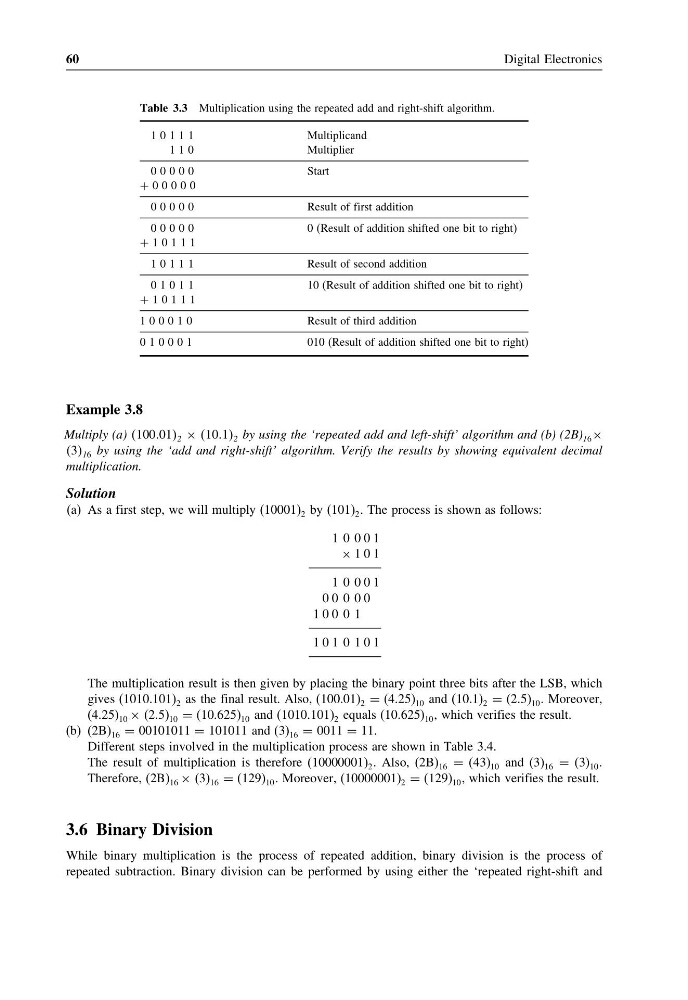
Table 3.3 Multiplication using the repeated add and right-shift algorithm.
1 0 1 1 1
Multiplicand
1 1 0
Multiplier
0 0 0 0 0
Start
+ 0 0 0 0 0
0 0 0 0 0
Result of first addition
0 0 0 0 0
0 (Result of addition shifted one bit to right)
+ 1 0 1 1 1
1 0 1 1 1
Result of second addition
0 1 0 1 1
10 (Result of addition shifted one bit to right)
+ 1 0 1 1 1
1 0 0 0 1 0
Result of third addition
0 1 0 0 0 1
010 (Result of addition shifted one bit to right)
Example 3.8
Multiply (a) 10001 2 × 101 2 by using the ‘repeated add and left-shift’ algorithm and (b) (2B) 16 ×
3 16 by using the ‘add and right-shift’ algorithm. Verify the results by showing equivalent decimal
multiplication.
Solution
(a) As a first step, we will multiply (10001) 2 by (101) 2 . The process is shown as follows:
1 0 0 0 1
× 1 0 1
1 0 0 0 1
0 0 0 0 0
1 0 0 0 1
1 0 1 0 1 0 1
The multiplication result is then given by placing the binary point three bits after the LSB, which
gives (1010.101) 2 as the final result. Also, (100.01) 2 = (4.25) 10 and (10.1) 2 = (2.5) 10 . Moreover,
(4.25) 10 × (2.5) 10 = (10.625) 10 and (1010.101) 2 equals (10.625) 10 , which verifies the result.
(b) (2B) 16 = 00101011 = 101011 and (3) 16 = 0011 = 11.
Different steps involved in the multiplication process are shown in Table 3.4.
The result of multiplication is therefore (10000001) 2 . Also, (2B) 16 = (43) 10 and (3) 16 = (3) 10 .
Therefore, (2B) 16 × (3) 16 = (129) 10 . Moreover, (10000001) 2 = (129) 10 , which verifies the result.
3.6 Binary Division
While binary multiplication is the process of repeated addition, binary division is the process of
repeated subtraction. Binary division can be performed by using either the ‘repeated right-shift and
Digital Electronics
Table 3.3 Multiplication using the repeated add and right-shift algorithm.
1 0 1 1 1
Multiplicand
1 1 0
Multiplier
0 0 0 0 0
Start
+ 0 0 0 0 0
0 0 0 0 0
Result of first addition
0 0 0 0 0
0 (Result of addition shifted one bit to right)
+ 1 0 1 1 1
1 0 1 1 1
Result of second addition
0 1 0 1 1
10 (Result of addition shifted one bit to right)
+ 1 0 1 1 1
1 0 0 0 1 0
Result of third addition
0 1 0 0 0 1
010 (Result of addition shifted one bit to right)
Example 3.8
Multiply (a) 10001 2 × 101 2 by using the ‘repeated add and left-shift’ algorithm and (b) (2B) 16 ×
3 16 by using the ‘add and right-shift’ algorithm. Verify the results by showing equivalent decimal
multiplication.
Solution
(a) As a first step, we will multiply (10001) 2 by (101) 2 . The process is shown as follows:
1 0 0 0 1
× 1 0 1
1 0 0 0 1
0 0 0 0 0
1 0 0 0 1
1 0 1 0 1 0 1
The multiplication result is then given by placing the binary point three bits after the LSB, which
gives (1010.101) 2 as the final result. Also, (100.01) 2 = (4.25) 10 and (10.1) 2 = (2.5) 10 . Moreover,
(4.25) 10 × (2.5) 10 = (10.625) 10 and (1010.101) 2 equals (10.625) 10 , which verifies the result.
(b) (2B) 16 = 00101011 = 101011 and (3) 16 = 0011 = 11.
Different steps involved in the multiplication process are shown in Table 3.4.
The result of multiplication is therefore (10000001) 2 . Also, (2B) 16 = (43) 10 and (3) 16 = (3) 10 .
Therefore, (2B) 16 × (3) 16 = (129) 10 . Moreover, (10000001) 2 = (129) 10 , which verifies the result.
3.6 Binary Division
While binary multiplication is the process of repeated addition, binary division is the process of
repeated subtraction. Binary division can be performed by using either the ‘repeated right-shift and