

Digital Arithmetic
49
bit. The borrow-out bit produced here becomes the borrow-in bit for the next more significant bit
column, and the process continues until we reach the most significant bit column. The addition and
subtraction of larger-bit binary numbers is illustrated with the help of examples in sections 3.2 and 3.3
respectively.
3.2 Addition of Larger-Bit Binary Numbers
The addition of larger binary integers, fractions or mixed binary numbers is performed columnwise
in just the same way as in the case of decimal numbers. In the case of binary numbers, however, we
follow the basic rules of addition of two or three binary digits, as outlined earlier. The process of
adding two larger-bit binary numbers can be best illustrated with the help of an example.
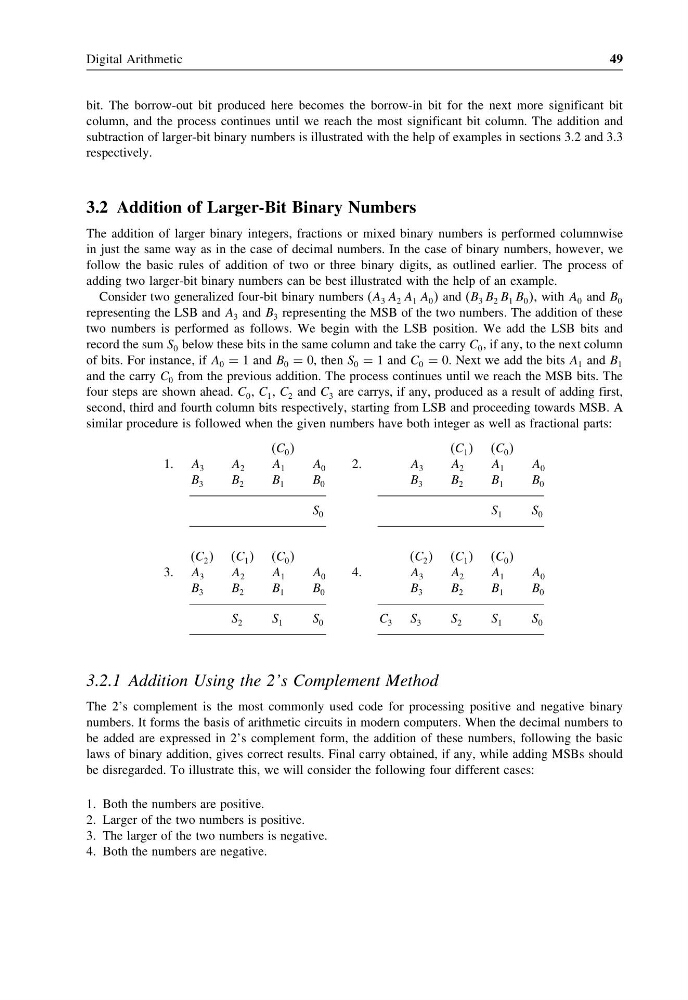
Consider two generalized four-bit binary numbers (A 3 A 2 A 1 A 0 and (B 3 B 2 B 1 B 0 , with A 0 and B 0
representing the LSB and A 3 and B 3 representing the MSB of the two numbers. The addition of these
two numbers is performed as follows. We begin with the LSB position. We add the LSB bits and
record the sum S 0 below these bits in the same column and take the carry C 0 , if any, to the next column
of bits. For instance, if A 0 = 1 and B 0 = 0, then S 0 = 1 and C 0 = 0. Next we add the bits A 1 and B 1
and the carry C 0 from the previous addition. The process continues until we reach the MSB bits. The
four steps are shown ahead. C 0 , C 1 , C 2 and C 3 are carrys, if any, produced as a result of adding first,
second, third and fourth column bits respectively, starting from LSB and proceeding towards MSB. A
similar procedure is followed when the given numbers have both integer as well as fractional parts:
(C 0
(C 1 (C 0
1. A 3
A 2
A 1
A 0
2.
A 3
A 2
A 1
A 0
B 3
B 2
B 1
B 0
B 3
B 2
B 1
B 0
S 0
S 1
S 0
(C 2 (C 1 (C 0
(C 2 (C 1 (C 0
3. A 3
A 2
A 1
A 0
4.
A 3
A 2
A 1
A 0
B 3
B 2
B 1
B 0
B 3
B 2
B 1
B 0
S 2
S 1
S 0
C 3 S 3
S 2
S 1
S 0
3.2.1 Addition Using the 2’s Complement Method
The 2’s complement is the most commonly used code for processing positive and negative binary
numbers. It forms the basis of arithmetic circuits in modern computers. When the decimal numbers to
be added are expressed in 2’s complement form, the addition of these numbers, following the basic
laws of binary addition, gives correct results. Final carry obtained, if any, while adding MSBs should
be disregarded. To illustrate this, we will consider the following four different cases:
1. Both the numbers are positive.
2. Larger of the two numbers is positive.
3. The larger of the two numbers is negative.
4. Both the numbers are negative.
49
bit. The borrow-out bit produced here becomes the borrow-in bit for the next more significant bit
column, and the process continues until we reach the most significant bit column. The addition and
subtraction of larger-bit binary numbers is illustrated with the help of examples in sections 3.2 and 3.3
respectively.
3.2 Addition of Larger-Bit Binary Numbers
The addition of larger binary integers, fractions or mixed binary numbers is performed columnwise
in just the same way as in the case of decimal numbers. In the case of binary numbers, however, we
follow the basic rules of addition of two or three binary digits, as outlined earlier. The process of
adding two larger-bit binary numbers can be best illustrated with the help of an example.
Consider two generalized four-bit binary numbers (A 3 A 2 A 1 A 0 and (B 3 B 2 B 1 B 0 , with A 0 and B 0
representing the LSB and A 3 and B 3 representing the MSB of the two numbers. The addition of these
two numbers is performed as follows. We begin with the LSB position. We add the LSB bits and
record the sum S 0 below these bits in the same column and take the carry C 0 , if any, to the next column
of bits. For instance, if A 0 = 1 and B 0 = 0, then S 0 = 1 and C 0 = 0. Next we add the bits A 1 and B 1
and the carry C 0 from the previous addition. The process continues until we reach the MSB bits. The
four steps are shown ahead. C 0 , C 1 , C 2 and C 3 are carrys, if any, produced as a result of adding first,
second, third and fourth column bits respectively, starting from LSB and proceeding towards MSB. A
similar procedure is followed when the given numbers have both integer as well as fractional parts:
(C 0
(C 1 (C 0
1. A 3
A 2
A 1
A 0
2.
A 3
A 2
A 1
A 0
B 3
B 2
B 1
B 0
B 3
B 2
B 1
B 0
S 0
S 1
S 0
(C 2 (C 1 (C 0
(C 2 (C 1 (C 0
3. A 3
A 2
A 1
A 0
4.
A 3
A 2
A 1
A 0
B 3
B 2
B 1
B 0
B 3
B 2
B 1
B 0
S 2
S 1
S 0
C 3 S 3
S 2
S 1
S 0
3.2.1 Addition Using the 2’s Complement Method
The 2’s complement is the most commonly used code for processing positive and negative binary
numbers. It forms the basis of arithmetic circuits in modern computers. When the decimal numbers to
be added are expressed in 2’s complement form, the addition of these numbers, following the basic
laws of binary addition, gives correct results. Final carry obtained, if any, while adding MSBs should
be disregarded. To illustrate this, we will consider the following four different cases:
1. Both the numbers are positive.
2. Larger of the two numbers is positive.
3. The larger of the two numbers is negative.
4. Both the numbers are negative.