

Binary Codes
37
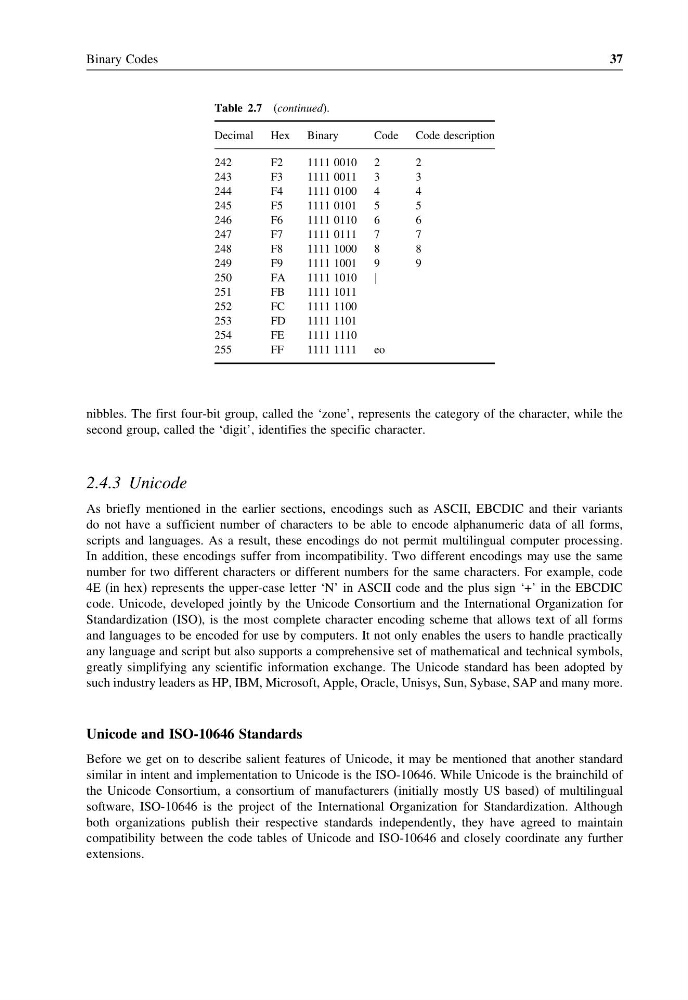
Table 2.7 (continued).
Decimal Hex Binary
Code Code description
242
F2
1111 0010 2
2
243
F3
1111 0011 3
3
244
F4
1111 0100 4
4
245
F5
1111 0101 5
5
246
F6
1111 0110 6
6
247
F7
1111 0111 7
7
248
F8
1111 1000 8
8
249
F9
1111 1001 9
9
250
FA
1111 1010
251
FB
1111 1011
252
FC
1111 1100
253
FD
1111 1101
254
FE
1111 1110
255
FF
1111 1111 eo
nibbles. The first four-bit group, called the ‘zone’, represents the category of the character, while the
second group, called the ‘digit’, identifies the specific character.
2.4.3 Unicode
As briefly mentioned in the earlier sections, encodings such as ASCII, EBCDIC and their variants
do not have a sufficient number of characters to be able to encode alphanumeric data of all forms,
scripts and languages. As a result, these encodings do not permit multilingual computer processing.
In addition, these encodings suffer from incompatibility. Two different encodings may use the same
number for two different characters or different numbers for the same characters. For example, code
4E (in hex) represents the upper-case letter ‘N’ in ASCII code and the plus sign ‘+’ in the EBCDIC
code. Unicode, developed jointly by the Unicode Consortium and the International Organization for
Standardization (ISO), is the most complete character encoding scheme that allows text of all forms
and languages to be encoded for use by computers. It not only enables the users to handle practically
any language and script but also supports a comprehensive set of mathematical and technical symbols,
greatly simplifying any scientific information exchange. The Unicode standard has been adopted by
such industry leaders as HP, IBM, Microsoft, Apple, Oracle, Unisys, Sun, Sybase, SAP and many more.
Unicode and ISO-10646 Standards
Before we get on to describe salient features of Unicode, it may be mentioned that another standard
similar in intent and implementation to Unicode is the ISO-10646. While Unicode is the brainchild of
the Unicode Consortium, a consortium of manufacturers (initially mostly US based) of multilingual
software, ISO-10646 is the project of the International Organization for Standardization. Although
both organizations publish their respective standards independently, they have agreed to maintain
compatibility between the code tables of Unicode and ISO-10646 and closely coordinate any further
extensions.
37
Table 2.7 (continued).
Decimal Hex Binary
Code Code description
242
F2
1111 0010 2
2
243
F3
1111 0011 3
3
244
F4
1111 0100 4
4
245
F5
1111 0101 5
5
246
F6
1111 0110 6
6
247
F7
1111 0111 7
7
248
F8
1111 1000 8
8
249
F9
1111 1001 9
9
250
FA
1111 1010
251
FB
1111 1011
252
FC
1111 1100
253
FD
1111 1101
254
FE
1111 1110
255
FF
1111 1111 eo
nibbles. The first four-bit group, called the ‘zone’, represents the category of the character, while the
second group, called the ‘digit’, identifies the specific character.
2.4.3 Unicode
As briefly mentioned in the earlier sections, encodings such as ASCII, EBCDIC and their variants
do not have a sufficient number of characters to be able to encode alphanumeric data of all forms,
scripts and languages. As a result, these encodings do not permit multilingual computer processing.
In addition, these encodings suffer from incompatibility. Two different encodings may use the same
number for two different characters or different numbers for the same characters. For example, code
4E (in hex) represents the upper-case letter ‘N’ in ASCII code and the plus sign ‘+’ in the EBCDIC
code. Unicode, developed jointly by the Unicode Consortium and the International Organization for
Standardization (ISO), is the most complete character encoding scheme that allows text of all forms
and languages to be encoded for use by computers. It not only enables the users to handle practically
any language and script but also supports a comprehensive set of mathematical and technical symbols,
greatly simplifying any scientific information exchange. The Unicode standard has been adopted by
such industry leaders as HP, IBM, Microsoft, Apple, Oracle, Unisys, Sun, Sybase, SAP and many more.
Unicode and ISO-10646 Standards
Before we get on to describe salient features of Unicode, it may be mentioned that another standard
similar in intent and implementation to Unicode is the ISO-10646. While Unicode is the brainchild of
the Unicode Consortium, a consortium of manufacturers (initially mostly US based) of multilingual
software, ISO-10646 is the project of the International Organization for Standardization. Although
both organizations publish their respective standards independently, they have agreed to maintain
compatibility between the code tables of Unicode and ISO-10646 and closely coordinate any further
extensions.