

Microcontrollers
567
microcontrollers are dedicated to one task and run one specific program. This program is stored in
ROM and generally does not change.
Figure 14.1 further illustrates the basic difference between a microprocessor-based system and
a microcontroller. As is evident from the two block schematics shown in the figure, while a
microprocessor-based system needs additional chips to make it a functional unit, in a microcontroller
the functions of all these additional chips are integrated on the same chip.
14.1.1 Applications
Microcontrollers are embedded inside a surprisingly large number of product categories including
automobiles, entertainment and consumer products, test and measurement equipment and desktop
computers, to name some prominent ones.
Any device or system that measures, stores, controls, calculates or displays information is sure
to have an embedded microcontroller as a part of the device or system. In automobiles, one or
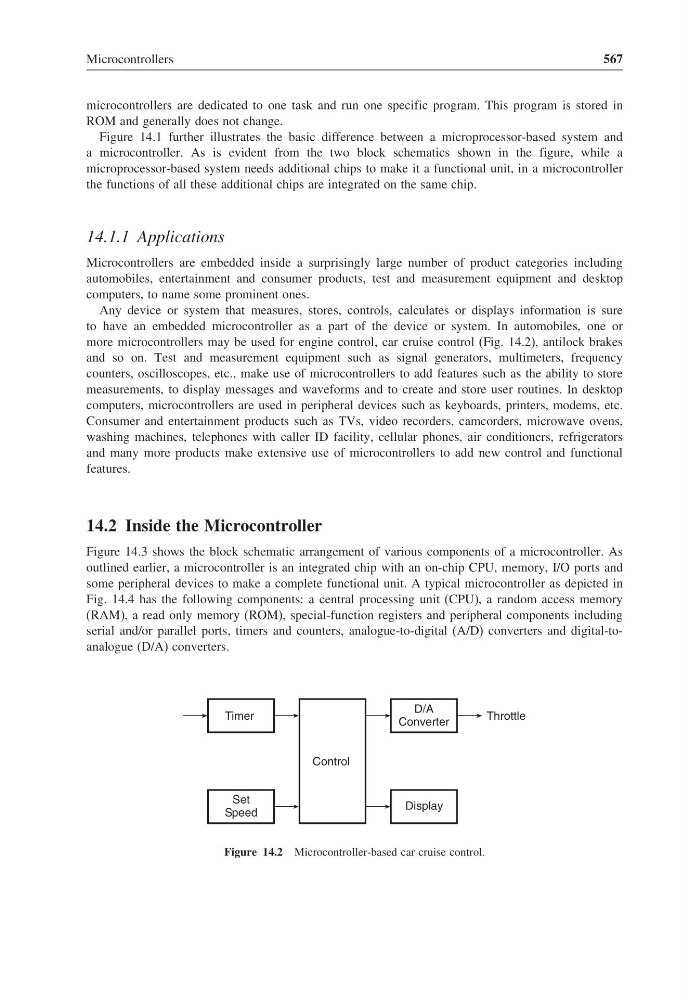
more microcontrollers may be used for engine control, car cruise control (Fig. 14.2), antilock brakes
and so on. Test and measurement equipment such as signal generators, multimeters, frequency
counters, oscilloscopes, etc., make use of microcontrollers to add features such as the ability to store
measurements, to display messages and waveforms and to create and store user routines. In desktop
computers, microcontrollers are used in peripheral devices such as keyboards, printers, modems, etc.
Consumer and entertainment products such as TVs, video recorders, camcorders, microwave ovens,
washing machines, telephones with caller ID facility, cellular phones, air conditioners, refrigerators
and many more products make extensive use of microcontrollers to add new control and functional
features.
14.2 Inside the Microcontroller
Figure 14.3 shows the block schematic arrangement of various components of a microcontroller. As
outlined earlier, a microcontroller is an integrated chip with an on-chip CPU, memory, I/O ports and
some peripheral devices to make a complete functional unit. A typical microcontroller as depicted in
Fig. 14.4 has the following components: a central processing unit (CPU), a random access memory
(RAM), a read only memory (ROM), special-function registers and peripheral components including
serial and/or parallel ports, timers and counters, analogue-to-digital (A/D) converters and digital-toanalogue (D/A) converters.
Timer
Control
Set
Speed
D/A
Converter
Display
Throttle
Figure 14.2 Microcontroller-based car cruise control.
567
microcontrollers are dedicated to one task and run one specific program. This program is stored in
ROM and generally does not change.
Figure 14.1 further illustrates the basic difference between a microprocessor-based system and
a microcontroller. As is evident from the two block schematics shown in the figure, while a
microprocessor-based system needs additional chips to make it a functional unit, in a microcontroller
the functions of all these additional chips are integrated on the same chip.
14.1.1 Applications
Microcontrollers are embedded inside a surprisingly large number of product categories including
automobiles, entertainment and consumer products, test and measurement equipment and desktop
computers, to name some prominent ones.
Any device or system that measures, stores, controls, calculates or displays information is sure
to have an embedded microcontroller as a part of the device or system. In automobiles, one or
more microcontrollers may be used for engine control, car cruise control (Fig. 14.2), antilock brakes
and so on. Test and measurement equipment such as signal generators, multimeters, frequency
counters, oscilloscopes, etc., make use of microcontrollers to add features such as the ability to store
measurements, to display messages and waveforms and to create and store user routines. In desktop
computers, microcontrollers are used in peripheral devices such as keyboards, printers, modems, etc.
Consumer and entertainment products such as TVs, video recorders, camcorders, microwave ovens,
washing machines, telephones with caller ID facility, cellular phones, air conditioners, refrigerators
and many more products make extensive use of microcontrollers to add new control and functional
features.
14.2 Inside the Microcontroller
Figure 14.3 shows the block schematic arrangement of various components of a microcontroller. As
outlined earlier, a microcontroller is an integrated chip with an on-chip CPU, memory, I/O ports and
some peripheral devices to make a complete functional unit. A typical microcontroller as depicted in
Fig. 14.4 has the following components: a central processing unit (CPU), a random access memory
(RAM), a read only memory (ROM), special-function registers and peripheral components including
serial and/or parallel ports, timers and counters, analogue-to-digital (A/D) converters and digital-toanalogue (D/A) converters.
Timer
Control
Set
Speed
D/A
Converter
Display
Throttle
Figure 14.2 Microcontroller-based car cruise control.