

Binary Codes
31
Table 2.6 (continued).
Decimal Hex
Binary
Code Code description
115
73
0111 0011 s
s
116
74
0111 0100 t
t
117
75
0111 0101 u
u
118
76
0111 0110 v
v
119
77
0111 0111 w
w
120
78
0111 1000 x
x
121
79
0111 1001 y
y
122
7A
0111 1010 z
z
123
7B
0111 1011 {
Opening brace
124
7C
0111 1100
Vertical line
125
7D
0111 1101 }
Closing brace
126
7E
0111 1110
∼
Tilde
127
7F
0111 1111 DEL
Delete
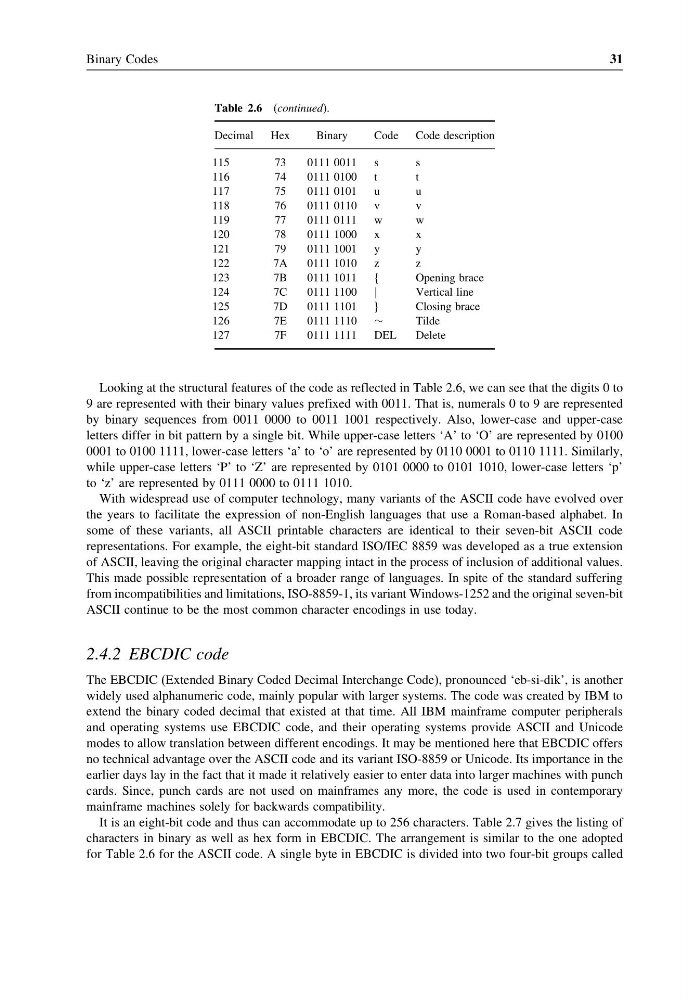
Looking at the structural features of the code as reflected in Table 2.6, we can see that the digits 0 to
9 are represented with their binary values prefixed with 0011. That is, numerals 0 to 9 are represented
by binary sequences from 0011 0000 to 0011 1001 respectively. Also, lower-case and upper-case
letters differ in bit pattern by a single bit. While upper-case letters ‘A’ to ‘O’ are represented by 0100
0001 to 0100 1111, lower-case letters ‘a’ to ‘o’ are represented by 0110 0001 to 0110 1111. Similarly,
while upper-case letters ‘P’ to ‘Z’ are represented by 0101 0000 to 0101 1010, lower-case letters ‘p’
to ‘z’ are represented by 0111 0000 to 0111 1010.
With widespread use of computer technology, many variants of the ASCII code have evolved over
the years to facilitate the expression of non-English languages that use a Roman-based alphabet. In
some of these variants, all ASCII printable characters are identical to their seven-bit ASCII code
representations. For example, the eight-bit standard ISO/IEC 8859 was developed as a true extension
of ASCII, leaving the original character mapping intact in the process of inclusion of additional values.
This made possible representation of a broader range of languages. In spite of the standard suffering
from incompatibilities and limitations, ISO-8859-1, its variant Windows-1252 and the original seven-bit
ASCII continue to be the most common character encodings in use today.
2.4.2 EBCDIC code
The EBCDIC (Extended Binary Coded Decimal Interchange Code), pronounced ‘eb-si-dik’, is another
widely used alphanumeric code, mainly popular with larger systems. The code was created by IBM to
extend the binary coded decimal that existed at that time. All IBM mainframe computer peripherals
and operating systems use EBCDIC code, and their operating systems provide ASCII and Unicode
modes to allow translation between different encodings. It may be mentioned here that EBCDIC offers
no technical advantage over the ASCII code and its variant ISO-8859 or Unicode. Its importance in the
earlier days lay in the fact that it made it relatively easier to enter data into larger machines with punch
cards. Since, punch cards are not used on mainframes any more, the code is used in contemporary
mainframe machines solely for backwards compatibility.
It is an eight-bit code and thus can accommodate up to 256 characters. Table 2.7 gives the listing of
characters in binary as well as hex form in EBCDIC. The arrangement is similar to the one adopted
for Table 2.6 for the ASCII code. A single byte in EBCDIC is divided into two four-bit groups called
31
Table 2.6 (continued).
Decimal Hex
Binary
Code Code description
115
73
0111 0011 s
s
116
74
0111 0100 t
t
117
75
0111 0101 u
u
118
76
0111 0110 v
v
119
77
0111 0111 w
w
120
78
0111 1000 x
x
121
79
0111 1001 y
y
122
7A
0111 1010 z
z
123
7B
0111 1011 {
Opening brace
124
7C
0111 1100
Vertical line
125
7D
0111 1101 }
Closing brace
126
7E
0111 1110
∼
Tilde
127
7F
0111 1111 DEL
Delete
Looking at the structural features of the code as reflected in Table 2.6, we can see that the digits 0 to
9 are represented with their binary values prefixed with 0011. That is, numerals 0 to 9 are represented
by binary sequences from 0011 0000 to 0011 1001 respectively. Also, lower-case and upper-case
letters differ in bit pattern by a single bit. While upper-case letters ‘A’ to ‘O’ are represented by 0100
0001 to 0100 1111, lower-case letters ‘a’ to ‘o’ are represented by 0110 0001 to 0110 1111. Similarly,
while upper-case letters ‘P’ to ‘Z’ are represented by 0101 0000 to 0101 1010, lower-case letters ‘p’
to ‘z’ are represented by 0111 0000 to 0111 1010.
With widespread use of computer technology, many variants of the ASCII code have evolved over
the years to facilitate the expression of non-English languages that use a Roman-based alphabet. In
some of these variants, all ASCII printable characters are identical to their seven-bit ASCII code
representations. For example, the eight-bit standard ISO/IEC 8859 was developed as a true extension
of ASCII, leaving the original character mapping intact in the process of inclusion of additional values.
This made possible representation of a broader range of languages. In spite of the standard suffering
from incompatibilities and limitations, ISO-8859-1, its variant Windows-1252 and the original seven-bit
ASCII continue to be the most common character encodings in use today.
2.4.2 EBCDIC code
The EBCDIC (Extended Binary Coded Decimal Interchange Code), pronounced ‘eb-si-dik’, is another
widely used alphanumeric code, mainly popular with larger systems. The code was created by IBM to
extend the binary coded decimal that existed at that time. All IBM mainframe computer peripherals
and operating systems use EBCDIC code, and their operating systems provide ASCII and Unicode
modes to allow translation between different encodings. It may be mentioned here that EBCDIC offers
no technical advantage over the ASCII code and its variant ISO-8859 or Unicode. Its importance in the
earlier days lay in the fact that it made it relatively easier to enter data into larger machines with punch
cards. Since, punch cards are not used on mainframes any more, the code is used in contemporary
mainframe machines solely for backwards compatibility.
It is an eight-bit code and thus can accommodate up to 256 characters. Table 2.7 gives the listing of
characters in binary as well as hex form in EBCDIC. The arrangement is similar to the one adopted
for Table 2.6 for the ASCII code. A single byte in EBCDIC is divided into two four-bit groups called