

Programmable Logic Devices
317
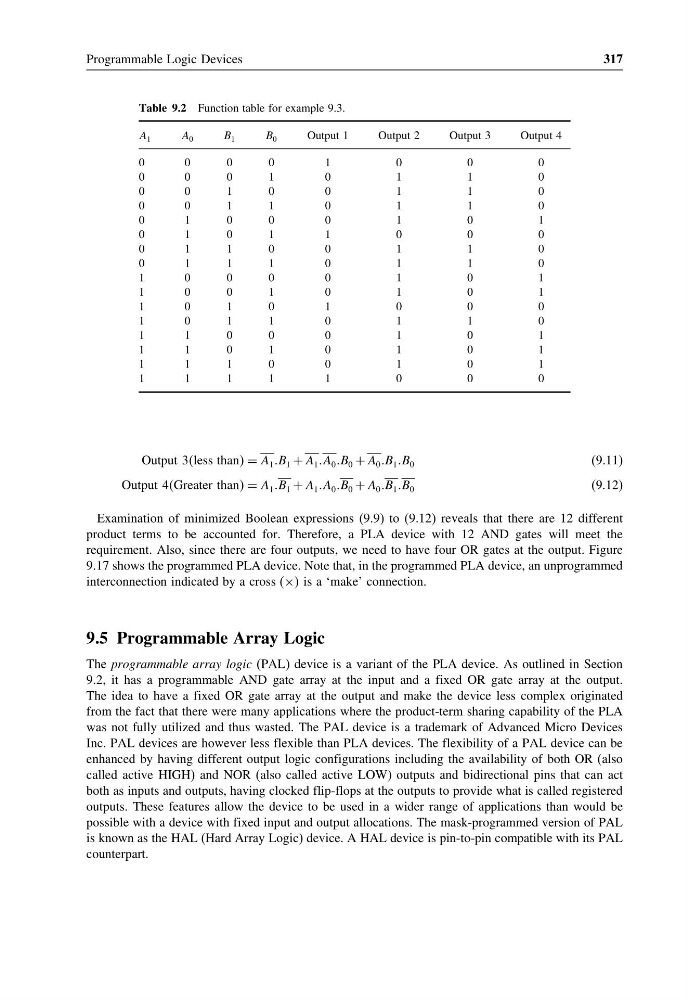
Table 9.2 Function table for example 9.3.
A 1
A 0
B 1
B 0
Output 1
Output 2
Output 3
Output 4
0
0
0
0
1
0
0
0
0
0
0
1
0
1
1
0
0
0
1
0
0
1
1
0
0
0
1
1
0
1
1
0
0
1
0
0
0
1
0
1
0
1
0
1
1
0
0
0
0
1
1
0
0
1
1
0
0
1
1
1
0
1
1
0
1
0
0
0
0
1
0
1
1
0
0
1
0
1
0
1
1
0
1
0
1
0
0
0
1
0
1
1
0
1
1
0
1
1
0
0
0
1
0
1
1
1
0
1
0
1
0
1
1
1
1
0
0
1
0
1
1
1
1
1
1
0
0
0
Output 3less than = A 1 B 1 + A 1 A 0 B 0 + A 0 B 1 B 0
(9.11)
Output 4Greater than = A 1 B 1 + A 1 A 0 B 0 + A 0 B 1 B 0
(9.12)
Examination of minimized Boolean expressions (9.9) to (9.12) reveals that there are 12 different
product terms to be accounted for. Therefore, a PLA device with 12 AND gates will meet the
requirement. Also, since there are four outputs, we need to have four OR gates at the output. Figure
9.17 shows the programmed PLA device. Note that, in the programmed PLA device, an unprogrammed
interconnection indicated by a cross (× is a ‘make’ connection.
9.5 Programmable Array Logic
The programmable array logic (PAL) device is a variant of the PLA device. As outlined in Section
9.2, it has a programmable AND gate array at the input and a fixed OR gate array at the output.
The idea to have a fixed OR gate array at the output and make the device less complex originated
from the fact that there were many applications where the product-term sharing capability of the PLA
was not fully utilized and thus wasted. The PAL device is a trademark of Advanced Micro Devices
Inc. PAL devices are however less flexible than PLA devices. The flexibility of a PAL device can be
enhanced by having different output logic configurations including the availability of both OR (also
called active HIGH) and NOR (also called active LOW) outputs and bidirectional pins that can act
both as inputs and outputs, having clocked flip-flops at the outputs to provide what is called registered
outputs. These features allow the device to be used in a wider range of applications than would be
possible with a device with fixed input and output allocations. The mask-programmed version of PAL
is known as the HAL (Hard Array Logic) device. A HAL device is pin-to-pin compatible with its PAL
counterpart.
317
Table 9.2 Function table for example 9.3.
A 1
A 0
B 1
B 0
Output 1
Output 2
Output 3
Output 4
0
0
0
0
1
0
0
0
0
0
0
1
0
1
1
0
0
0
1
0
0
1
1
0
0
0
1
1
0
1
1
0
0
1
0
0
0
1
0
1
0
1
0
1
1
0
0
0
0
1
1
0
0
1
1
0
0
1
1
1
0
1
1
0
1
0
0
0
0
1
0
1
1
0
0
1
0
1
0
1
1
0
1
0
1
0
0
0
1
0
1
1
0
1
1
0
1
1
0
0
0
1
0
1
1
1
0
1
0
1
0
1
1
1
1
0
0
1
0
1
1
1
1
1
1
0
0
0
Output 3less than = A 1 B 1 + A 1 A 0 B 0 + A 0 B 1 B 0
(9.11)
Output 4Greater than = A 1 B 1 + A 1 A 0 B 0 + A 0 B 1 B 0
(9.12)
Examination of minimized Boolean expressions (9.9) to (9.12) reveals that there are 12 different
product terms to be accounted for. Therefore, a PLA device with 12 AND gates will meet the
requirement. Also, since there are four outputs, we need to have four OR gates at the output. Figure
9.17 shows the programmed PLA device. Note that, in the programmed PLA device, an unprogrammed
interconnection indicated by a cross (× is a ‘make’ connection.
9.5 Programmable Array Logic
The programmable array logic (PAL) device is a variant of the PLA device. As outlined in Section
9.2, it has a programmable AND gate array at the input and a fixed OR gate array at the output.
The idea to have a fixed OR gate array at the output and make the device less complex originated
from the fact that there were many applications where the product-term sharing capability of the PLA
was not fully utilized and thus wasted. The PAL device is a trademark of Advanced Micro Devices
Inc. PAL devices are however less flexible than PLA devices. The flexibility of a PAL device can be
enhanced by having different output logic configurations including the availability of both OR (also
called active HIGH) and NOR (also called active LOW) outputs and bidirectional pins that can act
both as inputs and outputs, having clocked flip-flops at the outputs to provide what is called registered
outputs. These features allow the device to be used in a wider range of applications than would be
possible with a device with fixed input and output allocations. The mask-programmed version of PAL
is known as the HAL (Hard Array Logic) device. A HAL device is pin-to-pin compatible with its PAL
counterpart.