

230
Digital Electronics
Review Questions
1. Read the following statements carefully. For each one of these, identify the law associated with it.
Define the law and illustrate the same with one or two examples.
(a) While a NAND gate is equivalent to a bubbled OR gate, a NOR gate is equivalent to a bubbled
AND gate.
(b) When all the inputs of an AND gate or an OR gate are tied together to get a single-input,
single-output gate, both AND and OR gates with all their inputs tied together produce an output
that is the same as the input.
(c) When a variable is ORed with its complement the result is a logic ‘1’, and when it is ANDed
with its complement the result is a logic ‘0’, irrespective of the logic status of the variable.
(d) When two variables are ANDed and the result of the AND operation is ORed with one of the
variables, the result is that variable. Also, when two variables are ORed and the result of the
OR operation is ANDed with one of the variables, the result is that variable.
2. Write both sum-of-products and product-of-sums Boolean expressions for (a) a two-input AND
gate, (b) a two-input NAND-gate, (c) a two-input EX-OR gate and (d) a two-input NOR gate from
their respective truth tables.
3. What do you understand by canonical and expanded forms of Boolean expressions? Illustrate with
examples.
4. With the help of an example, prove that in an n-variable Karnaugh map, a group formed with 2
n−m
1s will yield a term having m literals, where m = 1, 2, 3, , n.
5. With the help of an example, prove that the dual of the complement of a Boolean expression is the
same as the complement of the dual of the same.
Problems
1. Simplify the following Boolean expressions:
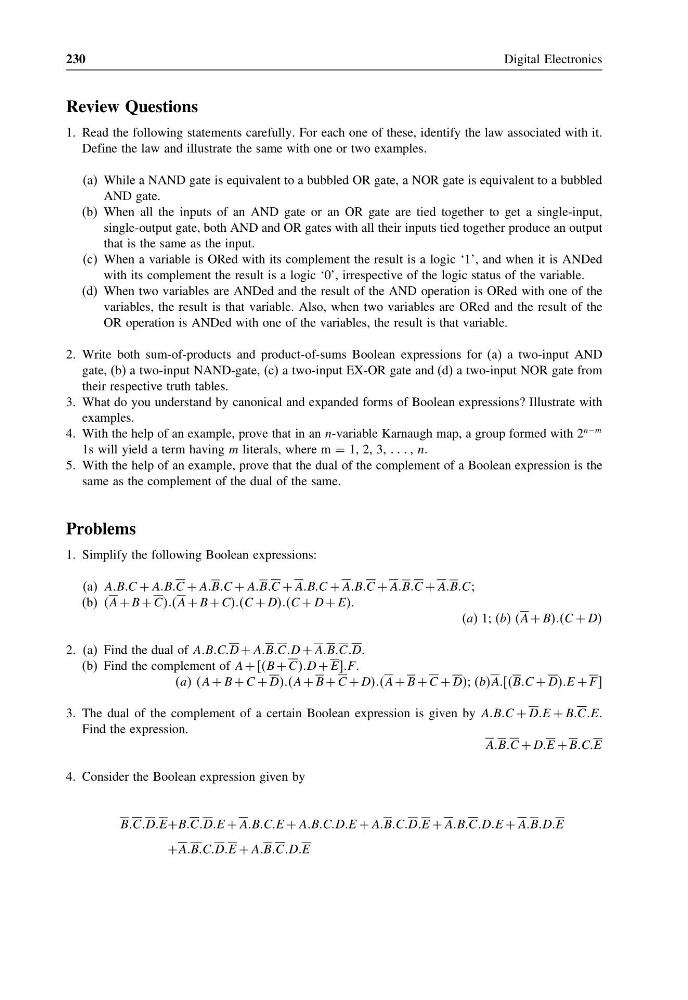
(a) AABBC + AABBC + AABBC + AABBC + AABBC + AABBC + AABBC + AABBC;
(b) A + B + CCCCA + B + CCCCC + DDDDC + D + EE.
(a) 1; (b) A + BBBBC + DD
2. (a) Find the dual of AABBCCD + AABBCCD + AABBCCD.
(b) Find the complement of A + B + CCCD + EEEF .
aA + B + C + DDDDA + B + C + DDDDA + B + C + DDD DbbAAAABBC + DDDE + F F
3. The dual of the complement of a certain Boolean expression is given by AABBC + DDE + BBCCE.
Find the expression.
AABBC + DDE + BBCCE
4. Consider the Boolean expression given by
BBCCDDE+BBCCDDE + AABBCCE + AABBCCDDE + AABBCCDDE + AABBCCDDE + AABBDDE
+AABBCCDDE + AABBCCDDE
Digital Electronics
Review Questions
1. Read the following statements carefully. For each one of these, identify the law associated with it.
Define the law and illustrate the same with one or two examples.
(a) While a NAND gate is equivalent to a bubbled OR gate, a NOR gate is equivalent to a bubbled
AND gate.
(b) When all the inputs of an AND gate or an OR gate are tied together to get a single-input,
single-output gate, both AND and OR gates with all their inputs tied together produce an output
that is the same as the input.
(c) When a variable is ORed with its complement the result is a logic ‘1’, and when it is ANDed
with its complement the result is a logic ‘0’, irrespective of the logic status of the variable.
(d) When two variables are ANDed and the result of the AND operation is ORed with one of the
variables, the result is that variable. Also, when two variables are ORed and the result of the
OR operation is ANDed with one of the variables, the result is that variable.
2. Write both sum-of-products and product-of-sums Boolean expressions for (a) a two-input AND
gate, (b) a two-input NAND-gate, (c) a two-input EX-OR gate and (d) a two-input NOR gate from
their respective truth tables.
3. What do you understand by canonical and expanded forms of Boolean expressions? Illustrate with
examples.
4. With the help of an example, prove that in an n-variable Karnaugh map, a group formed with 2
n−m
1s will yield a term having m literals, where m = 1, 2, 3, , n.
5. With the help of an example, prove that the dual of the complement of a Boolean expression is the
same as the complement of the dual of the same.
Problems
1. Simplify the following Boolean expressions:
(a) AABBC + AABBC + AABBC + AABBC + AABBC + AABBC + AABBC + AABBC;
(b) A + B + CCCCA + B + CCCCC + DDDDC + D + EE.
(a) 1; (b) A + BBBBC + DD
2. (a) Find the dual of AABBCCD + AABBCCD + AABBCCD.
(b) Find the complement of A + B + CCCD + EEEF .
aA + B + C + DDDDA + B + C + DDDDA + B + C + DDD DbbAAAABBC + DDDE + F F
3. The dual of the complement of a certain Boolean expression is given by AABBC + DDE + BBCCE.
Find the expression.
AABBC + DDE + BBCCE
4. Consider the Boolean expression given by
BBCCDDE+BBCCDDE + AABBCCE + AABBCCDDE + AABBCCDDE + AABBCCDDE + AABBDDE
+AABBCCDDE + AABBCCDDE