

222
Digital Electronics
6.6.2 Karnaugh Map for Boolean Expressions with a Larger Number of
Variables
The construction of Karnaugh maps for a larger number of variables is a complex and cumbersome
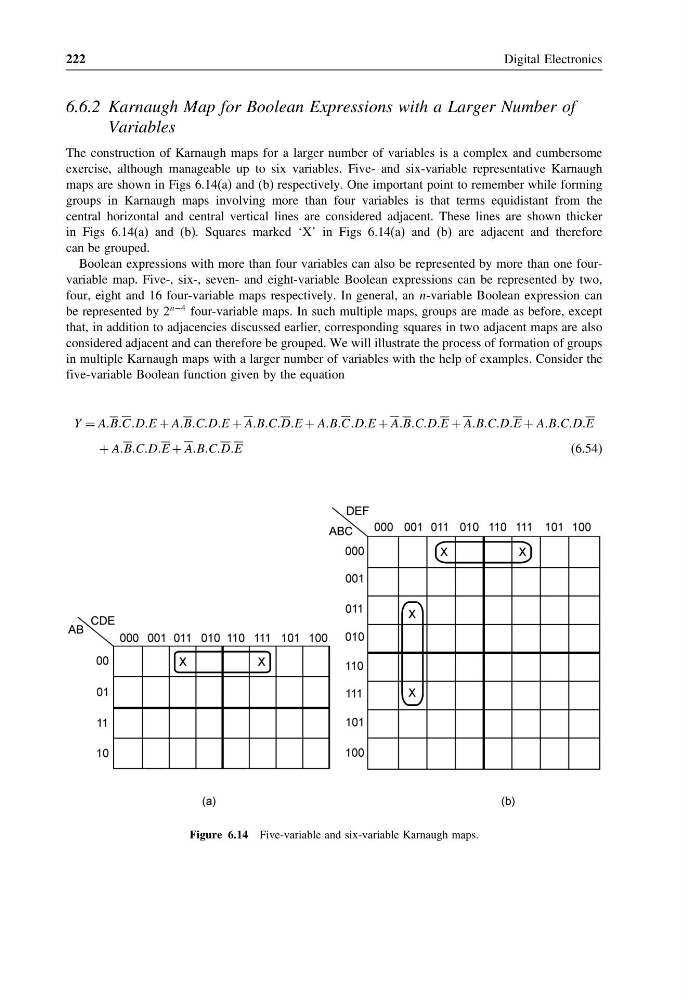
exercise, although manageable up to six variables. Five- and six-variable representative Karnaugh
maps are shown in Figs 6.14(a) and (b) respectively. One important point to remember while forming
groups in Karnaugh maps involving more than four variables is that terms equidistant from the
central horizontal and central vertical lines are considered adjacent. These lines are shown thicker
in Figs 6.14(a) and (b). Squares marked ‘X’ in Figs 6.14(a) and (b) are adjacent and therefore
can be grouped.
Boolean expressions with more than four variables can also be represented by more than one fourvariable map. Five-, six-, seven- and eight-variable Boolean expressions can be represented by two,
four, eight and 16 four-variable maps respectively. In general, an n-variable Boolean expression can
be represented by 2
n−4 four-variable maps. In such multiple maps, groups are made as before, except
that, in addition to adjacencies discussed earlier, corresponding squares in two adjacent maps are also
considered adjacent and can therefore be grouped. We will illustrate the process of formation of groups
in multiple Karnaugh maps with a larger number of variables with the help of examples. Consider the
five-variable Boolean function given by the equation
Y = AABBCCDDE + AABBCCDDE + AABBCCDDE + AABBCCDDE + AABBCCDDE + AABBCCDDE + AABBCCDDE
+ AABBCCDDE + AABBCCDDE
(6.54)
Figure 6.14 Five-variable and six-variable Karnaugh maps.
Digital Electronics
6.6.2 Karnaugh Map for Boolean Expressions with a Larger Number of
Variables
The construction of Karnaugh maps for a larger number of variables is a complex and cumbersome
exercise, although manageable up to six variables. Five- and six-variable representative Karnaugh
maps are shown in Figs 6.14(a) and (b) respectively. One important point to remember while forming
groups in Karnaugh maps involving more than four variables is that terms equidistant from the
central horizontal and central vertical lines are considered adjacent. These lines are shown thicker
in Figs 6.14(a) and (b). Squares marked ‘X’ in Figs 6.14(a) and (b) are adjacent and therefore
can be grouped.
Boolean expressions with more than four variables can also be represented by more than one fourvariable map. Five-, six-, seven- and eight-variable Boolean expressions can be represented by two,
four, eight and 16 four-variable maps respectively. In general, an n-variable Boolean expression can
be represented by 2
n−4 four-variable maps. In such multiple maps, groups are made as before, except
that, in addition to adjacencies discussed earlier, corresponding squares in two adjacent maps are also
considered adjacent and can therefore be grouped. We will illustrate the process of formation of groups
in multiple Karnaugh maps with a larger number of variables with the help of examples. Consider the
five-variable Boolean function given by the equation
Y = AABBCCDDE + AABBCCDDE + AABBCCDDE + AABBCCDDE + AABBCCDDE + AABBCCDDE + AABBCCDDE
+ AABBCCDDE + AABBCCDDE
(6.54)
Figure 6.14 Five-variable and six-variable Karnaugh maps.