

Boolean Algebra and Simplification Techniques
205
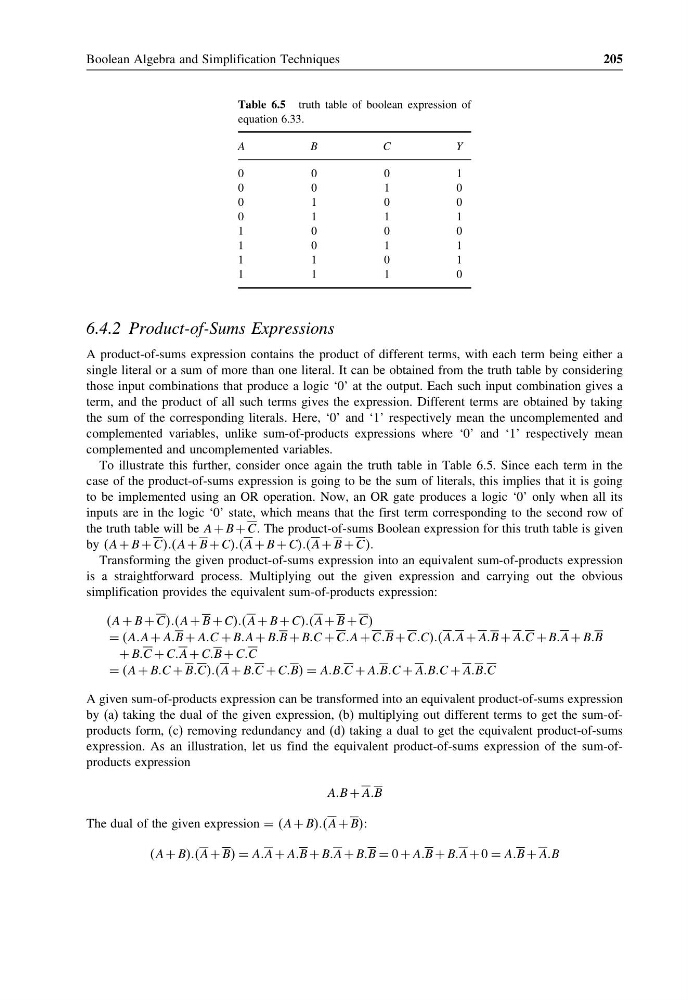
Table 6.5 truth table of boolean expression of
equation 6.33.
A
B
C
Y
0
0
0
1
0
0
1
0
0
1
0
0
0
1
1
1
1
0
0
0
1
0
1
1
1
1
0
1
1
1
1
0
6.4.2 Product-of-Sums Expressions
A product-of-sums expression contains the product of different terms, with each term being either a
single literal or a sum of more than one literal. It can be obtained from the truth table by considering
those input combinations that produce a logic ‘0’ at the output. Each such input combination gives a
term, and the product of all such terms gives the expression. Different terms are obtained by taking
the sum of the corresponding literals. Here, ‘0’ and ‘1’ respectively mean the uncomplemented and
complemented variables, unlike sum-of-products expressions where ‘0’ and ‘1’ respectively mean
complemented and uncomplemented variables.
To illustrate this further, consider once again the truth table in Table 6.5. Since each term in the
case of the product-of-sums expression is going to be the sum of literals, this implies that it is going
to be implemented using an OR operation. Now, an OR gate produces a logic ‘0’ only when all its
inputs are in the logic ‘0’ state, which means that the first term corresponding to the second row of
the truth table will be A + B + C. The product-of-sums Boolean expression for this truth table is given
by A + B + CCCCA + B + CCCCA + B + CCCCA + B + CC.
Transforming the given product-of-sums expression into an equivalent sum-of-products expression
is a straightforward process. Multiplying out the given expression and carrying out the obvious
simplification provides the equivalent sum-of-products expression:
A + B + CCCCA + B + CCCCA + B + CCCCA + B + CC
= AAA + AAB + AAC + BBA + BBB + BBC + CCA + CCB + CCCCCCAAA + AAB + AAC + BBA + BBB
+ BBC + CCA + CCB + CCC
= A + BBC + BBCCCCA + BBC + CCBB = AABBC + AABBC + AABBC + AABBC
A given sum-of-products expression can be transformed into an equivalent product-of-sums expression
by (a) taking the dual of the given expression, (b) multiplying out different terms to get the sum-ofproducts form, (c) removing redundancy and (d) taking a dual to get the equivalent product-of-sums
expression. As an illustration, let us find the equivalent product-of-sums expression of the sum-ofproducts expression
AAB + AAB
The dual of the given expression = A + BBBBA + BB:
A + BBBBA + BB = AAA + AAB + BBA + BBB = 0 + AAB + BBA + 0 = AAB + AAB
205
Table 6.5 truth table of boolean expression of
equation 6.33.
A
B
C
Y
0
0
0
1
0
0
1
0
0
1
0
0
0
1
1
1
1
0
0
0
1
0
1
1
1
1
0
1
1
1
1
0
6.4.2 Product-of-Sums Expressions
A product-of-sums expression contains the product of different terms, with each term being either a
single literal or a sum of more than one literal. It can be obtained from the truth table by considering
those input combinations that produce a logic ‘0’ at the output. Each such input combination gives a
term, and the product of all such terms gives the expression. Different terms are obtained by taking
the sum of the corresponding literals. Here, ‘0’ and ‘1’ respectively mean the uncomplemented and
complemented variables, unlike sum-of-products expressions where ‘0’ and ‘1’ respectively mean
complemented and uncomplemented variables.
To illustrate this further, consider once again the truth table in Table 6.5. Since each term in the
case of the product-of-sums expression is going to be the sum of literals, this implies that it is going
to be implemented using an OR operation. Now, an OR gate produces a logic ‘0’ only when all its
inputs are in the logic ‘0’ state, which means that the first term corresponding to the second row of
the truth table will be A + B + C. The product-of-sums Boolean expression for this truth table is given
by A + B + CCCCA + B + CCCCA + B + CCCCA + B + CC.
Transforming the given product-of-sums expression into an equivalent sum-of-products expression
is a straightforward process. Multiplying out the given expression and carrying out the obvious
simplification provides the equivalent sum-of-products expression:
A + B + CCCCA + B + CCCCA + B + CCCCA + B + CC
= AAA + AAB + AAC + BBA + BBB + BBC + CCA + CCB + CCCCCCAAA + AAB + AAC + BBA + BBB
+ BBC + CCA + CCB + CCC
= A + BBC + BBCCCCA + BBC + CCBB = AABBC + AABBC + AABBC + AABBC
A given sum-of-products expression can be transformed into an equivalent product-of-sums expression
by (a) taking the dual of the given expression, (b) multiplying out different terms to get the sum-ofproducts form, (c) removing redundancy and (d) taking a dual to get the equivalent product-of-sums
expression. As an illustration, let us find the equivalent product-of-sums expression of the sum-ofproducts expression
AAB + AAB
The dual of the given expression = A + BBBBA + BB:
A + BBBBA + BB = AAA + AAB + BBA + BBB = 0 + AAB + BBA + 0 = AAB + AAB