

198
Digital Electronics
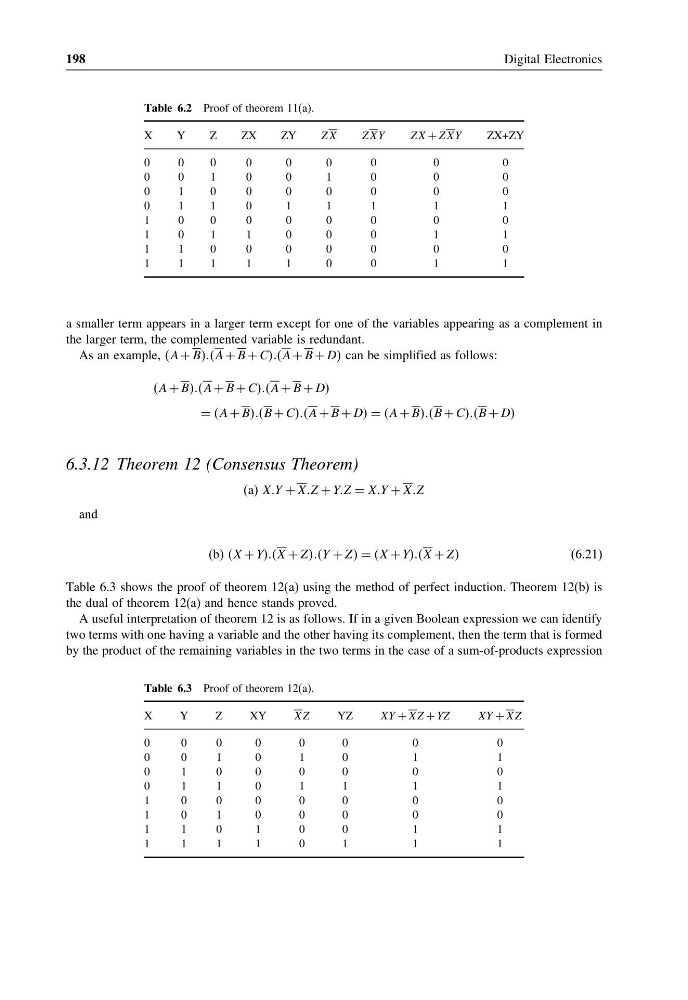
Table 6.2 Proof of theorem 11(a).
X
Y
Z
ZX
ZY
ZX
ZXY
ZX + ZXY
ZX+ZY
0
0
0
0
0
0
0
0
0
0
0
1
0
0
1
0
0
0
0
1
0
0
0
0
0
0
0
0
1
1
0
1
1
1
1
1
1
0
0
0
0
0
0
0
0
1
0
1
1
0
0
0
1
1
1
1
0
0
0
0
0
0
0
1
1
1
1
1
0
0
1
1
a smaller term appears in a larger term except for one of the variables appearing as a complement in
the larger term, the complemented variable is redundant.
As an example, A + BBBBA + B + CCCCA + B + DD can be simplified as follows:
A + BBBBA + B + CCCCA + B + DD
= A + BBBBB + CCCCA + B + DD = A + BBBBB + CCCCB + DD
6.3.12 Theorem 12 (Consensus Theorem)
(a) XXY + XXZ + YYZ = XXY + XXZ
and
(b) X + YYYYX + ZZZZY + ZZ = X + YYYYX + ZZ
(6.21)
Table 6.3 shows the proof of theorem 12(a) using the method of perfect induction. Theorem 12(b) is
the dual of theorem 12(a) and hence stands proved.
A useful interpretation of theorem 12 is as follows. If in a given Boolean expression we can identify
two terms with one having a variable and the other having its complement, then the term that is formed
by the product of the remaining variables in the two terms in the case of a sum-of-products expression
Table 6.3 Proof of theorem 12(a).
X
Y
Z
XY
XZ
YZ
XY + XZ + YZ
XY + XZ
0
0
0
0
0
0
0
0
0
0
1
0
1
0
1
1
0
1
0
0
0
0
0
0
0
1
1
0
1
1
1
1
1
0
0
0
0
0
0
0
1
0
1
0
0
0
0
0
1
1
0
1
0
0
1
1
1
1
1
1
0
1
1
1
Digital Electronics
Table 6.2 Proof of theorem 11(a).
X
Y
Z
ZX
ZY
ZX
ZXY
ZX + ZXY
ZX+ZY
0
0
0
0
0
0
0
0
0
0
0
1
0
0
1
0
0
0
0
1
0
0
0
0
0
0
0
0
1
1
0
1
1
1
1
1
1
0
0
0
0
0
0
0
0
1
0
1
1
0
0
0
1
1
1
1
0
0
0
0
0
0
0
1
1
1
1
1
0
0
1
1
a smaller term appears in a larger term except for one of the variables appearing as a complement in
the larger term, the complemented variable is redundant.
As an example, A + BBBBA + B + CCCCA + B + DD can be simplified as follows:
A + BBBBA + B + CCCCA + B + DD
= A + BBBBB + CCCCA + B + DD = A + BBBBB + CCCCB + DD
6.3.12 Theorem 12 (Consensus Theorem)
(a) XXY + XXZ + YYZ = XXY + XXZ
and
(b) X + YYYYX + ZZZZY + ZZ = X + YYYYX + ZZ
(6.21)
Table 6.3 shows the proof of theorem 12(a) using the method of perfect induction. Theorem 12(b) is
the dual of theorem 12(a) and hence stands proved.
A useful interpretation of theorem 12 is as follows. If in a given Boolean expression we can identify
two terms with one having a variable and the other having its complement, then the term that is formed
by the product of the remaining variables in the two terms in the case of a sum-of-products expression
Table 6.3 Proof of theorem 12(a).
X
Y
Z
XY
XZ
YZ
XY + XZ + YZ
XY + XZ
0
0
0
0
0
0
0
0
0
0
1
0
1
0
1
1
0
1
0
0
0
0
0
0
0
1
1
0
1
1
1
1
1
0
0
0
0
0
0
0
1
0
1
0
0
0
0
0
1
1
0
1
0
0
1
1
1
1
1
1
0
1
1
1