

Boolean Algebra and Simplification Techniques
191
Corresponding complement
AAB + AAB
(6.6)
When ORed with its complement the Boolean expression yields a ‘1’, and when ANDed with its
complement it yields a ‘0’. The ‘.’ sign is usually omitted in writing Boolean expressions and is
implied merely by writing the literals in juxtaposition. For instance, A.B would normally be written
as AB.
6.1.3 Dual of a Boolean Expression
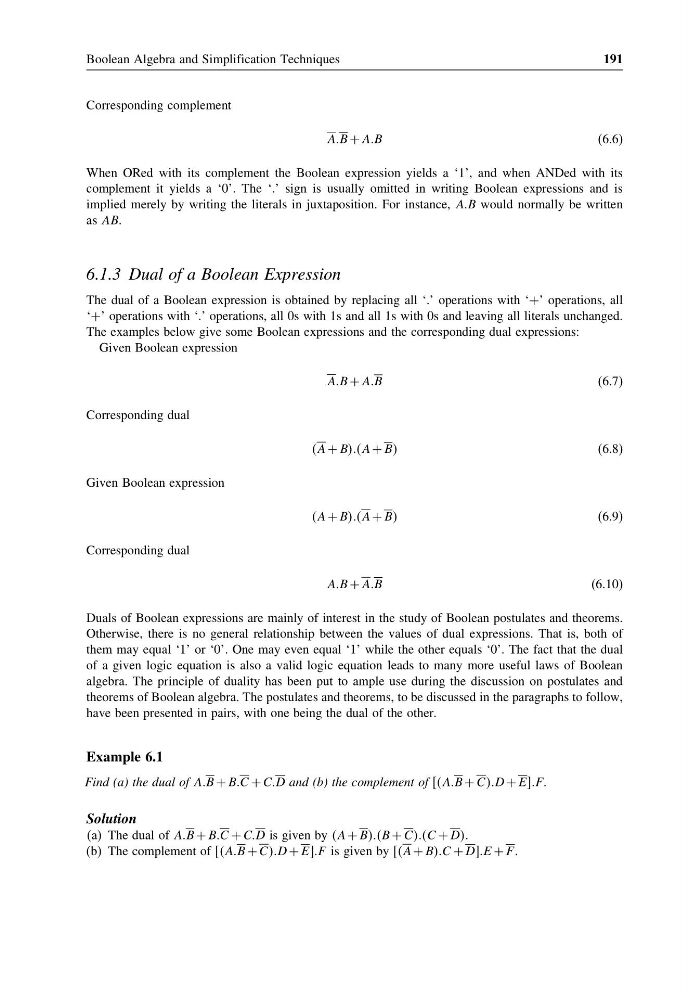
The dual of a Boolean expression is obtained by replacing all ‘.’ operations with ‘+’ operations, all
‘+’ operations with ‘.’ operations, all 0s with 1s and all 1s with 0s and leaving all literals unchanged.
The examples below give some Boolean expressions and the corresponding dual expressions:
Given Boolean expression
AAB + AAB
(6.7)
Corresponding dual
A + BBBBA + BB
(6.8)
Given Boolean expression
A + BBBBA + BB
(6.9)
Corresponding dual
AAB + AAB
(6.10)
Duals of Boolean expressions are mainly of interest in the study of Boolean postulates and theorems.
Otherwise, there is no general relationship between the values of dual expressions. That is, both of
them may equal ‘1’ or ‘0’. One may even equal ‘1’ while the other equals ‘0’. The fact that the dual
of a given logic equation is also a valid logic equation leads to many more useful laws of Boolean
algebra. The principle of duality has been put to ample use during the discussion on postulates and
theorems of Boolean algebra. The postulates and theorems, to be discussed in the paragraphs to follow,
have been presented in pairs, with one being the dual of the other.
Example 6.1
Find (a) the dual of AAB + BBC + CCD and (b) the complement of AAB + CCCD + EEEF .
Solution
(a) The dual of AAB + BBC + CCD is given by A + BBBBB + CCCCC + DD.
(b) The complement of AAB + CCCD + EEEF is given by A + BBBC + DDDE + F .
191
Corresponding complement
AAB + AAB
(6.6)
When ORed with its complement the Boolean expression yields a ‘1’, and when ANDed with its
complement it yields a ‘0’. The ‘.’ sign is usually omitted in writing Boolean expressions and is
implied merely by writing the literals in juxtaposition. For instance, A.B would normally be written
as AB.
6.1.3 Dual of a Boolean Expression
The dual of a Boolean expression is obtained by replacing all ‘.’ operations with ‘+’ operations, all
‘+’ operations with ‘.’ operations, all 0s with 1s and all 1s with 0s and leaving all literals unchanged.
The examples below give some Boolean expressions and the corresponding dual expressions:
Given Boolean expression
AAB + AAB
(6.7)
Corresponding dual
A + BBBBA + BB
(6.8)
Given Boolean expression
A + BBBBA + BB
(6.9)
Corresponding dual
AAB + AAB
(6.10)
Duals of Boolean expressions are mainly of interest in the study of Boolean postulates and theorems.
Otherwise, there is no general relationship between the values of dual expressions. That is, both of
them may equal ‘1’ or ‘0’. One may even equal ‘1’ while the other equals ‘0’. The fact that the dual
of a given logic equation is also a valid logic equation leads to many more useful laws of Boolean
algebra. The principle of duality has been put to ample use during the discussion on postulates and
theorems of Boolean algebra. The postulates and theorems, to be discussed in the paragraphs to follow,
have been presented in pairs, with one being the dual of the other.
Example 6.1
Find (a) the dual of AAB + BBC + CCD and (b) the complement of AAB + CCCD + EEEF .
Solution
(a) The dual of AAB + BBC + CCD is given by A + BBBBB + CCCCC + DD.
(b) The complement of AAB + CCCD + EEEF is given by A + BBBC + DDDE + F .