

public :
point (int abs=0, int ord=0)
{ x = abs ; y = ord ; }
int abscisse () { return x ; }
friend ostream & operator << (ostream &, point) ;
friend istream & operator >> (istream &, point &) ;
} ;
ostream & operator << (ostream & sortie, point p)
{
sortie << "<" << p.x << "," << p.y << ">" ;
return sortie ;
}
istream & operator >> (istream & entree, point & p)
{
char c = '\0' ;
float x, y ;
int ok = 1 ;
entree >> c ;
if (c != '<') ok = 0 ;
else
{ entree >> x >> c ;
if (c != ',') ok = 0 ;
else
{ entree >> y >> c ;
if (c != '>') ok = 0 ;
}
}
if (ok) { p.x = x ; p.y = y ; } // on n'affecte à p que si tout est OK
else entree.clear (ios::badbit | entree.rdstate () ) ;
return entree ;
}
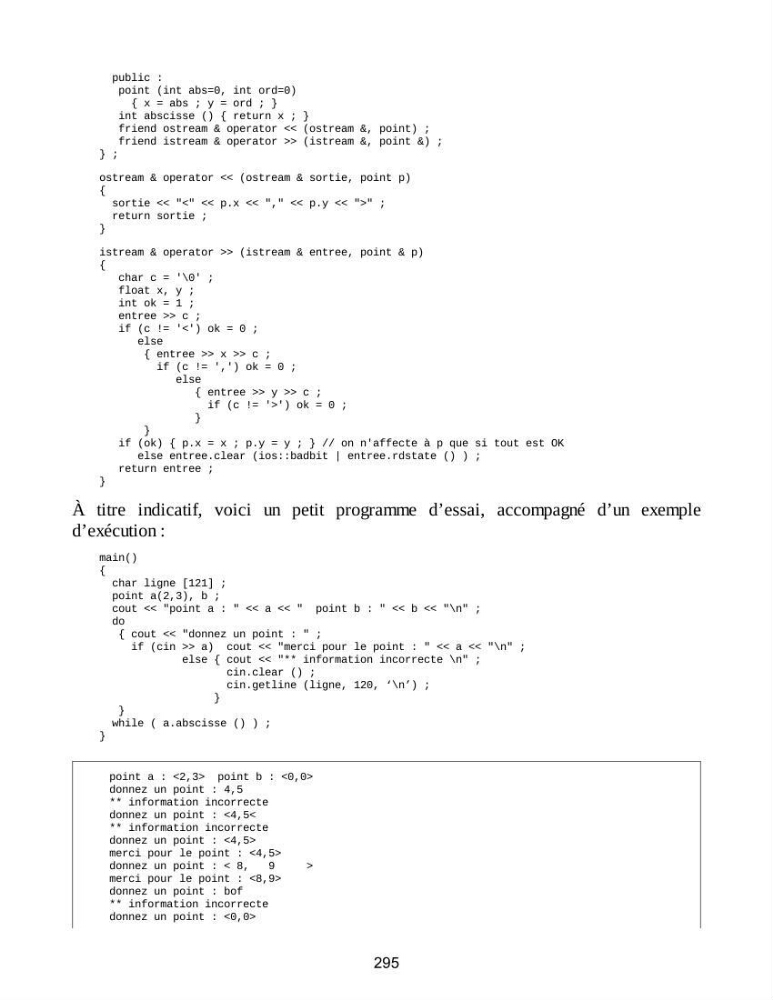
À titre indicatif, voici un petit programme d’essai, accompagné d’un exemple
d’exécution :
main()
{
char ligne [121] ;
point a(2,3), b ;
cout << "point a : " << a << " point b : " << b << "\n" ;
do
{ cout << "donnez un point : " ;
if (cin >> a) cout << "merci pour le point : " << a << "\n" ;
else { cout << "** information incorrecte \n" ;
cin.clear () ;
cin.getline (ligne, 120, ‘\n’) ;
}
}
while ( a.abscisse () ) ;
}
point a : <2,3> point b : <0,0>
donnez un point : 4,5
** information incorrecte
donnez un point : <4,5<
** information incorrecte
donnez un point : <4,5>
merci pour le point : <4,5>
donnez un point : < 8, 9 >
merci pour le point : <8,9>
donnez un point : bof
** information incorrecte
donnez un point : <0,0>
295
point (int abs=0, int ord=0)
{ x = abs ; y = ord ; }
int abscisse () { return x ; }
friend ostream & operator << (ostream &, point) ;
friend istream & operator >> (istream &, point &) ;
} ;
ostream & operator << (ostream & sortie, point p)
{
sortie << "<" << p.x << "," << p.y << ">" ;
return sortie ;
}
istream & operator >> (istream & entree, point & p)
{
char c = '\0' ;
float x, y ;
int ok = 1 ;
entree >> c ;
if (c != '<') ok = 0 ;
else
{ entree >> x >> c ;
if (c != ',') ok = 0 ;
else
{ entree >> y >> c ;
if (c != '>') ok = 0 ;
}
}
if (ok) { p.x = x ; p.y = y ; } // on n'affecte à p que si tout est OK
else entree.clear (ios::badbit | entree.rdstate () ) ;
return entree ;
}
À titre indicatif, voici un petit programme d’essai, accompagné d’un exemple
d’exécution :
main()
{
char ligne [121] ;
point a(2,3), b ;
cout << "point a : " << a << " point b : " << b << "\n" ;
do
{ cout << "donnez un point : " ;
if (cin >> a) cout << "merci pour le point : " << a << "\n" ;
else { cout << "** information incorrecte \n" ;
cin.clear () ;
cin.getline (ligne, 120, ‘\n’) ;
}
}
while ( a.abscisse () ) ;
}
point a : <2,3> point b : <0,0>
donnez un point : 4,5
** information incorrecte
donnez un point : <4,5<
** information incorrecte
donnez un point : <4,5>
merci pour le point : <4,5>
donnez un point : < 8, 9 >
merci pour le point : <8,9>
donnez un point : bof
** information incorrecte
donnez un point : <0,0>
295