

69
citizens from formaldehyde. Industry resistance to regulation and slow agency
review likely led to Guest’s death (Cranor 2017a).
Similarly, individuals who merely drank tap water contaminated with the “forever
chemical” PFOA (Perfluorooctanoic acid) or C8 used in Teflon, Gore-Tex, and
flame retardants, inter alia, contracted kidney and testicular cancer. Although they
received tort law compensation for their injuries, their serious diseases, associated
harms, and monetary costs truncated lifetime opportunities (Mancini 2017). DuPont
employees suffered similar diseases (Lerner 2015; Cranor 2017a). DuPont and
administrative institutions failed all these people, although the tort law provided
some compensation for some of their losses (Mancini 2017).
4 The Developmental Origins of Disease
Postmarket laws did not protect adults from chronic diseases, but a new science—
the “developmental origins of disease”—greatly heightens the urgency to better
serve this goal (Grandjean et al. 2008).
Children are among the most vulnerable humans exposed to toxicants (recall
exposures above). “In utero nutrition and/or in utero or neonatal exposures to toxicants alter susceptibility to disease later in life and … [can] result in death, malformations, low birth weight or functional changes including increased susceptibility
to diseases later in life.” (Heindel 2008). This shows chronic diseases can originate
from environmental insults to embryos to fetuses to infants to teenagers (Grandjean
et al. 2008; Cao et al. 2016), even to later life stages (Heindel 2018). For instance,
women are particularly vulnerable to breast cancer from toxicants during puberty
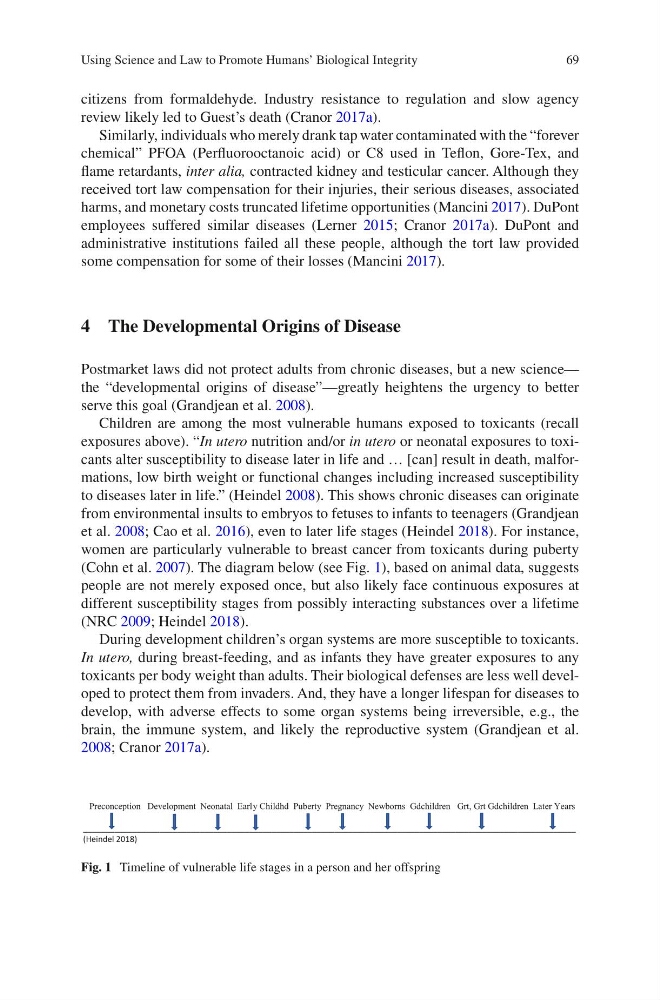
(Cohn et al. 2007). The diagram below (see Fig. 1), based on animal data, suggests
people are not merely exposed once, but also likely face continuous exposures at
different susceptibility stages from possibly interacting substances over a lifetime
(NRC 2009; Heindel 2018).
During development children’s organ systems are more susceptible to toxicants.
In utero, during breast-feeding, and as infants they have greater exposures to any
toxicants per body weight than adults. Their biological defenses are less well developed to protect them from invaders. And, they have a longer lifespan for diseases to
develop, with adverse effects to some organ systems being irreversible, e.g., the
brain, the immune system, and likely the reproductive system (Grandjean et al.
2008; Cranor 2017a).
Preconception Development Neonatal Early Childhd Puberty Pregnancy Newborns Gdchildren Grt, Grt Gdchildren Later Years
______________________________________________________________________________________________________________
(Heindel 2018)
Fig. 1 Timeline of vulnerable life stages in a person and her offspring
Using Science and Law to Promote Humans’ Biological Integrity
citizens from formaldehyde. Industry resistance to regulation and slow agency
review likely led to Guest’s death (Cranor 2017a).
Similarly, individuals who merely drank tap water contaminated with the “forever
chemical” PFOA (Perfluorooctanoic acid) or C8 used in Teflon, Gore-Tex, and
flame retardants, inter alia, contracted kidney and testicular cancer. Although they
received tort law compensation for their injuries, their serious diseases, associated
harms, and monetary costs truncated lifetime opportunities (Mancini 2017). DuPont
employees suffered similar diseases (Lerner 2015; Cranor 2017a). DuPont and
administrative institutions failed all these people, although the tort law provided
some compensation for some of their losses (Mancini 2017).
4 The Developmental Origins of Disease
Postmarket laws did not protect adults from chronic diseases, but a new science—
the “developmental origins of disease”—greatly heightens the urgency to better
serve this goal (Grandjean et al. 2008).
Children are among the most vulnerable humans exposed to toxicants (recall
exposures above). “In utero nutrition and/or in utero or neonatal exposures to toxicants alter susceptibility to disease later in life and … [can] result in death, malformations, low birth weight or functional changes including increased susceptibility
to diseases later in life.” (Heindel 2008). This shows chronic diseases can originate
from environmental insults to embryos to fetuses to infants to teenagers (Grandjean
et al. 2008; Cao et al. 2016), even to later life stages (Heindel 2018). For instance,
women are particularly vulnerable to breast cancer from toxicants during puberty
(Cohn et al. 2007). The diagram below (see Fig. 1), based on animal data, suggests
people are not merely exposed once, but also likely face continuous exposures at
different susceptibility stages from possibly interacting substances over a lifetime
(NRC 2009; Heindel 2018).
During development children’s organ systems are more susceptible to toxicants.
In utero, during breast-feeding, and as infants they have greater exposures to any
toxicants per body weight than adults. Their biological defenses are less well developed to protect them from invaders. And, they have a longer lifespan for diseases to
develop, with adverse effects to some organ systems being irreversible, e.g., the
brain, the immune system, and likely the reproductive system (Grandjean et al.
2008; Cranor 2017a).
Preconception Development Neonatal Early Childhd Puberty Pregnancy Newborns Gdchildren Grt, Grt Gdchildren Later Years
______________________________________________________________________________________________________________
(Heindel 2018)
Fig. 1 Timeline of vulnerable life stages in a person and her offspring
Using Science and Law to Promote Humans’ Biological Integrity