

62
Introduction
The east coast of Peninsular Malaysia, consisting of three states, forms the main
part of the backbone of Peninsular Malaysia, which also fall within the Central
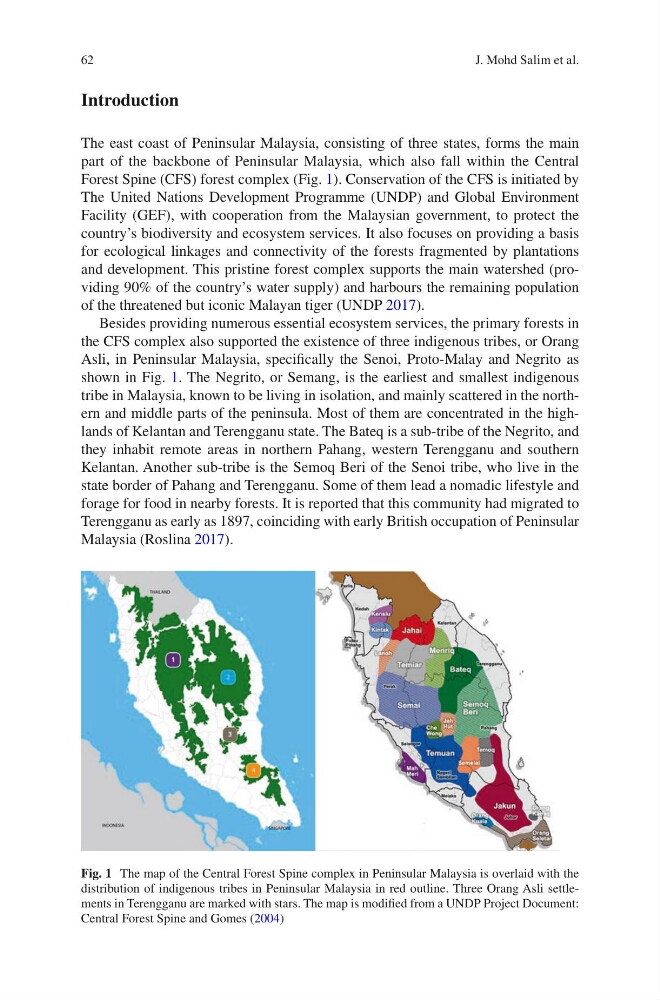
Forest Spine (CFS) forest complex (Fig. 1). Conservation of the CFS is initiated by
The United Nations Development Programme (UNDP) and Global Environment
Facility (GEF), with cooperation from the Malaysian government, to protect the
country’s biodiversity and ecosystem services. It also focuses on providing a basis
for ecological linkages and connectivity of the forests fragmented by plantations
and development. This pristine forest complex supports the main watershed (providing 90% of the country’s water supply) and harbours the remaining population
of the threatened but iconic Malayan tiger (UNDP 2017).
Besides providing numerous essential ecosystem services, the primary forests in
the CFS complex also supported the existence of three indigenous tribes, or Orang
Asli, in Peninsular Malaysia, specifically the Senoi, Proto-Malay and Negrito as
shown in Fig. 1. The Negrito, or Semang, is the earliest and smallest indigenous
tribe in Malaysia, known to be living in isolation, and mainly scattered in the northern and middle parts of the peninsula. Most of them are concentrated in the highlands of Kelantan and Terengganu state. The Bateq is a sub-tribe of the Negrito, and
they inhabit remote areas in northern Pahang, western Terengganu and southern
Kelantan. Another sub-tribe is the Semoq Beri of the Senoi tribe, who live in the
state border of Pahang and Terengganu. Some of them lead a nomadic lifestyle and
forage for food in nearby forests. It is reported that this community had migrated to
Terengganu as early as 1897, coinciding with early British occupation of Peninsular
Malaysia (Roslina 2017).
Fig. 1 The map of the Central Forest Spine complex in Peninsular Malaysia is overlaid with the
distribution of indigenous tribes in Peninsular Malaysia in red outline. Three Orang Asli settlements in Terengganu are marked with stars. The map is modified from a UNDP Project Document:
Central Forest Spine and Gomes (2004)
J. Mohd Salim et al.
Introduction
The east coast of Peninsular Malaysia, consisting of three states, forms the main
part of the backbone of Peninsular Malaysia, which also fall within the Central
Forest Spine (CFS) forest complex (Fig. 1). Conservation of the CFS is initiated by
The United Nations Development Programme (UNDP) and Global Environment
Facility (GEF), with cooperation from the Malaysian government, to protect the
country’s biodiversity and ecosystem services. It also focuses on providing a basis
for ecological linkages and connectivity of the forests fragmented by plantations
and development. This pristine forest complex supports the main watershed (providing 90% of the country’s water supply) and harbours the remaining population
of the threatened but iconic Malayan tiger (UNDP 2017).
Besides providing numerous essential ecosystem services, the primary forests in
the CFS complex also supported the existence of three indigenous tribes, or Orang
Asli, in Peninsular Malaysia, specifically the Senoi, Proto-Malay and Negrito as
shown in Fig. 1. The Negrito, or Semang, is the earliest and smallest indigenous
tribe in Malaysia, known to be living in isolation, and mainly scattered in the northern and middle parts of the peninsula. Most of them are concentrated in the highlands of Kelantan and Terengganu state. The Bateq is a sub-tribe of the Negrito, and
they inhabit remote areas in northern Pahang, western Terengganu and southern
Kelantan. Another sub-tribe is the Semoq Beri of the Senoi tribe, who live in the
state border of Pahang and Terengganu. Some of them lead a nomadic lifestyle and
forage for food in nearby forests. It is reported that this community had migrated to
Terengganu as early as 1897, coinciding with early British occupation of Peninsular
Malaysia (Roslina 2017).
Fig. 1 The map of the Central Forest Spine complex in Peninsular Malaysia is overlaid with the
distribution of indigenous tribes in Peninsular Malaysia in red outline. Three Orang Asli settlements in Terengganu are marked with stars. The map is modified from a UNDP Project Document:
Central Forest Spine and Gomes (2004)
J. Mohd Salim et al.