

37
his son with me, and that his son would live with us until he got a job. That would
have been fine except for the fact that Sheila and I were scheduled to leave for the
United States in 3 days! We could not take the boy in at that moment. I looked at Bot
and with a lump in my throat, I shook my head and almost whispered, “No, we cannot take your boy,” and then I tried to explain to him that we were leaving the country to fly back to the United States.
But all that did not seem to matter. Bot’s face became ashen with embarrassment
or rejection — I do not know what it was, but it was the most awful experience we
had ever had! Then Bot and his boy quietly turned away and walked back into the
forest. That image would forever be seared in my mind. I got back in the car, and we
did not make it but a mile when I stopped, and both Sheila and I wept. It was so very
sad. It was heart-wrenching. After collecting ourselves, I started to drive off again
and Sheila said, “Al, you cannot help these people individually; you have to help
them collectively.”
We went back to the United States for a few weeks, and while home, I wrote a
paper, “Integrating the Orang Asli into the National Development Program”, which
advocated training Orang Asli to do forestry work in extended forest reserve areas
that DARA recommended. When I returned to Malaysia, I gave Mohamed Saufi,
who was then director of DARA, my working paper. He reviewed it and suggested
that the areas identified for sustained timber management also be included as a possibility for Orang Asli training or employment. Mohamed Saufi empowered me to
take our recommendations to the director of Orang Asli Affairs in Kuala Lumpur. I
met the director, showed him many pictures, and gave him the DARA
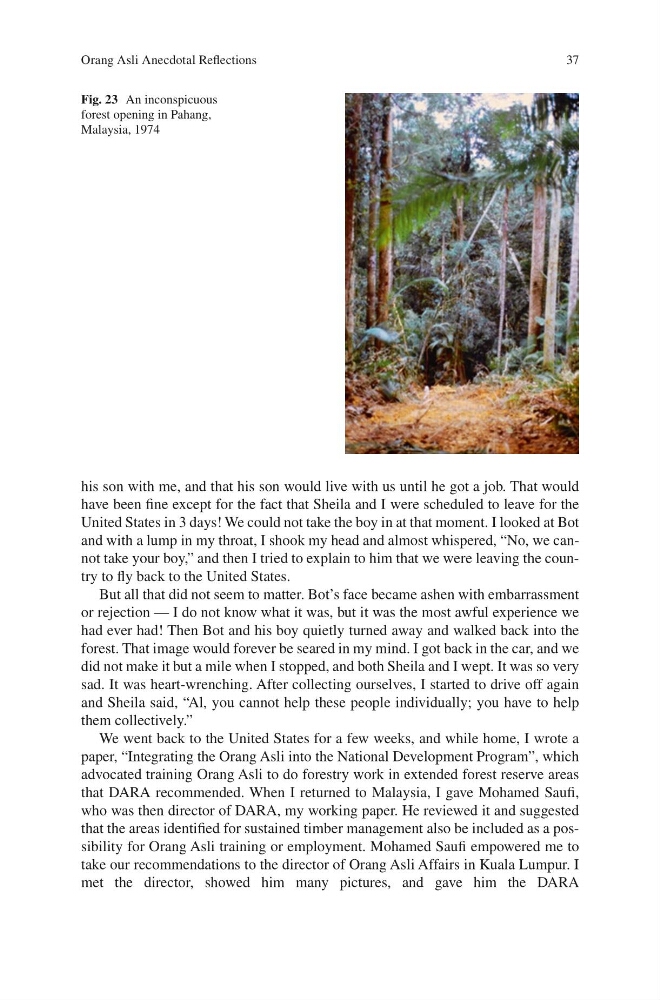
Fig. 23 An inconspicuous
forest opening in Pahang,
Malaysia, 1974
Orang Asli Anecdotal Reflections
his son with me, and that his son would live with us until he got a job. That would
have been fine except for the fact that Sheila and I were scheduled to leave for the
United States in 3 days! We could not take the boy in at that moment. I looked at Bot
and with a lump in my throat, I shook my head and almost whispered, “No, we cannot take your boy,” and then I tried to explain to him that we were leaving the country to fly back to the United States.
But all that did not seem to matter. Bot’s face became ashen with embarrassment
or rejection — I do not know what it was, but it was the most awful experience we
had ever had! Then Bot and his boy quietly turned away and walked back into the
forest. That image would forever be seared in my mind. I got back in the car, and we
did not make it but a mile when I stopped, and both Sheila and I wept. It was so very
sad. It was heart-wrenching. After collecting ourselves, I started to drive off again
and Sheila said, “Al, you cannot help these people individually; you have to help
them collectively.”
We went back to the United States for a few weeks, and while home, I wrote a
paper, “Integrating the Orang Asli into the National Development Program”, which
advocated training Orang Asli to do forestry work in extended forest reserve areas
that DARA recommended. When I returned to Malaysia, I gave Mohamed Saufi,
who was then director of DARA, my working paper. He reviewed it and suggested
that the areas identified for sustained timber management also be included as a possibility for Orang Asli training or employment. Mohamed Saufi empowered me to
take our recommendations to the director of Orang Asli Affairs in Kuala Lumpur. I
met the director, showed him many pictures, and gave him the DARA
Fig. 23 An inconspicuous
forest opening in Pahang,
Malaysia, 1974
Orang Asli Anecdotal Reflections