

24
Field Reconnaissance Was Intensive
I spent the better part of 3 years in a Land Rover doing onsite reviews of Pahang
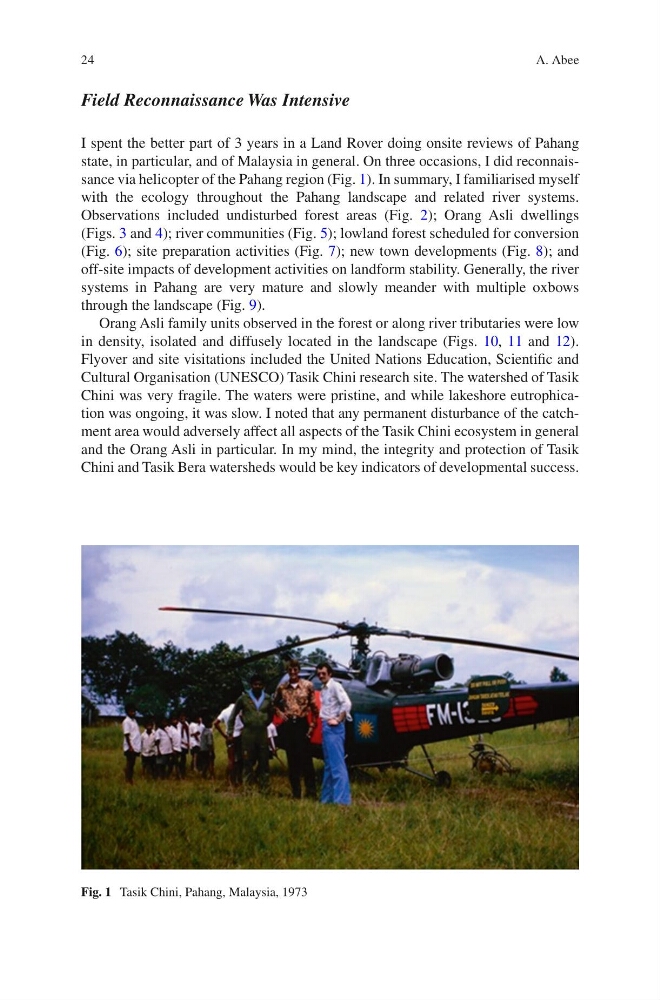
state, in particular, and of Malaysia in general. On three occasions, I did reconnaissance via helicopter of the Pahang region (Fig. 1). In summary, I familiarised myself
with the ecology throughout the Pahang landscape and related river systems.
Observations included undisturbed forest areas (Fig. 2); Orang Asli dwellings
(Figs. 3 and 4); river communities (Fig. 5); lowland forest scheduled for conversion
(Fig. 6); site preparation activities (Fig. 7); new town developments (Fig. 8); and
off-site impacts of development activities on landform stability. Generally, the river
systems in Pahang are very mature and slowly meander with multiple oxbows
through the landscape (Fig. 9).
Orang Asli family units observed in the forest or along river tributaries were low
in density, isolated and diffusely located in the landscape (Figs. 10, 11 and 12).
Flyover and site visitations included the United Nations Education, Scientific and
Cultural Organisation (UNESCO) Tasik Chini research site. The watershed of Tasik
Chini was very fragile. The waters were pristine, and while lakeshore eutrophication was ongoing, it was slow. I noted that any permanent disturbance of the catchment area would adversely affect all aspects of the Tasik Chini ecosystem in general
and the Orang Asli in particular. In my mind, the integrity and protection of Tasik
Chini and Tasik Bera watersheds would be key indicators of developmental success.
Fig. 1 Tasik Chini, Pahang, Malaysia, 1973
A. Abee
Field Reconnaissance Was Intensive
I spent the better part of 3 years in a Land Rover doing onsite reviews of Pahang
state, in particular, and of Malaysia in general. On three occasions, I did reconnaissance via helicopter of the Pahang region (Fig. 1). In summary, I familiarised myself
with the ecology throughout the Pahang landscape and related river systems.
Observations included undisturbed forest areas (Fig. 2); Orang Asli dwellings
(Figs. 3 and 4); river communities (Fig. 5); lowland forest scheduled for conversion
(Fig. 6); site preparation activities (Fig. 7); new town developments (Fig. 8); and
off-site impacts of development activities on landform stability. Generally, the river
systems in Pahang are very mature and slowly meander with multiple oxbows
through the landscape (Fig. 9).
Orang Asli family units observed in the forest or along river tributaries were low
in density, isolated and diffusely located in the landscape (Figs. 10, 11 and 12).
Flyover and site visitations included the United Nations Education, Scientific and
Cultural Organisation (UNESCO) Tasik Chini research site. The watershed of Tasik
Chini was very fragile. The waters were pristine, and while lakeshore eutrophication was ongoing, it was slow. I noted that any permanent disturbance of the catchment area would adversely affect all aspects of the Tasik Chini ecosystem in general
and the Orang Asli in particular. In my mind, the integrity and protection of Tasik
Chini and Tasik Bera watersheds would be key indicators of developmental success.
Fig. 1 Tasik Chini, Pahang, Malaysia, 1973
A. Abee