

5
and wealth, and then subsequently fix and repair unwanted environmental consequences. This approach and worldview were much at play in Malaysia during the
Second Malaysia Plan. The country was excited about economic opportunities,
about providing jobs for people and about wealth redistribution, thus giving Malays
a foothold in the national economy. Tun Abdul Razak, who was the prime minister
at that time, had many issues to deal with, but was very focused in creating economic opportunities for the people. It was an exciting time, filled with hope and
anticipation. However, from the onset, the lifestyle of the Orang Asli had been the
most negatively affected by implementation of the Stategic Malaysia Plans for economic development through forest conversion.
One year after completing graduate school (forest ecology), my wife and I joined
the Peace Corps in January 1973, and I was offered a teaching position at Institut
Teknologi MARA (ITM) in Shah Alam in Selangor state. It was a privilege to teach
the first forestry class at ITM, in which I taught Basic Forestry and Silviculture. The
young men and women in my class were among the brightest I have ever worked
with. The students were well informed about world events, environmental issues
and enjoyed much of the same music (noted) that I thought I had left behind in the
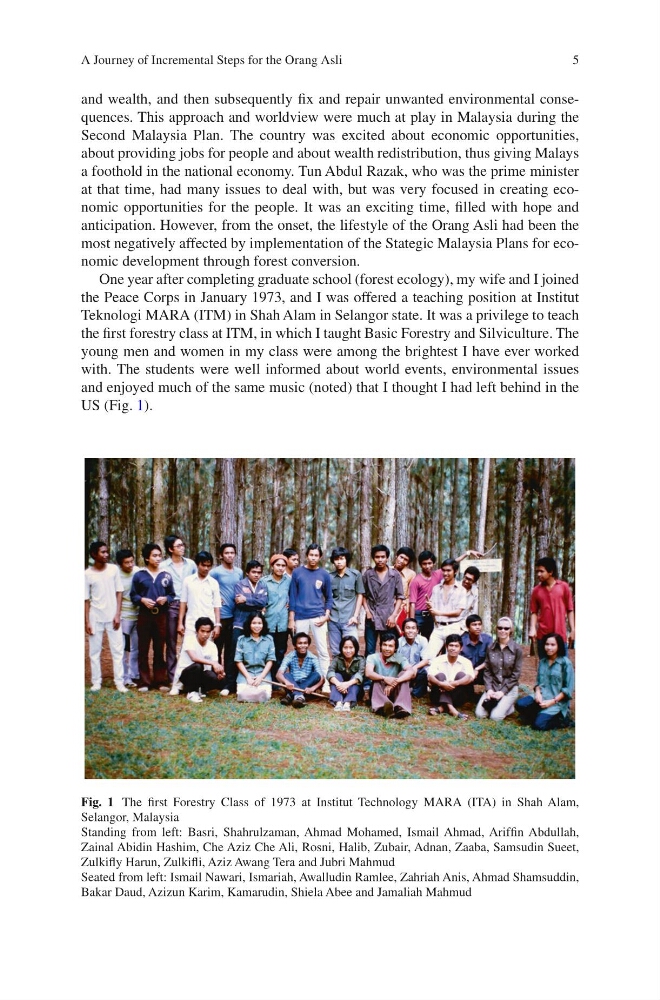
US (Fig. 1).
Fig. 1 The first Forestry Class of 1973 at Institut Technology MARA (ITA) in Shah Alam,
Selangor, Malaysia
Standing from left: Basri, Shahrulzaman, Ahmad Mohamed, Ismail Ahmad, Ariffin Abdullah,
Zainal Abidin Hashim, Che Aziz Che Ali, Rosni, Halib, Zubair, Adnan, Zaaba, Samsudin Sueet,
Zulkifly Harun, Zulkifli, Aziz Awang Tera and Jubri Mahmud
Seated from left: Ismail Nawari, Ismariah, Awalludin Ramlee, Zahriah Anis, Ahmad Shamsuddin,
Bakar Daud, Azizun Karim, Kamarudin, Shiela Abee and Jamaliah Mahmud
A Journey of Incremental Steps for the Orang Asli
and wealth, and then subsequently fix and repair unwanted environmental consequences. This approach and worldview were much at play in Malaysia during the
Second Malaysia Plan. The country was excited about economic opportunities,
about providing jobs for people and about wealth redistribution, thus giving Malays
a foothold in the national economy. Tun Abdul Razak, who was the prime minister
at that time, had many issues to deal with, but was very focused in creating economic opportunities for the people. It was an exciting time, filled with hope and
anticipation. However, from the onset, the lifestyle of the Orang Asli had been the
most negatively affected by implementation of the Stategic Malaysia Plans for economic development through forest conversion.
One year after completing graduate school (forest ecology), my wife and I joined
the Peace Corps in January 1973, and I was offered a teaching position at Institut
Teknologi MARA (ITM) in Shah Alam in Selangor state. It was a privilege to teach
the first forestry class at ITM, in which I taught Basic Forestry and Silviculture. The
young men and women in my class were among the brightest I have ever worked
with. The students were well informed about world events, environmental issues
and enjoyed much of the same music (noted) that I thought I had left behind in the
US (Fig. 1).
Fig. 1 The first Forestry Class of 1973 at Institut Technology MARA (ITA) in Shah Alam,
Selangor, Malaysia
Standing from left: Basri, Shahrulzaman, Ahmad Mohamed, Ismail Ahmad, Ariffin Abdullah,
Zainal Abidin Hashim, Che Aziz Che Ali, Rosni, Halib, Zubair, Adnan, Zaaba, Samsudin Sueet,
Zulkifly Harun, Zulkifli, Aziz Awang Tera and Jubri Mahmud
Seated from left: Ismail Nawari, Ismariah, Awalludin Ramlee, Zahriah Anis, Ahmad Shamsuddin,
Bakar Daud, Azizun Karim, Kamarudin, Shiela Abee and Jamaliah Mahmud
A Journey of Incremental Steps for the Orang Asli