

environmental laws that are now associated with natural resources management. In
general, there is at least one principal environmental law that has a major coordination role, and this law generally sets the rules and standards that many of the
individual pieces of legislation are obligated to follow in land, vegetation and
general environmental management.
50
Each individual jurisdiction has a number of primary environmental laws that
establish the standards, rules, policies, auditing and compliance responsibilities for
natural resources management (i.e. sustainable land management; ecologically sustainable development; integrated natural resource management; biodiversity
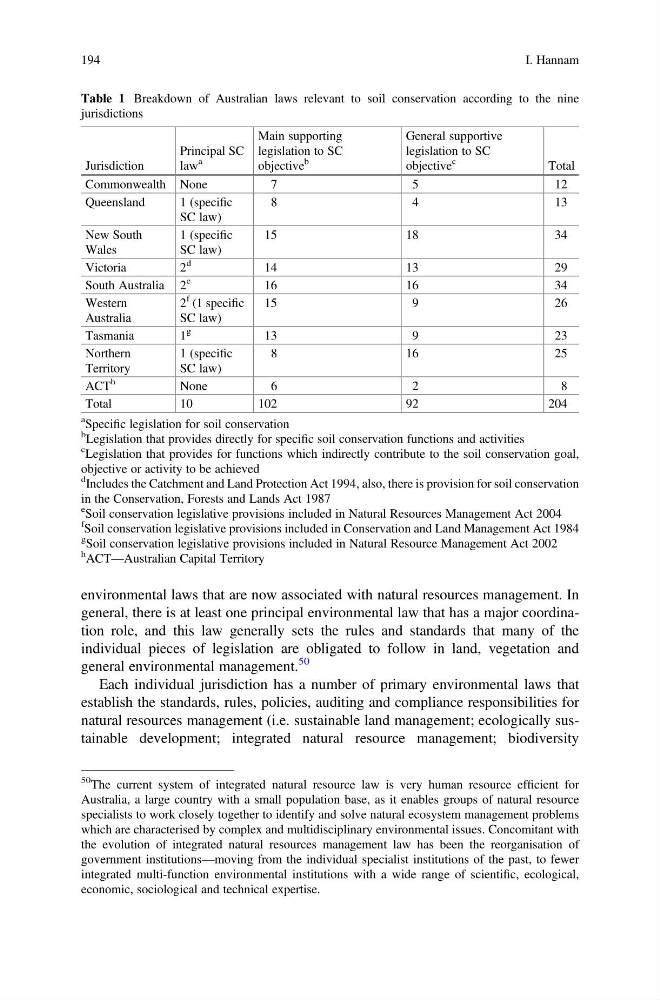
Table 1 Breakdown of Australian laws relevant to soil conservation according to the nine
jurisdictions
Jurisdiction
Principal SC
law
a
Main supporting
legislation to SC
objective
b
General supportive
legislation to SC
objective
c
Total
Commonwealth None
7
5
12
Queensland
1 (specific
SC law)
8
4
1 3
New South
Wales
1 (specific
SC law)
15
18
34
Victoria
2
d
14
13
29
South Australia 2
e
16
16
34
Western
Australia
2
f (1 specific
SC law)
15
9
26
Tasmania
1
g
13
9
23
Northern
Territory
1 (specific
SC law)
8
1 6
2 5
ACT
h
None
6
2
8
Total
10
102
92
204
a Specific legislation for soil conservation
b
Legislation that provides directly for specific soil conservation functions and activities
c Legislation that provides for functions which indirectly contribute to the soil conservation goal,
objective or activity to be achieved
d
Includes the Catchment and Land Protection Act 1994, also, there is provision for soil conservation
in the Conservation, Forests and Lands Act 1987
e Soil conservation legislative provisions included in Natural Resources Management Act 2004
f
Soil conservation legislative provisions included in Conservation and Land Management Act 1984
g
Soil conservation legislative provisions included in Natural Resource Management Act 2002
h
ACT—Australian Capital Territory
50 The current system of integrated natural resource law is very human resource efficient for
Australia, a large country with a small population base, as it enables groups of natural resource
specialists to work closely together to identify and solve natural ecosystem management problems
which are characterised by complex and multidisciplinary environmental issues. Concomitant with
the evolution of integrated natural resources management law has been the reorganisation of
government institutions—moving from the individual specialist institutions of the past, to fewer
integrated multi-function environmental institutions with a wide range of scientific, ecological,
economic, sociological and technical expertise.
194
I. Hannam
general, there is at least one principal environmental law that has a major coordination role, and this law generally sets the rules and standards that many of the
individual pieces of legislation are obligated to follow in land, vegetation and
general environmental management.
50
Each individual jurisdiction has a number of primary environmental laws that
establish the standards, rules, policies, auditing and compliance responsibilities for
natural resources management (i.e. sustainable land management; ecologically sustainable development; integrated natural resource management; biodiversity
Table 1 Breakdown of Australian laws relevant to soil conservation according to the nine
jurisdictions
Jurisdiction
Principal SC
law
a
Main supporting
legislation to SC
objective
b
General supportive
legislation to SC
objective
c
Total
Commonwealth None
7
5
12
Queensland
1 (specific
SC law)
8
4
1 3
New South
Wales
1 (specific
SC law)
15
18
34
Victoria
2
d
14
13
29
South Australia 2
e
16
16
34
Western
Australia
2
f (1 specific
SC law)
15
9
26
Tasmania
1
g
13
9
23
Northern
Territory
1 (specific
SC law)
8
1 6
2 5
ACT
h
None
6
2
8
Total
10
102
92
204
a Specific legislation for soil conservation
b
Legislation that provides directly for specific soil conservation functions and activities
c Legislation that provides for functions which indirectly contribute to the soil conservation goal,
objective or activity to be achieved
d
Includes the Catchment and Land Protection Act 1994, also, there is provision for soil conservation
in the Conservation, Forests and Lands Act 1987
e Soil conservation legislative provisions included in Natural Resources Management Act 2004
f
Soil conservation legislative provisions included in Conservation and Land Management Act 1984
g
Soil conservation legislative provisions included in Natural Resource Management Act 2002
h
ACT—Australian Capital Territory
50 The current system of integrated natural resource law is very human resource efficient for
Australia, a large country with a small population base, as it enables groups of natural resource
specialists to work closely together to identify and solve natural ecosystem management problems
which are characterised by complex and multidisciplinary environmental issues. Concomitant with
the evolution of integrated natural resources management law has been the reorganisation of
government institutions—moving from the individual specialist institutions of the past, to fewer
integrated multi-function environmental institutions with a wide range of scientific, ecological,
economic, sociological and technical expertise.
194
I. Hannam