

A Systems Approach to Ecotourism, Leisure and Education …
261
condition is necessary if society wants to succeed in achieving a culture for sustainable development that reaches out from its campus borders to businesses, organizations, institutions and people. Borsari and Vidrine (2005) focused their effort on the
preparation of agricultural students with curricula that aimed at making them better
stewards of resources when they are employed in food production. The fragility of
tropical environments requires farming approaches that are inclusive of sustainable
practices, as deforestation through clear-cutting leads rapidly to soil loss and desertification in these and similar environments (Borsari 2020). Therefore, an addition of
hands-on workshops about themes related to soil, water conservation and agrobiodiversity became effective, educational efforts for farmers and students (Borsari et al.
2016). We thought this model of instruction could enrich programs already available
at BFI for the benefit of more students and farmers, in this western region of Panamá,
and introduce them to agroecology (Guerra and Dufau 2015). OTEIMA Technological University and its field station (BFI) strive at becoming a premier research and
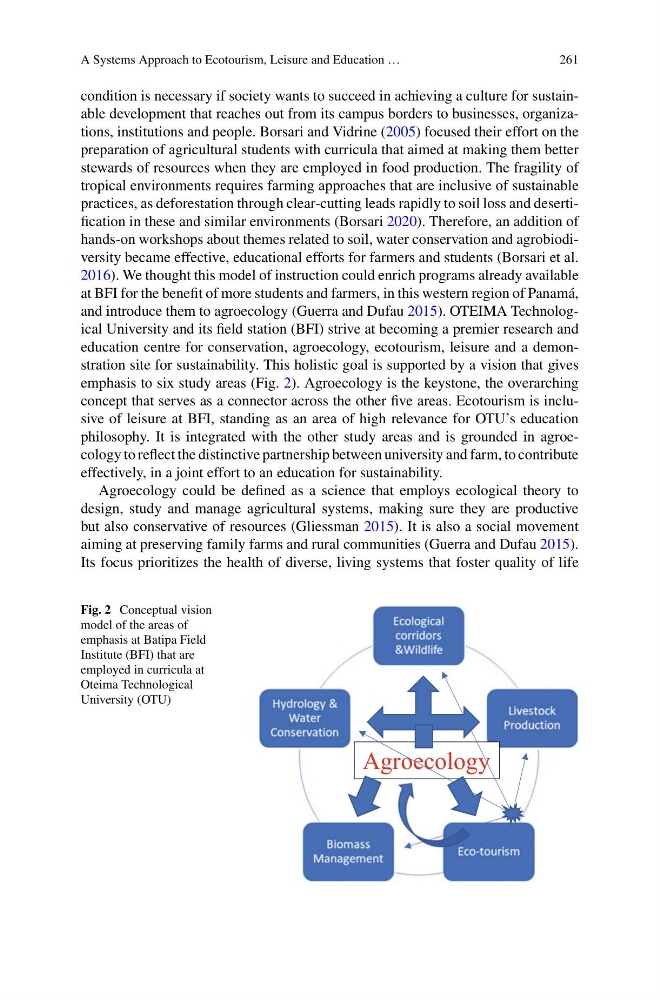
education centre for conservation, agroecology, ecotourism, leisure and a demonstration site for sustainability. This holistic goal is supported by a vision that gives
emphasis to six study areas (Fig. 2). Agroecology is the keystone, the overarching
concept that serves as a connector across the other five areas. Ecotourism is inclusive of leisure at BFI, standing as an area of high relevance for OTU’s education
philosophy. It is integrated with the other study areas and is grounded in agroecology to reflect the distinctive partnership between university and farm, to contribute
effectively, in a joint effort to an education for sustainability.
Agroecology could be defined as a science that employs ecological theory to
design, study and manage agricultural systems, making sure they are productive
but also conservative of resources (Gliessman 2015). It is also a social movement
aiming at preserving family farms and rural communities (Guerra and Dufau 2015).
Its focus prioritizes the health of diverse, living systems that foster quality of life
Fig. 2 Conceptual vision
model of the areas of
emphasis at Batipa Field
Institute (BFI) that are
employed in curricula at
Oteima Technological
University (OTU)
Agroecology
261
condition is necessary if society wants to succeed in achieving a culture for sustainable development that reaches out from its campus borders to businesses, organizations, institutions and people. Borsari and Vidrine (2005) focused their effort on the
preparation of agricultural students with curricula that aimed at making them better
stewards of resources when they are employed in food production. The fragility of
tropical environments requires farming approaches that are inclusive of sustainable
practices, as deforestation through clear-cutting leads rapidly to soil loss and desertification in these and similar environments (Borsari 2020). Therefore, an addition of
hands-on workshops about themes related to soil, water conservation and agrobiodiversity became effective, educational efforts for farmers and students (Borsari et al.
2016). We thought this model of instruction could enrich programs already available
at BFI for the benefit of more students and farmers, in this western region of Panamá,
and introduce them to agroecology (Guerra and Dufau 2015). OTEIMA Technological University and its field station (BFI) strive at becoming a premier research and
education centre for conservation, agroecology, ecotourism, leisure and a demonstration site for sustainability. This holistic goal is supported by a vision that gives
emphasis to six study areas (Fig. 2). Agroecology is the keystone, the overarching
concept that serves as a connector across the other five areas. Ecotourism is inclusive of leisure at BFI, standing as an area of high relevance for OTU’s education
philosophy. It is integrated with the other study areas and is grounded in agroecology to reflect the distinctive partnership between university and farm, to contribute
effectively, in a joint effort to an education for sustainability.
Agroecology could be defined as a science that employs ecological theory to
design, study and manage agricultural systems, making sure they are productive
but also conservative of resources (Gliessman 2015). It is also a social movement
aiming at preserving family farms and rural communities (Guerra and Dufau 2015).
Its focus prioritizes the health of diverse, living systems that foster quality of life
Fig. 2 Conceptual vision
model of the areas of
emphasis at Batipa Field
Institute (BFI) that are
employed in curricula at
Oteima Technological
University (OTU)
Agroecology