

176
D. Gatari´ c and B. M. Ðerˇ can
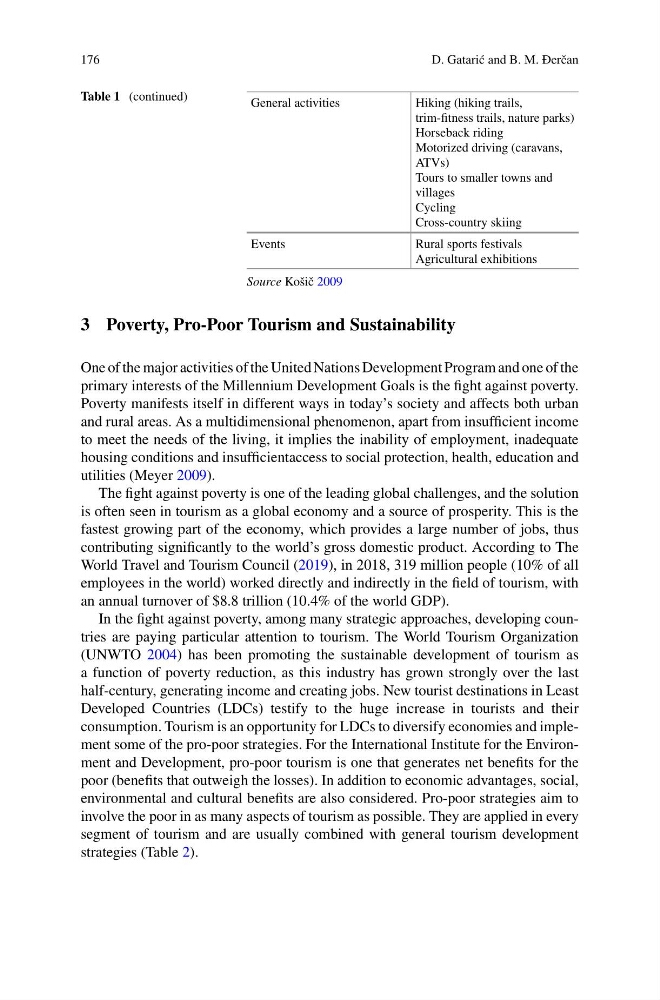
Table 1 (continued)
General activities
Hiking (hiking trails,
trim-fitness trails, nature parks)
Horseback riding
Motorized driving (caravans,
ATVs)
Tours to smaller towns and
villages
Cycling
Cross-country skiing
Events
Rural sports festivals
Agricultural exhibitions
Source Košiˇ c 2009
3 Poverty, Pro-Poor Tourism and Sustainability
One of the major activities of the United Nations Development Program and one of the
primary interests of the Millennium Development Goals is the fight against poverty.
Poverty manifests itself in different ways in today’s society and affects both urban
and rural areas. As a multidimensional phenomenon, apart from insufficient income
to meet the needs of the living, it implies the inability of employment, inadequate
housing conditions and insufficientaccess to social protection, health, education and
utilities (Meyer 2009).
The fight against poverty is one of the leading global challenges, and the solution
is often seen in tourism as a global economy and a source of prosperity. This is the
fastest growing part of the economy, which provides a large number of jobs, thus
contributing significantly to the world’s gross domestic product. According to The
World Travel and Tourism Council (2019), in 2018, 319 million people (10% of all
employees in the world) worked directly and indirectly in the field of tourism, with
an annual turnover of $8.8 trillion (10.4% of the world GDP).
In the fight against poverty, among many strategic approaches, developing countries are paying particular attention to tourism. The World Tourism Organization
(UNWTO 2004) has been promoting the sustainable development of tourism as
a function of poverty reduction, as this industry has grown strongly over the last
half-century, generating income and creating jobs. New tourist destinations in Least
Developed Countries (LDCs) testify to the huge increase in tourists and their
consumption. Tourism is an opportunity for LDCs to diversify economies and implement some of the pro-poor strategies. For the International Institute for the Environment and Development, pro-poor tourism is one that generates net benefits for the
poor (benefits that outweigh the losses). In addition to economic advantages, social,
environmental and cultural benefits are also considered. Pro-poor strategies aim to
involve the poor in as many aspects of tourism as possible. They are applied in every
segment of tourism and are usually combined with general tourism development
strategies (Table 2).
D. Gatari´ c and B. M. Ðerˇ can
Table 1 (continued)
General activities
Hiking (hiking trails,
trim-fitness trails, nature parks)
Horseback riding
Motorized driving (caravans,
ATVs)
Tours to smaller towns and
villages
Cycling
Cross-country skiing
Events
Rural sports festivals
Agricultural exhibitions
Source Košiˇ c 2009
3 Poverty, Pro-Poor Tourism and Sustainability
One of the major activities of the United Nations Development Program and one of the
primary interests of the Millennium Development Goals is the fight against poverty.
Poverty manifests itself in different ways in today’s society and affects both urban
and rural areas. As a multidimensional phenomenon, apart from insufficient income
to meet the needs of the living, it implies the inability of employment, inadequate
housing conditions and insufficientaccess to social protection, health, education and
utilities (Meyer 2009).
The fight against poverty is one of the leading global challenges, and the solution
is often seen in tourism as a global economy and a source of prosperity. This is the
fastest growing part of the economy, which provides a large number of jobs, thus
contributing significantly to the world’s gross domestic product. According to The
World Travel and Tourism Council (2019), in 2018, 319 million people (10% of all
employees in the world) worked directly and indirectly in the field of tourism, with
an annual turnover of $8.8 trillion (10.4% of the world GDP).
In the fight against poverty, among many strategic approaches, developing countries are paying particular attention to tourism. The World Tourism Organization
(UNWTO 2004) has been promoting the sustainable development of tourism as
a function of poverty reduction, as this industry has grown strongly over the last
half-century, generating income and creating jobs. New tourist destinations in Least
Developed Countries (LDCs) testify to the huge increase in tourists and their
consumption. Tourism is an opportunity for LDCs to diversify economies and implement some of the pro-poor strategies. For the International Institute for the Environment and Development, pro-poor tourism is one that generates net benefits for the
poor (benefits that outweigh the losses). In addition to economic advantages, social,
environmental and cultural benefits are also considered. Pro-poor strategies aim to
involve the poor in as many aspects of tourism as possible. They are applied in every
segment of tourism and are usually combined with general tourism development
strategies (Table 2).