

Rural Community Prosperity Versus Tourism Progress …
113
of community-based tourism (Nickerson et al. 2001), which relies on the urban residents’ need for outdoor space for recreation and peace. Community-based tourism
refers mainly to products and services, which are directly associated with the countryside, local culture, food, and non-material goods. Such offerings involve community
support through staying in their rural environment, recreational activities, educational visits and selling agricultural and homemade products (Sznajder et al. 2009).
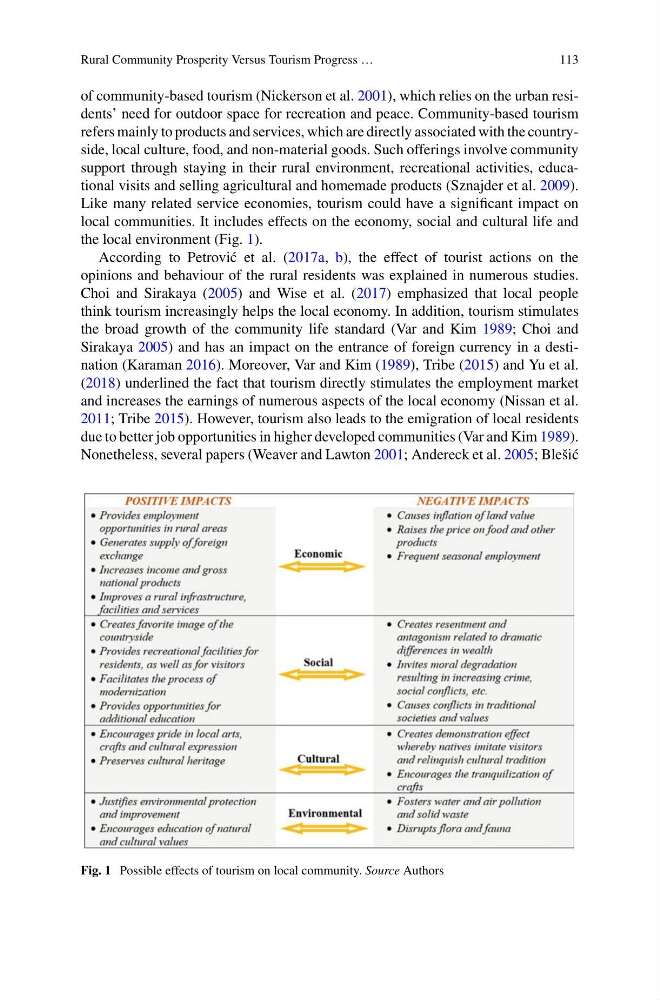
Like many related service economies, tourism could have a significant impact on
local communities. It includes effects on the economy, social and cultural life and
the local environment (Fig. 1).
According to Petrovi´ c et al. (2017a, b), the effect of tourist actions on the
opinions and behaviour of the rural residents was explained in numerous studies.
Choi and Sirakaya (2005) and Wise et al. (2017) emphasized that local people
think tourism increasingly helps the local economy. In addition, tourism stimulates
the broad growth of the community life standard (Var and Kim 1989; Choi and
Sirakaya 2005) and has an impact on the entrance of foreign currency in a destination (Karaman 2016). Moreover, Var and Kim (1989), Tribe (2015) and Yu et al.
(2018) underlined the fact that tourism directly stimulates the employment market
and increases the earnings of numerous aspects of the local economy (Nissan et al.
2011; Tribe 2015). However, tourism also leads to the emigration of local residents
due to better job opportunities in higher developed communities (Var and Kim 1989).
Nonetheless, several papers (Weaver and Lawton 2001; Andereck et al. 2005; Bleši´ c
Fig. 1 Possible effects of tourism on local community. Source Authors
113
of community-based tourism (Nickerson et al. 2001), which relies on the urban residents’ need for outdoor space for recreation and peace. Community-based tourism
refers mainly to products and services, which are directly associated with the countryside, local culture, food, and non-material goods. Such offerings involve community
support through staying in their rural environment, recreational activities, educational visits and selling agricultural and homemade products (Sznajder et al. 2009).
Like many related service economies, tourism could have a significant impact on
local communities. It includes effects on the economy, social and cultural life and
the local environment (Fig. 1).
According to Petrovi´ c et al. (2017a, b), the effect of tourist actions on the
opinions and behaviour of the rural residents was explained in numerous studies.
Choi and Sirakaya (2005) and Wise et al. (2017) emphasized that local people
think tourism increasingly helps the local economy. In addition, tourism stimulates
the broad growth of the community life standard (Var and Kim 1989; Choi and
Sirakaya 2005) and has an impact on the entrance of foreign currency in a destination (Karaman 2016). Moreover, Var and Kim (1989), Tribe (2015) and Yu et al.
(2018) underlined the fact that tourism directly stimulates the employment market
and increases the earnings of numerous aspects of the local economy (Nissan et al.
2011; Tribe 2015). However, tourism also leads to the emigration of local residents
due to better job opportunities in higher developed communities (Var and Kim 1989).
Nonetheless, several papers (Weaver and Lawton 2001; Andereck et al. 2005; Bleši´ c
Fig. 1 Possible effects of tourism on local community. Source Authors