

66 Basic Seismological Theory
Wave fronts
k 1
i 1
i 2
z
x
Pay paths
i 2
i 1
k 2
Incident
P
i 1
i 1 SV
P
Reflected
j 1
SV
P
j 2
i 2
Transmitted
(refracted)
1 ,
α
1 ,
β
2 ,
α
2 ,
β
Incident
SV
i 1 SV
P
Reflected
j 1
SV
P
j 2
i 2
Transmitted
(refracted)
1 ,
α
1 ,
β
2 ,
α
2 ,
β
j 1
x
z
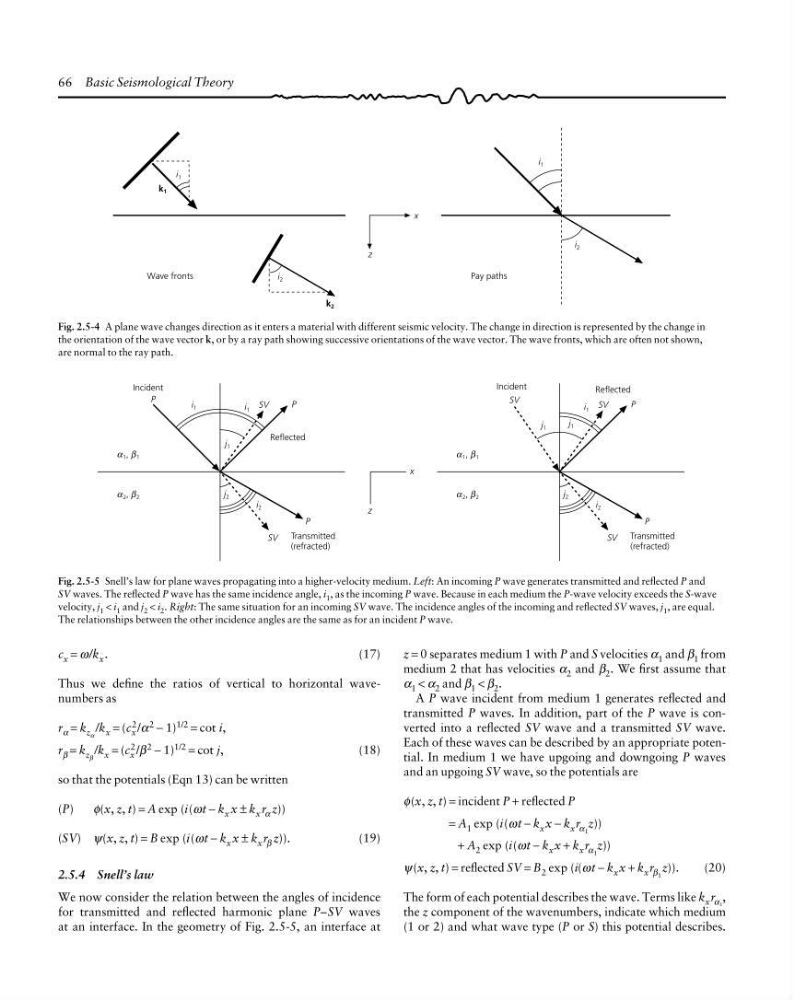
Fig. 2.5-4 A plane wave changes direction as it enters a material with different seismic velocity. The change in direction is represented by the change in
the orientation of the wave vector k, or by a ray path showing successive orientations of the wave vector. The wave fronts, which are often not shown,
are normal to the ray path.
Fig. 2.5-5 Snell’s law for plane waves propagating into a higher-velocity medium. Left: An incoming P wave generates transmitted and reflected P and
SV waves. The reflected P wave has the same incidence angle, i 1 , as the incoming P wave. Because in each medium the P-wave velocity exceeds the S-wave
velocity, j 1 < i 1 and j 2 < i 2 . Right: The same situation for an incoming SV wave. The incidence angles of the incoming and reflected SV waves, j 1 , are equal.
The relationships between the other incidence angles are the same as for an incident P wave.
c x = ω/k x .
(17)
Thus we define the ratios of vertical to horizontal wavenumbers as
r α = k z α /k x = (c x
2 /α 2 − 1) 1/2 = cot i,
r β = k z β /k x = (c x
2 /β 2 − 1) 1/2 = cot j,
(18)
so that the potentials (Eqn 13) can be written
(P)
φ(x, z, t) = A exp (i(ωt − k x x ± k x r α z))
(SV) ψ(x, z, t) = B exp (i(ωt − k x x ± k x r β z)).
(19)
2.5.4 Snell’s law
We now consider the relation between the angles of incidence
for transmitted and reflected harmonic plane P–SV waves
at an interface. In the geometry of Fig. 2.5-5, an interface at
z = 0 separates medium 1 with P and S velocities α 1 and β 1 from
medium 2 that has velocities α 2 and β 2 . We first assume that
α 1 < α 2 and β 1 < β 2 .
A P wave incident from medium 1 generates reflected and
transmitted P waves. In addition, part of the P wave is converted into a reflected SV wave and a transmitted SV wave.
Each of these waves can be described by an appropriate potential. In medium 1 we have upgoing and downgoing P waves
and an upgoing SV wave, so the potentials are
φ(x, z, t) = incident P + reflected P
= A 1 exp (i(ωt − k x x − k x r α 1 z))
+ A 2 exp (i(ωt − k x x + k x r α 1 z))
ψ (x, z, t) = reflected SV = B 2 exp (i(ωt − k x x + k x r β 1 z)).
(20)
The form of each potential describes the wave. Terms like k x r α 1 ,
the z component of the wavenumbers, indicate which medium
(1 or 2) and what wave type (P or S) this potential describes.
Wave fronts
k 1
i 1
i 2
z
x
Pay paths
i 2
i 1
k 2
Incident
P
i 1
i 1 SV
P
Reflected
j 1
SV
P
j 2
i 2
Transmitted
(refracted)
1 ,
α
1 ,
β
2 ,
α
2 ,
β
Incident
SV
i 1 SV
P
Reflected
j 1
SV
P
j 2
i 2
Transmitted
(refracted)
1 ,
α
1 ,
β
2 ,
α
2 ,
β
j 1
x
z
Fig. 2.5-4 A plane wave changes direction as it enters a material with different seismic velocity. The change in direction is represented by the change in
the orientation of the wave vector k, or by a ray path showing successive orientations of the wave vector. The wave fronts, which are often not shown,
are normal to the ray path.
Fig. 2.5-5 Snell’s law for plane waves propagating into a higher-velocity medium. Left: An incoming P wave generates transmitted and reflected P and
SV waves. The reflected P wave has the same incidence angle, i 1 , as the incoming P wave. Because in each medium the P-wave velocity exceeds the S-wave
velocity, j 1 < i 1 and j 2 < i 2 . Right: The same situation for an incoming SV wave. The incidence angles of the incoming and reflected SV waves, j 1 , are equal.
The relationships between the other incidence angles are the same as for an incident P wave.
c x = ω/k x .
(17)
Thus we define the ratios of vertical to horizontal wavenumbers as
r α = k z α /k x = (c x
2 /α 2 − 1) 1/2 = cot i,
r β = k z β /k x = (c x
2 /β 2 − 1) 1/2 = cot j,
(18)
so that the potentials (Eqn 13) can be written
(P)
φ(x, z, t) = A exp (i(ωt − k x x ± k x r α z))
(SV) ψ(x, z, t) = B exp (i(ωt − k x x ± k x r β z)).
(19)
2.5.4 Snell’s law
We now consider the relation between the angles of incidence
for transmitted and reflected harmonic plane P–SV waves
at an interface. In the geometry of Fig. 2.5-5, an interface at
z = 0 separates medium 1 with P and S velocities α 1 and β 1 from
medium 2 that has velocities α 2 and β 2 . We first assume that
α 1 < α 2 and β 1 < β 2 .
A P wave incident from medium 1 generates reflected and
transmitted P waves. In addition, part of the P wave is converted into a reflected SV wave and a transmitted SV wave.
Each of these waves can be described by an appropriate potential. In medium 1 we have upgoing and downgoing P waves
and an upgoing SV wave, so the potentials are
φ(x, z, t) = incident P + reflected P
= A 1 exp (i(ωt − k x x − k x r α 1 z))
+ A 2 exp (i(ωt − k x x + k x r α 1 z))
ψ (x, z, t) = reflected SV = B 2 exp (i(ωt − k x x + k x r β 1 z)).
(20)
The form of each potential describes the wave. Terms like k x r α 1 ,
the z component of the wavenumbers, indicate which medium
(1 or 2) and what wave type (P or S) this potential describes.