

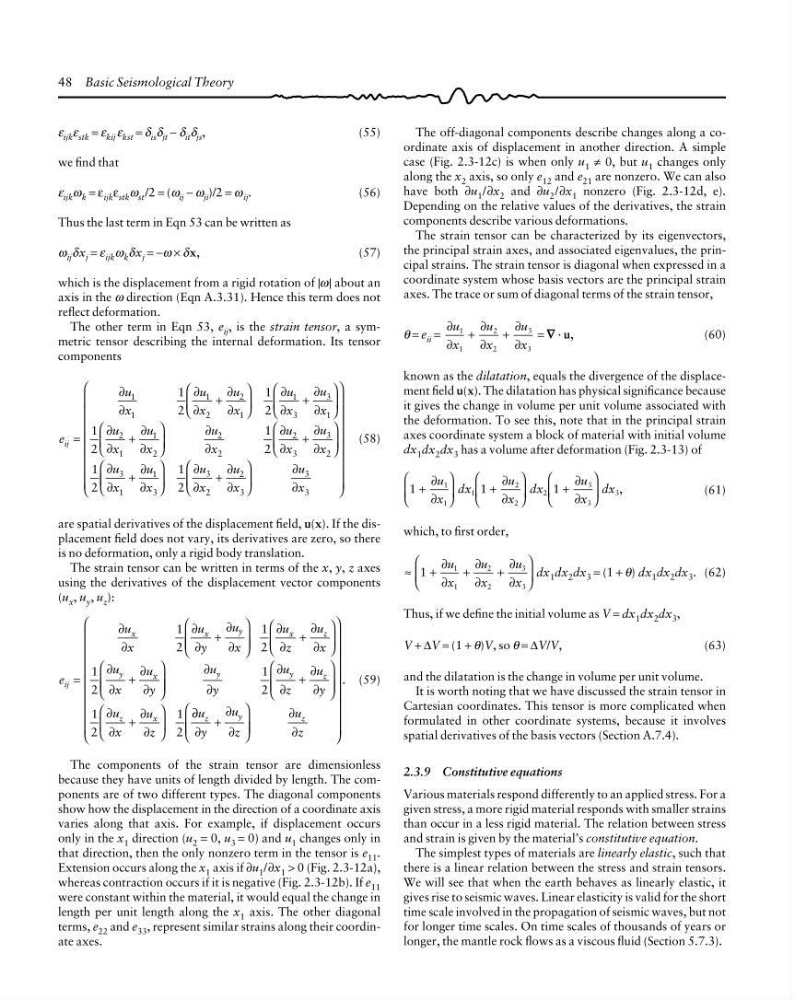
48 Basic Seismological Theory
The off-diagonal components describe changes along a coordinate axis of displacement in another direction. A simple
case (Fig. 2.3-12c) is when only u 1 ≠ 0, but u 1 changes only
along the x 2 axis, so only e 12 and e 21 are nonzero. We can also
have both ∂u 1 /∂x 2 and ∂u 2 /∂x 1 nonzero (Fig. 2.3-12d, e).
Depending on the relative values of the derivatives, the strain
components describe various deformations.
The strain tensor can be characterized by its eigenvectors,
the principal strain axes, and associated eigenvalues, the principal strains. The strain tensor is diagonal when expressed in a
coordinate system whose basis vectors are the principal strain
axes. The trace or sum of diagonal terms of the strain tensor,
θ = e ii =
∂
∂
∂
∂
∂
∂
u
x
u
x
u
x
1
1
2
2
3
3
+
+
= ∇
∇ ∇
∇ ∇ · u,
(60)
known as the dilatation, equals the divergence of the displacement field u(x). The dilatation has physical significance because
it gives the change in volume per unit volume associated with
the deformation. To see this, note that in the principal strain
axes coordinate system a block of material with initial volume
dx 1 dx 2 dx 3 has a volume after deformation (Fig. 2.3-13) of
1
1
1
1
1
1
2
2
2
3
3
3 ,
+
⎛
⎝
⎜
⎞
⎠
⎟
+
⎛
⎝
⎜
⎞
⎠
⎟
+
⎛
⎝
⎜
⎞
⎠
⎟
∂
∂
∂
∂
∂
∂
u
x
dx
u
x
dx
u
x
dx
(61)
which, to first order,
≈ +
+
+
⎛
⎝
⎜
⎞
⎠
⎟
1
1
1
2
2
3
3
∂
∂
∂
∂
∂
∂
u
x
u
x
u
x
dx 1 dx 2 dx 3 = (1 + θ) dx 1 dx 2 dx 3 . (62)
Thus, if we define the initial volume as V = dx 1 dx 2 dx 3 ,
V + ∆V = (1 + θ)V, so θ = ∆V/V,
(63)
and the dilatation is the change in volume per unit volume.
It is worth noting that we have discussed the strain tensor in
Cartesian coordinates. This tensor is more complicated when
formulated in other coordinate systems, because it involves
spatial derivatives of the basis vectors (Section A.7.4).
2.3.9 Constitutive equations
Various materials respond differently to an applied stress. For a
given stress, a more rigid material responds with smaller strains
than occur in a less rigid material. The relation between stress
and strain is given by the material’s constitutive equation.
The simplest types of materials are linearly elastic, such that
there is a linear relation between the stress and strain tensors.
We will see that when the earth behaves as linearly elastic, it
gives rise to seismic waves. Linear elasticity is valid for the short
time scale involved in the propagation of seismic waves, but not
for longer time scales. On time scales of thousands of years or
longer, the mantle rock flows as a viscous fluid (Section 5.7.3).
ε ijk ε stk = ε kij ε kst = δ is δ jt − δ it δ js ,
(55)
we find that
ε ijk ω k = ε ijk ε stk ω st /2 = (ω ij − ω ji )/2 = ω ij .
(56)
Thus the last term in Eqn 53 can be written as
ω ij δx j = ε ijk ω k δx j = −ω × δx,
(57)
which is the displacement from a rigid rotation of |ω| about an
axis in the ω direction (Eqn A.3.31). Hence this term does not
reflect deformation.
The other term in Eqn 53, e ij , is the strain tensor, a symmetric tensor describing the internal deformation. Its tensor
components
e
u
x
u
x
u
x
u
x
u
x
u
x
u
x
u
x
u
x
u
x
u
x
u
x
ij =
+
⎛
⎝
⎜
⎞
⎠
⎟
+
⎛
⎝
⎜
⎞
⎠
⎟
+
⎛
⎝
⎜
⎞
⎠
⎟
+
⎛
⎝
⎜
⎞
⎠
⎟
+
⎛
⎝
∂
∂
∂
∂
∂
∂
∂
∂
∂
∂
∂
∂
∂
∂
∂
∂
∂
∂
∂
∂
∂
∂
∂
∂
1
1
1
2
2
1
1
3
3
1
2
1
1
2
2
2
2
3
3
2
3
1
1
3
1
2
1
2
1
2
1
2
1
2
⎜ ⎜
⎞
⎠
⎟
+
⎛
⎝
⎜
⎞
⎠
⎟
⎛
⎝
⎜
⎜
⎜
⎜
⎜
⎜
⎜
⎜
⎞
⎠
⎟
⎟
⎟
⎟
⎟
⎟
⎟
⎟
1
2
3
2
2
3
3
3
∂
∂
∂
∂
∂
∂
u
x
u
x
u
x
(58)
are spatial derivatives of the displacement field, u(x). If the displacement field does not vary, its derivatives are zero, so there
is no deformation, only a rigid body translation.
The strain tensor can be written in terms of the x, y, z axes
using the derivatives of the displacement vector components
(u x , u y , u z ):
e
u
x
u
y
u
x
u
z
u
x
u
x
u
y
u
y
u
z
u
y
u
x
u
z
ij
x
x
y
x
z
y
x
y
y
z
z
x
=
+
⎛
⎝
⎜ ⎜
⎞
⎠
⎟ ⎟
+
⎛
⎝
⎜
⎞
⎠
⎟
+
⎛
⎝
⎜ ⎜
⎞
⎠
⎟ ⎟
+
⎛
⎝
⎜ ⎜
⎞
⎠
⎟ ⎟
+
⎛
⎝
⎜
⎞
⎠
⎟
∂
∂
∂
∂
∂
∂
∂
∂
∂
∂
∂
∂
∂
∂
∂
∂
∂
∂
∂
∂
∂
∂
∂
∂
1
2
1
2
1
2
1
2
1
2
1
2
∂ ∂
∂
∂
∂
∂
∂
u
y
u
z
u
z
z
y
z
+
⎛
⎝
⎜ ⎜
⎞
⎠
⎟ ⎟
⎛
⎝
⎜
⎜
⎜
⎜
⎜
⎜
⎜
⎜
⎜
⎞
⎠
⎟
⎟
⎟
⎟
⎟
⎟
⎟
⎟
⎟
. (59)
The components of the strain tensor are dimensionless
because they have units of length divided by length. The components are of two different types. The diagonal components
show how the displacement in the direction of a coordinate axis
varies along that axis. For example, if displacement occurs
only in the x 1 direction (u 2 = 0, u 3 = 0) and u 1 changes only in
that direction, then the only nonzero term in the tensor is e 11 .
Extension occurs along the x 1 axis if ∂u 1 /∂x 1 > 0 (Fig. 2.3-12a),
whereas contraction occurs if it is negative (Fig. 2.3-12b). If e 11
were constant within the material, it would equal the change in
length per unit length along the x 1 axis. The other diagonal
terms, e 22 and e 33 , represent similar strains along their coordinate axes.
The off-diagonal components describe changes along a coordinate axis of displacement in another direction. A simple
case (Fig. 2.3-12c) is when only u 1 ≠ 0, but u 1 changes only
along the x 2 axis, so only e 12 and e 21 are nonzero. We can also
have both ∂u 1 /∂x 2 and ∂u 2 /∂x 1 nonzero (Fig. 2.3-12d, e).
Depending on the relative values of the derivatives, the strain
components describe various deformations.
The strain tensor can be characterized by its eigenvectors,
the principal strain axes, and associated eigenvalues, the principal strains. The strain tensor is diagonal when expressed in a
coordinate system whose basis vectors are the principal strain
axes. The trace or sum of diagonal terms of the strain tensor,
θ = e ii =
∂
∂
∂
∂
∂
∂
u
x
u
x
u
x
1
1
2
2
3
3
+
+
= ∇
∇ ∇
∇ ∇ · u,
(60)
known as the dilatation, equals the divergence of the displacement field u(x). The dilatation has physical significance because
it gives the change in volume per unit volume associated with
the deformation. To see this, note that in the principal strain
axes coordinate system a block of material with initial volume
dx 1 dx 2 dx 3 has a volume after deformation (Fig. 2.3-13) of
1
1
1
1
1
1
2
2
2
3
3
3 ,
+
⎛
⎝
⎜
⎞
⎠
⎟
+
⎛
⎝
⎜
⎞
⎠
⎟
+
⎛
⎝
⎜
⎞
⎠
⎟
∂
∂
∂
∂
∂
∂
u
x
dx
u
x
dx
u
x
dx
(61)
which, to first order,
≈ +
+
+
⎛
⎝
⎜
⎞
⎠
⎟
1
1
1
2
2
3
3
∂
∂
∂
∂
∂
∂
u
x
u
x
u
x
dx 1 dx 2 dx 3 = (1 + θ) dx 1 dx 2 dx 3 . (62)
Thus, if we define the initial volume as V = dx 1 dx 2 dx 3 ,
V + ∆V = (1 + θ)V, so θ = ∆V/V,
(63)
and the dilatation is the change in volume per unit volume.
It is worth noting that we have discussed the strain tensor in
Cartesian coordinates. This tensor is more complicated when
formulated in other coordinate systems, because it involves
spatial derivatives of the basis vectors (Section A.7.4).
2.3.9 Constitutive equations
Various materials respond differently to an applied stress. For a
given stress, a more rigid material responds with smaller strains
than occur in a less rigid material. The relation between stress
and strain is given by the material’s constitutive equation.
The simplest types of materials are linearly elastic, such that
there is a linear relation between the stress and strain tensors.
We will see that when the earth behaves as linearly elastic, it
gives rise to seismic waves. Linear elasticity is valid for the short
time scale involved in the propagation of seismic waves, but not
for longer time scales. On time scales of thousands of years or
longer, the mantle rock flows as a viscous fluid (Section 5.7.3).
ε ijk ε stk = ε kij ε kst = δ is δ jt − δ it δ js ,
(55)
we find that
ε ijk ω k = ε ijk ε stk ω st /2 = (ω ij − ω ji )/2 = ω ij .
(56)
Thus the last term in Eqn 53 can be written as
ω ij δx j = ε ijk ω k δx j = −ω × δx,
(57)
which is the displacement from a rigid rotation of |ω| about an
axis in the ω direction (Eqn A.3.31). Hence this term does not
reflect deformation.
The other term in Eqn 53, e ij , is the strain tensor, a symmetric tensor describing the internal deformation. Its tensor
components
e
u
x
u
x
u
x
u
x
u
x
u
x
u
x
u
x
u
x
u
x
u
x
u
x
ij =
+
⎛
⎝
⎜
⎞
⎠
⎟
+
⎛
⎝
⎜
⎞
⎠
⎟
+
⎛
⎝
⎜
⎞
⎠
⎟
+
⎛
⎝
⎜
⎞
⎠
⎟
+
⎛
⎝
∂
∂
∂
∂
∂
∂
∂
∂
∂
∂
∂
∂
∂
∂
∂
∂
∂
∂
∂
∂
∂
∂
∂
∂
1
1
1
2
2
1
1
3
3
1
2
1
1
2
2
2
2
3
3
2
3
1
1
3
1
2
1
2
1
2
1
2
1
2
⎜ ⎜
⎞
⎠
⎟
+
⎛
⎝
⎜
⎞
⎠
⎟
⎛
⎝
⎜
⎜
⎜
⎜
⎜
⎜
⎜
⎜
⎞
⎠
⎟
⎟
⎟
⎟
⎟
⎟
⎟
⎟
1
2
3
2
2
3
3
3
∂
∂
∂
∂
∂
∂
u
x
u
x
u
x
(58)
are spatial derivatives of the displacement field, u(x). If the displacement field does not vary, its derivatives are zero, so there
is no deformation, only a rigid body translation.
The strain tensor can be written in terms of the x, y, z axes
using the derivatives of the displacement vector components
(u x , u y , u z ):
e
u
x
u
y
u
x
u
z
u
x
u
x
u
y
u
y
u
z
u
y
u
x
u
z
ij
x
x
y
x
z
y
x
y
y
z
z
x
=
+
⎛
⎝
⎜ ⎜
⎞
⎠
⎟ ⎟
+
⎛
⎝
⎜
⎞
⎠
⎟
+
⎛
⎝
⎜ ⎜
⎞
⎠
⎟ ⎟
+
⎛
⎝
⎜ ⎜
⎞
⎠
⎟ ⎟
+
⎛
⎝
⎜
⎞
⎠
⎟
∂
∂
∂
∂
∂
∂
∂
∂
∂
∂
∂
∂
∂
∂
∂
∂
∂
∂
∂
∂
∂
∂
∂
∂
1
2
1
2
1
2
1
2
1
2
1
2
∂ ∂
∂
∂
∂
∂
∂
u
y
u
z
u
z
z
y
z
+
⎛
⎝
⎜ ⎜
⎞
⎠
⎟ ⎟
⎛
⎝
⎜
⎜
⎜
⎜
⎜
⎜
⎜
⎜
⎜
⎞
⎠
⎟
⎟
⎟
⎟
⎟
⎟
⎟
⎟
⎟
. (59)
The components of the strain tensor are dimensionless
because they have units of length divided by length. The components are of two different types. The diagonal components
show how the displacement in the direction of a coordinate axis
varies along that axis. For example, if displacement occurs
only in the x 1 direction (u 2 = 0, u 3 = 0) and u 1 changes only in
that direction, then the only nonzero term in the tensor is e 11 .
Extension occurs along the x 1 axis if ∂u 1 /∂x 1 > 0 (Fig. 2.3-12a),
whereas contraction occurs if it is negative (Fig. 2.3-12b). If e 11
were constant within the material, it would equal the change in
length per unit length along the x 1 axis. The other diagonal
terms, e 22 and e 33 , represent similar strains along their coordinate axes.