

46 Basic Seismological Theory
x 3
x 2
x 1
22
σ
dx 2
12
σ
32
σ
d x1
dx 3
12 +
dx 1
σ
∂ 12
σ
∂x 1
22 +
dx 2
σ
∂ 22
σ
∂x 2
32 +
dx 3
σ
∂ 32
σ
∂x 3
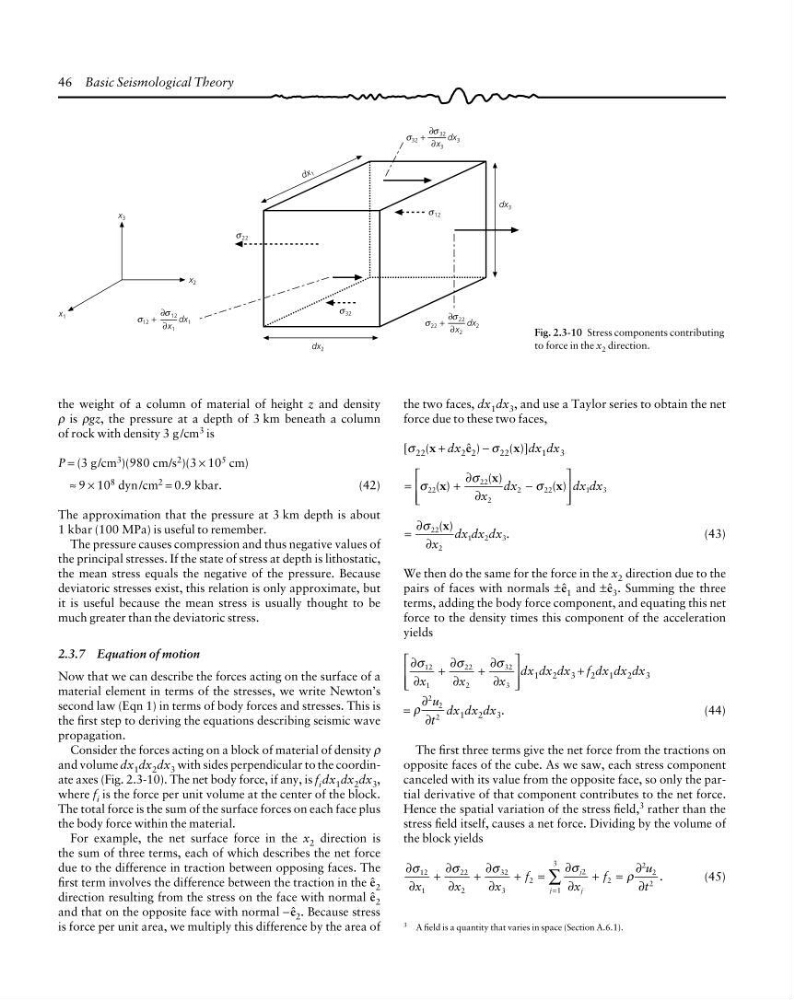
Fig. 2.3-10 Stress components contributing
to force in the x 2 direction.
3 A field is a quantity that varies in space (Section A.6.1).
the two faces, dx 1 dx 3 , and use a Taylor series to obtain the net
force due to these two faces,
[σ 22 (x + dx 2 ê 2 ) − σ 22 (x)]dx 1 dx 3
=
+
−
⎡
⎣
⎢
⎢
⎤
⎦
⎥
⎥
( )
( )
( )
σ
σ
σ
22
22
2
2
2 2
1
3
x
x
x
∂
∂x
dx
dx dx
=
( )
.
∂
∂
σ 22
2
1
2
3
x
x
dx dx dx
(43)
We then do the same for the force in the x 2 direction due to the
pairs of faces with normals ±ê 1 and ±ê 3 . Summing the three
terms, adding the body force component, and equating this net
force to the density times this component of the acceleration
yields
∂
∂
∂
∂
∂
∂
σ
σ
σ
12
1
22
2
32
3
x
x
x
+
+
⎡
⎣
⎢
⎢
⎤
⎦
⎥
⎥
dx 1 dx 2 dx 3 + f 2 dx 1 dx 2 dx 3
= ρ
∂
∂
2
2
2
u
t
dx 1 dx 2 dx 3 .
(44)
The first three terms give the net force from the tractions on
opposite faces of the cube. As we saw, each stress component
canceled with its value from the opposite face, so only the partial derivative of that component contributes to the net force.
Hence the spatial variation of the stress field,
3 rather than the
stress field itself, causes a net force. Dividing by the volume of
the block yields
∂
∂
∂
∂
∂
∂
∂
∂
∂
∂
σ
σ
σ
σ
ρ
12
1
22
2
32
3
2
2
1
3
2
2
2
2
x
x
x
f
x
f
u
t
j
j
j
.
+
+
+ =
+ =
=
∑
(45)
the weight of a column of material of height z and density
ρ is ρgz, the pressure at a depth of 3 km beneath a column
of rock with density 3 g /cm
3 is
P = (3 g/cm 3 )(980 cm/s 2 )(3 × 10 5 cm)
≈ 9 × 10 8 dyn /cm 2 = 0.9 kbar.
(42)
The approximation that the pressure at 3 km depth is about
1 kbar (100 MPa) is useful to remember.
The pressure causes compression and thus negative values of
the principal stresses. If the state of stress at depth is lithostatic,
the mean stress equals the negative of the pressure. Because
deviatoric stresses exist, this relation is only approximate, but
it is useful because the mean stress is usually thought to be
much greater than the deviatoric stress.
2.3.7 Equation of motion
Now that we can describe the forces acting on the surface of a
material element in terms of the stresses, we write Newton’s
second law (Eqn 1) in terms of body forces and stresses. This is
the first step to deriving the equations describing seismic wave
propagation.
Consider the forces acting on a block of material of density ρ
and volume dx 1 dx 2 dx 3 with sides perpendicular to the coordinate axes (Fig. 2.3-10). The net body force, if any, is f i dx 1 dx 2 dx 3 ,
where f i is the force per unit volume at the center of the block.
The total force is the sum of the surface forces on each face plus
the body force within the material.
For example, the net surface force in the x 2 direction is
the sum of three terms, each of which describes the net force
due to the difference in traction between opposing faces. The
first term involves the difference between the traction in the ê 2
direction resulting from the stress on the face with normal ê 2
and that on the opposite face with normal −ê 2 . Because stress
is force per unit area, we multiply this difference by the area of
x 3
x 2
x 1
22
σ
dx 2
12
σ
32
σ
d x1
dx 3
12 +
dx 1
σ
∂ 12
σ
∂x 1
22 +
dx 2
σ
∂ 22
σ
∂x 2
32 +
dx 3
σ
∂ 32
σ
∂x 3
Fig. 2.3-10 Stress components contributing
to force in the x 2 direction.
3 A field is a quantity that varies in space (Section A.6.1).
the two faces, dx 1 dx 3 , and use a Taylor series to obtain the net
force due to these two faces,
[σ 22 (x + dx 2 ê 2 ) − σ 22 (x)]dx 1 dx 3
=
+
−
⎡
⎣
⎢
⎢
⎤
⎦
⎥
⎥
( )
( )
( )
σ
σ
σ
22
22
2
2
2 2
1
3
x
x
x
∂
∂x
dx
dx dx
=
( )
.
∂
∂
σ 22
2
1
2
3
x
x
dx dx dx
(43)
We then do the same for the force in the x 2 direction due to the
pairs of faces with normals ±ê 1 and ±ê 3 . Summing the three
terms, adding the body force component, and equating this net
force to the density times this component of the acceleration
yields
∂
∂
∂
∂
∂
∂
σ
σ
σ
12
1
22
2
32
3
x
x
x
+
+
⎡
⎣
⎢
⎢
⎤
⎦
⎥
⎥
dx 1 dx 2 dx 3 + f 2 dx 1 dx 2 dx 3
= ρ
∂
∂
2
2
2
u
t
dx 1 dx 2 dx 3 .
(44)
The first three terms give the net force from the tractions on
opposite faces of the cube. As we saw, each stress component
canceled with its value from the opposite face, so only the partial derivative of that component contributes to the net force.
Hence the spatial variation of the stress field,
3 rather than the
stress field itself, causes a net force. Dividing by the volume of
the block yields
∂
∂
∂
∂
∂
∂
∂
∂
∂
∂
σ
σ
σ
σ
ρ
12
1
22
2
32
3
2
2
1
3
2
2
2
2
x
x
x
f
x
f
u
t
j
j
j
.
+
+
+ =
+ =
=
∑
(45)
the weight of a column of material of height z and density
ρ is ρgz, the pressure at a depth of 3 km beneath a column
of rock with density 3 g /cm
3 is
P = (3 g/cm 3 )(980 cm/s 2 )(3 × 10 5 cm)
≈ 9 × 10 8 dyn /cm 2 = 0.9 kbar.
(42)
The approximation that the pressure at 3 km depth is about
1 kbar (100 MPa) is useful to remember.
The pressure causes compression and thus negative values of
the principal stresses. If the state of stress at depth is lithostatic,
the mean stress equals the negative of the pressure. Because
deviatoric stresses exist, this relation is only approximate, but
it is useful because the mean stress is usually thought to be
much greater than the deviatoric stress.
2.3.7 Equation of motion
Now that we can describe the forces acting on the surface of a
material element in terms of the stresses, we write Newton’s
second law (Eqn 1) in terms of body forces and stresses. This is
the first step to deriving the equations describing seismic wave
propagation.
Consider the forces acting on a block of material of density ρ
and volume dx 1 dx 2 dx 3 with sides perpendicular to the coordinate axes (Fig. 2.3-10). The net body force, if any, is f i dx 1 dx 2 dx 3 ,
where f i is the force per unit volume at the center of the block.
The total force is the sum of the surface forces on each face plus
the body force within the material.
For example, the net surface force in the x 2 direction is
the sum of three terms, each of which describes the net force
due to the difference in traction between opposing faces. The
first term involves the difference between the traction in the ê 2
direction resulting from the stress on the face with normal ê 2
and that on the opposite face with normal −ê 2 . Because stress
is force per unit area, we multiply this difference by the area of