

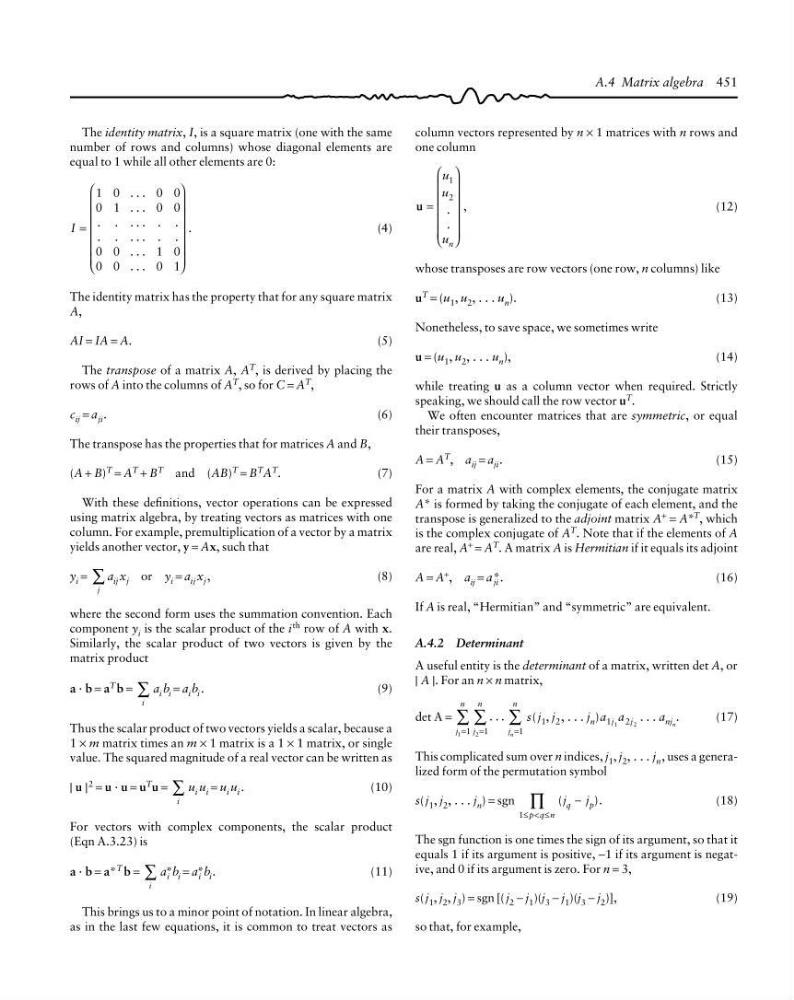
The identity matrix, I, is a square matrix (one with the same
number of rows and columns) whose diagonal elements are
equal to 1 while all other elements are 0:
I
. . .
. . .
. . . . . . .
. . . . . . .
. . .
. . .
.
=
⎛
⎝
⎜
⎜
⎜
⎜
⎜
⎜
⎞
⎠
⎟
⎟
⎟
⎟
⎟
⎟
1 0
0 0
0 1
0 0
0 0
1 0
0 0
0 1
(4)
The identity matrix has the property that for any square matrix
A,
AI = IA = A.
(5)
The transpose of a matrix A, A T , is derived by placing the
rows of A into the columns of A T , so for C = A T ,
c ij = a ji .
(6)
The transpose has the properties that for matrices A and B,
(A + B) T = A T + B T and (AB) T = B T A T .
(7)
With these definitions, vector operations can be expressed
using matrix algebra, by treating vectors as matrices with one
column. For example, premultiplication of a vector by a matrix
yields another vector, y = Ax, such that
y i =
j
∑ a ij x j or y i = a ij x j ,
(8)
where the second form uses the summation convention. Each
component y i is the scalar product of the i th row of A with x.
Similarly, the scalar product of two vectors is given by the
matrix product
a · b = a T b =
i
∑ a i b i = a i b i .
(9)
Thus the scalar product of two vectors yields a scalar, because a
1 × m matrix times an m × 1 matrix is a 1 × 1 matrix, or single
value. The squared magnitude of a real vector can be written as
| u | 2 = u · u = u T u =
i
∑ u i u i = u i u i .
(10)
For vectors with complex components, the scalar product
(Eqn A.3.23) is
a · b = a* T b =
i
∑ a i
*b i = a i
*b i .
(11)
This brings us to a minor point of notation. In linear algebra,
as in the last few equations, it is common to treat vectors as
column vectors represented by n × 1 matrices with n rows and
one column
u
.
.
,
=
⎛
⎝
⎜
⎜
⎜
⎜
⎜
⎞
⎠
⎟
⎟
⎟
⎟
⎟
u
u
u n
1
2
(12)
whose transposes are row vectors (one row, n columns) like
u T = (u 1 , u 2 , . . . u n ).
(13)
Nonetheless, to save space, we sometimes write
u = (u 1 , u 2 , . . . u n ),
(14)
while treating u as a column vector when required. Strictly
speaking, we should call the row vector u T .
We often encounter matrices that are symmetric, or equal
their transposes,
A = A T , a ij = a ji .
(15)
For a matrix A with complex elements, the conjugate matrix
A* is formed by taking the conjugate of each element, and the
transpose is generalized to the adjoint matrix A
+
= A*
T , which
is the complex conjugate of A T . Note that if the elements of A
are real, A + = A T . A matrix A is Hermitian if it equals its adjoint
A = A + , a ij = a ji
*.
(16)
If A is real, “Hermitian” and “symmetric” are equivalent.
A.4.2 Determinant
A useful entity is the determinant of a matrix, written det A, or
| A |. For an n × n matrix,
det A =
. . .
j
n
j
n
j
n
n
1
2
1
1
1
=
=
=
∑ ∑ ∑ s( j 1 , j 2 , . . . j n )a 1j 1 a 2j 2 . . . a nj n .
(17)
This complicated sum over n indices, j 1 , j 2 , . . . j n , uses a generalized form of the permutation symbol
s( j 1 , j 2 , . . . j n ) = sgn
(
).
j
j
q
p
p q n
−
≤ < ≤
∏
1
(18)
The sgn function is one times the sign of its argument, so that it
equals 1 if its argument is positive, −1 if its argument is negative, and 0 if its argument is zero. For n = 3,
s( j 1 , j 2 , j 3 ) = sgn [( j 2 − j 1 )(j 3 − j 1 )(j 3 − j 2 )],
(19)
so that, for example,
A.4 Matrix algebra 451
number of rows and columns) whose diagonal elements are
equal to 1 while all other elements are 0:
I
. . .
. . .
. . . . . . .
. . . . . . .
. . .
. . .
.
=
⎛
⎝
⎜
⎜
⎜
⎜
⎜
⎜
⎞
⎠
⎟
⎟
⎟
⎟
⎟
⎟
1 0
0 0
0 1
0 0
0 0
1 0
0 0
0 1
(4)
The identity matrix has the property that for any square matrix
A,
AI = IA = A.
(5)
The transpose of a matrix A, A T , is derived by placing the
rows of A into the columns of A T , so for C = A T ,
c ij = a ji .
(6)
The transpose has the properties that for matrices A and B,
(A + B) T = A T + B T and (AB) T = B T A T .
(7)
With these definitions, vector operations can be expressed
using matrix algebra, by treating vectors as matrices with one
column. For example, premultiplication of a vector by a matrix
yields another vector, y = Ax, such that
y i =
j
∑ a ij x j or y i = a ij x j ,
(8)
where the second form uses the summation convention. Each
component y i is the scalar product of the i th row of A with x.
Similarly, the scalar product of two vectors is given by the
matrix product
a · b = a T b =
i
∑ a i b i = a i b i .
(9)
Thus the scalar product of two vectors yields a scalar, because a
1 × m matrix times an m × 1 matrix is a 1 × 1 matrix, or single
value. The squared magnitude of a real vector can be written as
| u | 2 = u · u = u T u =
i
∑ u i u i = u i u i .
(10)
For vectors with complex components, the scalar product
(Eqn A.3.23) is
a · b = a* T b =
i
∑ a i
*b i = a i
*b i .
(11)
This brings us to a minor point of notation. In linear algebra,
as in the last few equations, it is common to treat vectors as
column vectors represented by n × 1 matrices with n rows and
one column
u
.
.
,
=
⎛
⎝
⎜
⎜
⎜
⎜
⎜
⎞
⎠
⎟
⎟
⎟
⎟
⎟
u
u
u n
1
2
(12)
whose transposes are row vectors (one row, n columns) like
u T = (u 1 , u 2 , . . . u n ).
(13)
Nonetheless, to save space, we sometimes write
u = (u 1 , u 2 , . . . u n ),
(14)
while treating u as a column vector when required. Strictly
speaking, we should call the row vector u T .
We often encounter matrices that are symmetric, or equal
their transposes,
A = A T , a ij = a ji .
(15)
For a matrix A with complex elements, the conjugate matrix
A* is formed by taking the conjugate of each element, and the
transpose is generalized to the adjoint matrix A
+
= A*
T , which
is the complex conjugate of A T . Note that if the elements of A
are real, A + = A T . A matrix A is Hermitian if it equals its adjoint
A = A + , a ij = a ji
*.
(16)
If A is real, “Hermitian” and “symmetric” are equivalent.
A.4.2 Determinant
A useful entity is the determinant of a matrix, written det A, or
| A |. For an n × n matrix,
det A =
. . .
j
n
j
n
j
n
n
1
2
1
1
1
=
=
=
∑ ∑ ∑ s( j 1 , j 2 , . . . j n )a 1j 1 a 2j 2 . . . a nj n .
(17)
This complicated sum over n indices, j 1 , j 2 , . . . j n , uses a generalized form of the permutation symbol
s( j 1 , j 2 , . . . j n ) = sgn
(
).
j
j
q
p
p q n
−
≤ < ≤
∏
1
(18)
The sgn function is one times the sign of its argument, so that it
equals 1 if its argument is positive, −1 if its argument is negative, and 0 if its argument is zero. For n = 3,
s( j 1 , j 2 , j 3 ) = sgn [( j 2 − j 1 )(j 3 − j 1 )(j 3 − j 2 )],
(19)
so that, for example,
A.4 Matrix algebra 451