

B(145°)
C(153°)
(98°)
B(145°)
22
20
18
16
14
100
Time (min)
PKP
PKIKP
B
D
C
Pd
PKiKP
P d (98°)
PKiKP
PKIKP
PKP
A(177°)
D(122°)
F(180°)
C(153°)
Distance (°)
120
140
160
180
F
A
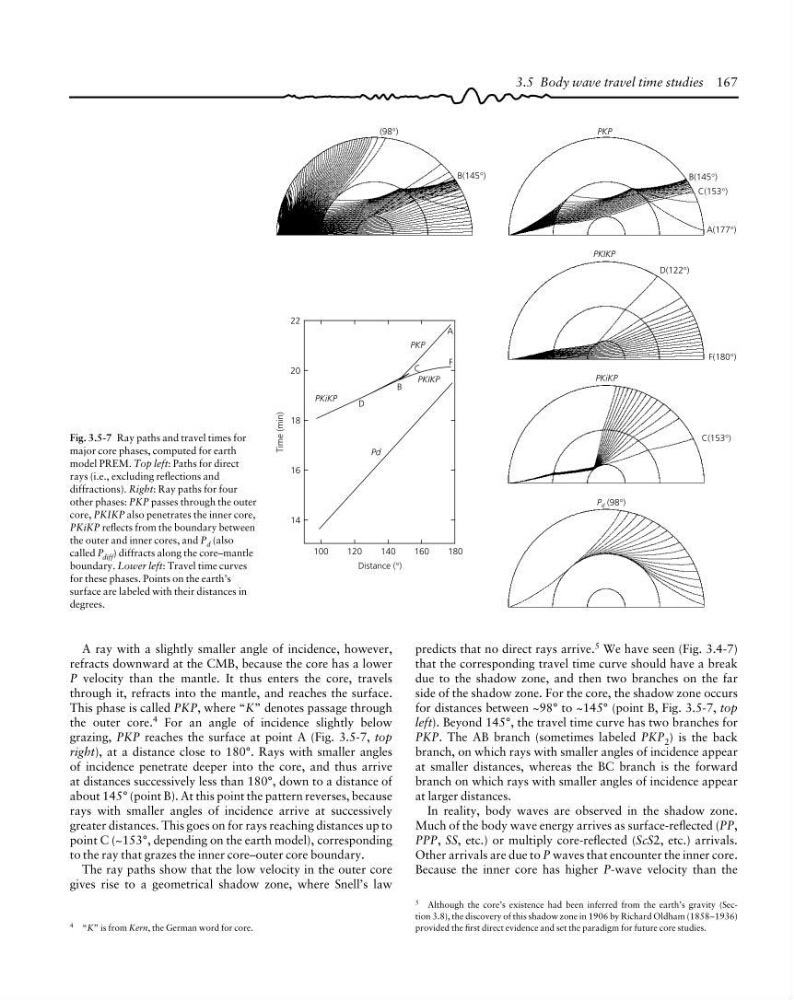
Fig. 3.5-7 Ray paths and travel times for
major core phases, computed for earth
model PREM. Top left: Paths for direct
rays (i.e., excluding reflections and
diffractions). Right: Ray paths for four
other phases: PKP passes through the outer
core, PKIKP also penetrates the inner core,
PKiKP reflects from the boundary between
the outer and inner cores, and P d (also
called P diff ) diffracts along the core–mantle
boundary. Lower left: Travel time curves
for these phases. Points on the earth’s
surface are labeled with their distances in
degrees.
3.5 Body wave travel time studies 167
A ray with a slightly smaller angle of incidence, however,
refracts downward at the CMB, because the core has a lower
P velocity than the mantle. It thus enters the core, travels
through it, refracts into the mantle, and reaches the surface.
This phase is called PKP, where “K” denotes passage through
the outer core. 4 For an angle of incidence slightly below
grazing, PKP reaches the surface at point A (Fig. 3.5-7, top
right), at a distance close to 180°. Rays with smaller angles
of incidence penetrate deeper into the core, and thus arrive
at distances successively less than 180°, down to a distance of
about 145° (point B). At this point the pattern reverses, because
rays with smaller angles of incidence arrive at successively
greater distances. This goes on for rays reaching distances up to
point C (~153°, depending on the earth model), corresponding
to the ray that grazes the inner core–outer core boundary.
The ray paths show that the low velocity in the outer core
gives rise to a geometrical shadow zone, where Snell’s law
predicts that no direct rays arrive. 5 We have seen (Fig. 3.4-7)
that the corresponding travel time curve should have a break
due to the shadow zone, and then two branches on the far
side of the shadow zone. For the core, the shadow zone occurs
for distances between ~98° to ~145° (point B, Fig. 3.5-7, top
left). Beyond 145°, the travel time curve has two branches for
PKP. The AB branch (sometimes labeled PKP 2 ) is the back
branch, on which rays with smaller angles of incidence appear
at smaller distances, whereas the BC branch is the forward
branch on which rays with smaller angles of incidence appear
at larger distances.
In reality, body waves are observed in the shadow zone.
Much of the body wave energy arrives as surface-reflected (PP,
PPP, SS, etc.) or multiply core-reflected (ScS2, etc.) arrivals.
Other arrivals are due to P waves that encounter the inner core.
Because the inner core has higher P-wave velocity than the
5 Although the core’s existence had been inferred from the earth’s gravity (Section 3.8), the discovery of this shadow zone in 1906 by Richard Oldham (1858–1936)
provided the first direct evidence and set the paradigm for future core studies.
4 “K” is from Kern, the German word for core.
C(153°)
(98°)
B(145°)
22
20
18
16
14
100
Time (min)
PKP
PKIKP
B
D
C
Pd
PKiKP
P d (98°)
PKiKP
PKIKP
PKP
A(177°)
D(122°)
F(180°)
C(153°)
Distance (°)
120
140
160
180
F
A
Fig. 3.5-7 Ray paths and travel times for
major core phases, computed for earth
model PREM. Top left: Paths for direct
rays (i.e., excluding reflections and
diffractions). Right: Ray paths for four
other phases: PKP passes through the outer
core, PKIKP also penetrates the inner core,
PKiKP reflects from the boundary between
the outer and inner cores, and P d (also
called P diff ) diffracts along the core–mantle
boundary. Lower left: Travel time curves
for these phases. Points on the earth’s
surface are labeled with their distances in
degrees.
3.5 Body wave travel time studies 167
A ray with a slightly smaller angle of incidence, however,
refracts downward at the CMB, because the core has a lower
P velocity than the mantle. It thus enters the core, travels
through it, refracts into the mantle, and reaches the surface.
This phase is called PKP, where “K” denotes passage through
the outer core. 4 For an angle of incidence slightly below
grazing, PKP reaches the surface at point A (Fig. 3.5-7, top
right), at a distance close to 180°. Rays with smaller angles
of incidence penetrate deeper into the core, and thus arrive
at distances successively less than 180°, down to a distance of
about 145° (point B). At this point the pattern reverses, because
rays with smaller angles of incidence arrive at successively
greater distances. This goes on for rays reaching distances up to
point C (~153°, depending on the earth model), corresponding
to the ray that grazes the inner core–outer core boundary.
The ray paths show that the low velocity in the outer core
gives rise to a geometrical shadow zone, where Snell’s law
predicts that no direct rays arrive. 5 We have seen (Fig. 3.4-7)
that the corresponding travel time curve should have a break
due to the shadow zone, and then two branches on the far
side of the shadow zone. For the core, the shadow zone occurs
for distances between ~98° to ~145° (point B, Fig. 3.5-7, top
left). Beyond 145°, the travel time curve has two branches for
PKP. The AB branch (sometimes labeled PKP 2 ) is the back
branch, on which rays with smaller angles of incidence appear
at smaller distances, whereas the BC branch is the forward
branch on which rays with smaller angles of incidence appear
at larger distances.
In reality, body waves are observed in the shadow zone.
Much of the body wave energy arrives as surface-reflected (PP,
PPP, SS, etc.) or multiply core-reflected (ScS2, etc.) arrivals.
Other arrivals are due to P waves that encounter the inner core.
Because the inner core has higher P-wave velocity than the
5 Although the core’s existence had been inferred from the earth’s gravity (Section 3.8), the discovery of this shadow zone in 1906 by Richard Oldham (1858–1936)
provided the first direct evidence and set the paradigm for future core studies.
4 “K” is from Kern, the German word for core.