

Problems 117
Fig. P2.1 See Problem 22.
B
C
D
A
A
B
C
D
E
Fig. P2.2 See Problem 23.
v = 1
z = 4
z = 2
v = 1.5
z
x
24. Fermat’s principle problems:
(a) Use Fermat’s principle to show that the angles of incidence
for the incident and reflected waves at the surface of a homogeneous halfspace (Fig. 2.5-13) are equal.
(b) Use the second derivative of the travel time to determine
whether the ray path in (a) is a minimum- or a maximumtime path.
(c) Use the second derivative of the travel time to show that the
refracted ray path in Fig. 2.5-14 is a minimum-time path.
25. For an SV wave incident on a free surface:
(a) Write the potentials for the incident SV wave and reflected P
and SV waves.
(b) Derive the continuity equations at the interface in terms of
both the potentials and the amplitude coefficients.
(c) Assume that the potential reflection coefficients, the ratios of
the reflected SV and P potentials to that of the incident SV
wave, are
B
B
p
p
p
p
A
B
p
p
p
p
2
1
2
2
2 2
2
2
2 2
2
1
2
2
2
2
2 2
4
4
4
4
(
)
(
)
,
(
)
(
)
.
=
−
−
+
−
=
−
+
−
η η
η
η η
η
η η
η η
η
α β
β
α β
β
β β
α β
β
Evaluate the potential reflection coefficients at vertical incidence, and explain the result physically.
(d) Find the displacement magnitude ratios and energy flux
ratios for the two reflected waves relative to the incident
wave.
(e) Show that the energy fluxes satisfy conservation of energy.
26. Show that conservation of energy is satisfied by:
(a) The energy flux for the incident, reflected and transmitted
SH waves at an interface (Eqn 2.6.14).
(b) The energy flux for the incident P wave and reflected P and
SV waves at a free surface (Eqn 2.6.39).
27. For the ScSp conversion at the top of the downgoing slab (Fig. 2.615), assume that ScS is traveling vertically in the slab, which dips
at 30°. Assume that the velocities in the slab are α = 9.3 km/s and
β = 5.2 km/s, and the overlying mantle between the slab and the
surface has velocities α 2 = 8.0 km/s and β 2 = 4.6 km/s.
(a) Find the angle of incidence for ScS and ScSp at the top of the
slab and at the earth’s surface.
(b) Use this result and the seismograms shown to estimate the
depth beneath the station to the top of the slab. Bear in mind
that the ScSp and ScS arrivals observed at a given station
originated from different points on the slab.
(b) Show that the S-wave displacement due to the vector
potential
ϒ(x, t) = Ae i(ωt −k·x) , A = (A x , A y , A z ),
is perpendicular to the propagation direction.
21. For a medium composed of upper, middle, and lower layers with
velocities of 6, 8, and 10 km/s, calculate the angle of incidence in
the 8 and 10 km/s layers for a ray with an incidence angle of 10°
in the 6 km/s layer. What is the smallest angle of incidence in the
6 km/s layer that causes total internal reflection at the 8 km/s–
10 km/s interface?
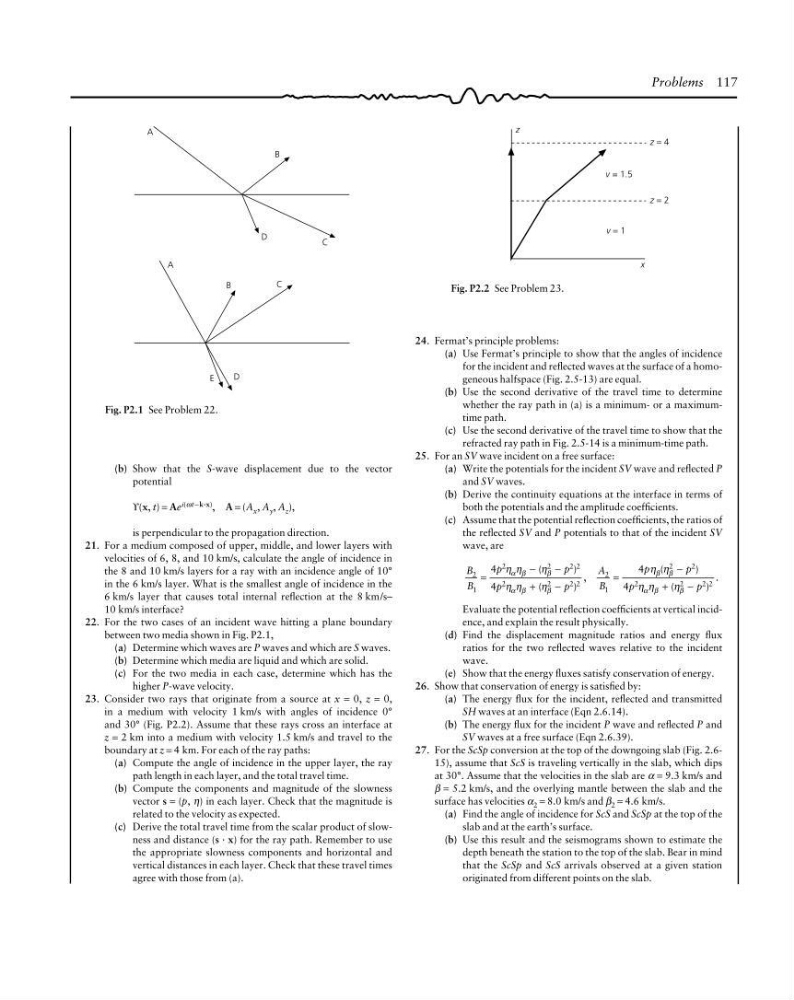
22. For the two cases of an incident wave hitting a plane boundary
between two media shown in Fig. P2.1,
(a) Determine which waves are P waves and which are S waves.
(b) Determine which media are liquid and which are solid.
(c) For the two media in each case, determine which has the
higher P-wave velocity.
23. Consider two rays that originate from a source at x = 0, z = 0,
in a medium with velocity 1 km/s with angles of incidence 0°
and 30° (Fig. P2.2). Assume that these rays cross an interface at
z = 2 km into a medium with velocity 1.5 km/s and travel to the
boundary at z = 4 km. For each of the ray paths:
(a) Compute the angle of incidence in the upper layer, the ray
path length in each layer, and the total travel time.
(b) Compute the components and magnitude of the slowness
vector s = (p, η) in each layer. Check that the magnitude is
related to the velocity as expected.
(c) Derive the total travel time from the scalar product of slowness and distance (s · x) for the ray path. Remember to use
the appropriate slowness components and horizontal and
vertical distances in each layer. Check that these travel times
agree with those from (a).
Fig. P2.1 See Problem 22.
B
C
D
A
A
B
C
D
E
Fig. P2.2 See Problem 23.
v = 1
z = 4
z = 2
v = 1.5
z
x
24. Fermat’s principle problems:
(a) Use Fermat’s principle to show that the angles of incidence
for the incident and reflected waves at the surface of a homogeneous halfspace (Fig. 2.5-13) are equal.
(b) Use the second derivative of the travel time to determine
whether the ray path in (a) is a minimum- or a maximumtime path.
(c) Use the second derivative of the travel time to show that the
refracted ray path in Fig. 2.5-14 is a minimum-time path.
25. For an SV wave incident on a free surface:
(a) Write the potentials for the incident SV wave and reflected P
and SV waves.
(b) Derive the continuity equations at the interface in terms of
both the potentials and the amplitude coefficients.
(c) Assume that the potential reflection coefficients, the ratios of
the reflected SV and P potentials to that of the incident SV
wave, are
B
B
p
p
p
p
A
B
p
p
p
p
2
1
2
2
2 2
2
2
2 2
2
1
2
2
2
2
2 2
4
4
4
4
(
)
(
)
,
(
)
(
)
.
=
−
−
+
−
=
−
+
−
η η
η
η η
η
η η
η η
η
α β
β
α β
β
β β
α β
β
Evaluate the potential reflection coefficients at vertical incidence, and explain the result physically.
(d) Find the displacement magnitude ratios and energy flux
ratios for the two reflected waves relative to the incident
wave.
(e) Show that the energy fluxes satisfy conservation of energy.
26. Show that conservation of energy is satisfied by:
(a) The energy flux for the incident, reflected and transmitted
SH waves at an interface (Eqn 2.6.14).
(b) The energy flux for the incident P wave and reflected P and
SV waves at a free surface (Eqn 2.6.39).
27. For the ScSp conversion at the top of the downgoing slab (Fig. 2.615), assume that ScS is traveling vertically in the slab, which dips
at 30°. Assume that the velocities in the slab are α = 9.3 km/s and
β = 5.2 km/s, and the overlying mantle between the slab and the
surface has velocities α 2 = 8.0 km/s and β 2 = 4.6 km/s.
(a) Find the angle of incidence for ScS and ScSp at the top of the
slab and at the earth’s surface.
(b) Use this result and the seismograms shown to estimate the
depth beneath the station to the top of the slab. Bear in mind
that the ScSp and ScS arrivals observed at a given station
originated from different points on the slab.
(b) Show that the S-wave displacement due to the vector
potential
ϒ(x, t) = Ae i(ωt −k·x) , A = (A x , A y , A z ),
is perpendicular to the propagation direction.
21. For a medium composed of upper, middle, and lower layers with
velocities of 6, 8, and 10 km/s, calculate the angle of incidence in
the 8 and 10 km/s layers for a ray with an incidence angle of 10°
in the 6 km/s layer. What is the smallest angle of incidence in the
6 km/s layer that causes total internal reflection at the 8 km/s–
10 km/s interface?
22. For the two cases of an incident wave hitting a plane boundary
between two media shown in Fig. P2.1,
(a) Determine which waves are P waves and which are S waves.
(b) Determine which media are liquid and which are solid.
(c) For the two media in each case, determine which has the
higher P-wave velocity.
23. Consider two rays that originate from a source at x = 0, z = 0,
in a medium with velocity 1 km/s with angles of incidence 0°
and 30° (Fig. P2.2). Assume that these rays cross an interface at
z = 2 km into a medium with velocity 1.5 km/s and travel to the
boundary at z = 4 km. For each of the ray paths:
(a) Compute the angle of incidence in the upper layer, the ray
path length in each layer, and the total travel time.
(b) Compute the components and magnitude of the slowness
vector s = (p, η) in each layer. Check that the magnitude is
related to the velocity as expected.
(c) Derive the total travel time from the scalar product of slowness and distance (s · x) for the ray path. Remember to use
the appropriate slowness components and horizontal and
vertical distances in each layer. Check that these travel times
agree with those from (a).