

32
P. Lazo et al.
45
40
35
30
25
20
15
10
5
5000
4000
3000
2000
1000
0
MAPE
53
MAD
686
MSD
766747
Accuracy Measures
n
Al
Actual
Fits
Variable
Spatial Analysis Plot for Al
Linear Trend Model
Al = 1767 - 4.67×n
1
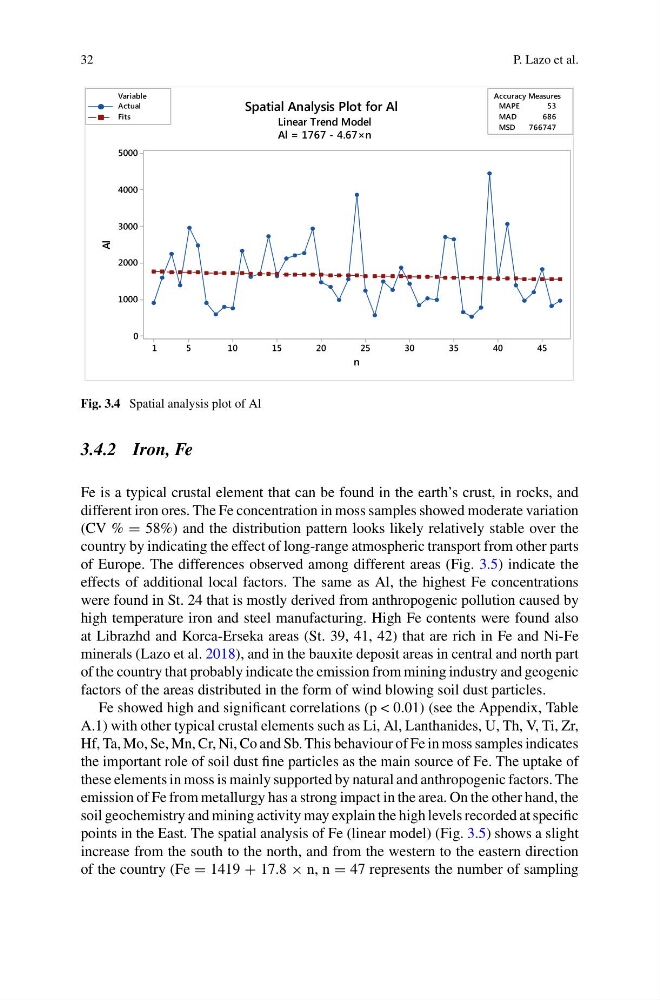
Fig. 3.4 Spatial analysis plot of Al
3.4.2 Iron, Fe
Fe is a typical crustal element that can be found in the earth’s crust, in rocks, and
different iron ores. The Fe concentration in moss samples showed moderate variation
(CV % = 58%) and the distribution pattern looks likely relatively stable over the
country by indicating the effect of long-range atmospheric transport from other parts
of Europe. The differences observed among different areas (Fig. 3.5) indicate the
effects of additional local factors. The same as Al, the highest Fe concentrations
were found in St. 24 that is mostly derived from anthropogenic pollution caused by
high temperature iron and steel manufacturing. High Fe contents were found also
at Librazhd and Korca-Erseka areas (St. 39, 41, 42) that are rich in Fe and Ni-Fe
minerals (Lazo et al. 2018), and in the bauxite deposit areas in central and north part
of the country that probably indicate the emission from mining industry and geogenic
factors of the areas distributed in the form of wind blowing soil dust particles.
Fe showed high and significant correlations (p < 0.01) (see the Appendix, Table
A.1) with other typical crustal elements such as Li, Al, Lanthanides, U, Th, V, Ti, Zr,
Hf, Ta, Mo, Se, Mn, Cr, Ni, Co and Sb. This behaviour of Fe in moss samples indicates
the important role of soil dust fine particles as the main source of Fe. The uptake of
these elements in moss is mainly supported by natural and anthropogenic factors. The
emission of Fe from metallurgy has a strong impact in the area. On the other hand, the
soil geochemistry and mining activity may explain the high levels recorded at specific
points in the East. The spatial analysis of Fe (linear model) (Fig. 3.5) shows a slight
increase from the south to the north, and from the western to the eastern direction
of the country (Fe = 1419 + 17.8 × n, n = 47 represents the number of sampling
P. Lazo et al.
45
40
35
30
25
20
15
10
5
5000
4000
3000
2000
1000
0
MAPE
53
MAD
686
MSD
766747
Accuracy Measures
n
Al
Actual
Fits
Variable
Spatial Analysis Plot for Al
Linear Trend Model
Al = 1767 - 4.67×n
1
Fig. 3.4 Spatial analysis plot of Al
3.4.2 Iron, Fe
Fe is a typical crustal element that can be found in the earth’s crust, in rocks, and
different iron ores. The Fe concentration in moss samples showed moderate variation
(CV % = 58%) and the distribution pattern looks likely relatively stable over the
country by indicating the effect of long-range atmospheric transport from other parts
of Europe. The differences observed among different areas (Fig. 3.5) indicate the
effects of additional local factors. The same as Al, the highest Fe concentrations
were found in St. 24 that is mostly derived from anthropogenic pollution caused by
high temperature iron and steel manufacturing. High Fe contents were found also
at Librazhd and Korca-Erseka areas (St. 39, 41, 42) that are rich in Fe and Ni-Fe
minerals (Lazo et al. 2018), and in the bauxite deposit areas in central and north part
of the country that probably indicate the emission from mining industry and geogenic
factors of the areas distributed in the form of wind blowing soil dust particles.
Fe showed high and significant correlations (p < 0.01) (see the Appendix, Table
A.1) with other typical crustal elements such as Li, Al, Lanthanides, U, Th, V, Ti, Zr,
Hf, Ta, Mo, Se, Mn, Cr, Ni, Co and Sb. This behaviour of Fe in moss samples indicates
the important role of soil dust fine particles as the main source of Fe. The uptake of
these elements in moss is mainly supported by natural and anthropogenic factors. The
emission of Fe from metallurgy has a strong impact in the area. On the other hand, the
soil geochemistry and mining activity may explain the high levels recorded at specific
points in the East. The spatial analysis of Fe (linear model) (Fig. 3.5) shows a slight
increase from the south to the north, and from the western to the eastern direction
of the country (Fe = 1419 + 17.8 × n, n = 47 represents the number of sampling