

10
P. Lazo et al.
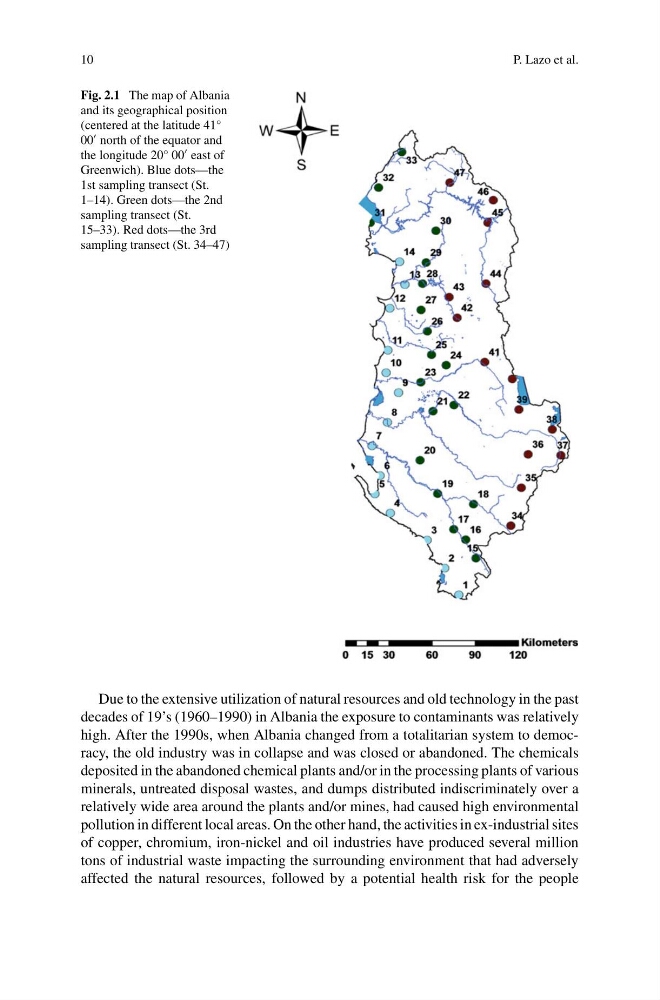
Fig. 2.1 The map of Albania
and its geographical position
(centered at the latitude 41°
00 north of the equator and
the longitude 20° 00 east of
Greenwich). Blue dots—the
1st sampling transect (St.
1–14). Green dots—the 2nd
sampling transect (St.
15–33). Red dots—the 3rd
sampling transect (St. 34–47)
Due to the extensive utilization of natural resources and old technology in the past
decades of 19’s (1960–1990) in Albania the exposure to contaminants was relatively
high. After the 1990s, when Albania changed from a totalitarian system to democracy, the old industry was in collapse and was closed or abandoned. The chemicals
deposited in the abandoned chemical plants and/or in the processing plants of various
minerals, untreated disposal wastes, and dumps distributed indiscriminately over a
relatively wide area around the plants and/or mines, had caused high environmental
pollution in different local areas. On the other hand, the activities in ex-industrial sites
of copper, chromium, iron-nickel and oil industries have produced several million
tons of industrial waste impacting the surrounding environment that had adversely
affected the natural resources, followed by a potential health risk for the people
P. Lazo et al.
Fig. 2.1 The map of Albania
and its geographical position
(centered at the latitude 41°
00 north of the equator and
the longitude 20° 00 east of
Greenwich). Blue dots—the
1st sampling transect (St.
1–14). Green dots—the 2nd
sampling transect (St.
15–33). Red dots—the 3rd
sampling transect (St. 34–47)
Due to the extensive utilization of natural resources and old technology in the past
decades of 19’s (1960–1990) in Albania the exposure to contaminants was relatively
high. After the 1990s, when Albania changed from a totalitarian system to democracy, the old industry was in collapse and was closed or abandoned. The chemicals
deposited in the abandoned chemical plants and/or in the processing plants of various
minerals, untreated disposal wastes, and dumps distributed indiscriminately over a
relatively wide area around the plants and/or mines, had caused high environmental
pollution in different local areas. On the other hand, the activities in ex-industrial sites
of copper, chromium, iron-nickel and oil industries have produced several million
tons of industrial waste impacting the surrounding environment that had adversely
affected the natural resources, followed by a potential health risk for the people