

86
ether of an enolate of butane-2,3-dione together with a phenol moiety. The characteristic feature of the phytochemistry of L. atroviolacea is compound oxidation at
the C-15 position, and thus many 15-oic acids and 15,6-lactones are produced.
3.6 Ligularia kanaitzensis (Franchet) Handel-Mazzetti
Ligularia kanaitzensis is distributed widely in Yunnan Province, and our groups
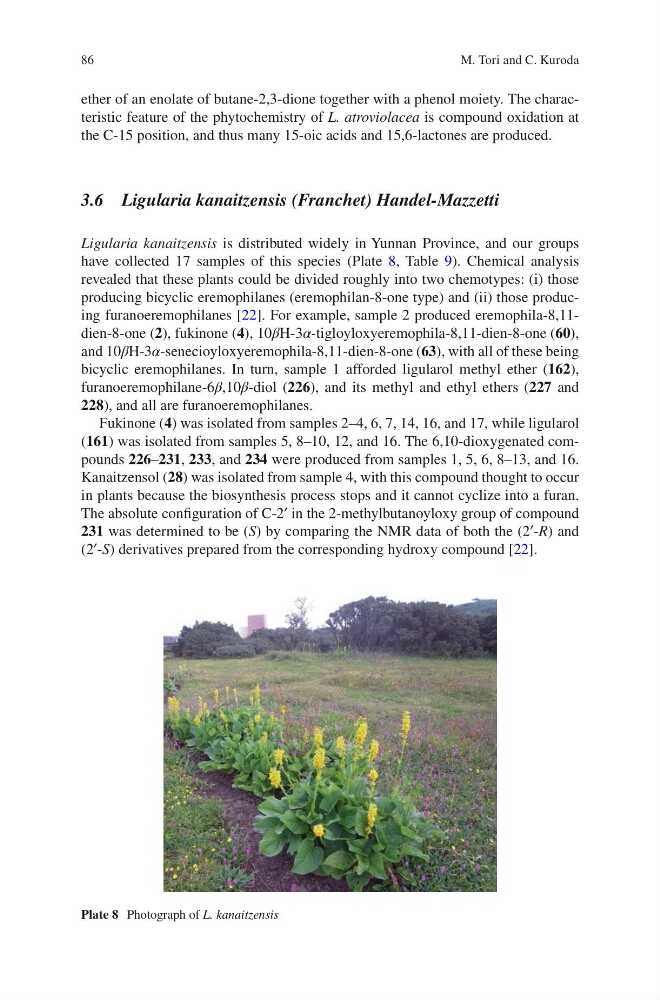
have collected 17 samples of this species (Plate 8, Table 9). Chemical analysis
revealed that these plants could be divided roughly into two chemotypes: (i) those
producing bicyclic eremophilanes (eremophilan-8-one type) and (ii) those producing furanoeremophilanes [22]. For example, sample 2 produced eremophila- 8,11dien- 8-one (2), fukinone (4), 10βH-3α-tigloyloxyeremophila-8,11-dien-8-one (60),
and 10βH-3α-senecioyloxyeremophila-8,11-dien-8-one (63), with all of these being
bicyclic eremophilanes. In turn, sample 1 afforded ligularol methyl ether (162),
furanoeremophilane-6β,10β-diol (226), and its methyl and ethyl ethers (227 and
228), and all are furanoeremophilanes.
Fukinone (4) was isolated from samples 2–4, 6, 7, 14, 16, and 17, while ligularol
(161) was isolated from samples 5, 8–10, 12, and 16. The 6,10-dioxygenated compounds 226–231, 233, and 234 were produced from samples 1, 5, 6, 8–13, and 16.
Kanaitzensol (28) was isolated from sample 4, with this compound thought to occur
in plants because the biosynthesis process stops and it cannot cyclize into a furan.
The absolute configuration of C-2′ in the 2-methylbutanoyloxy group of compound
231 was determined to be (S) by comparing the NMR data of both the (2′-R) and
(2′-S) derivatives prepared from the corresponding hydroxy compound [22].
Plate 8 Photograph of L. kanaitzensis
M. Tori and C. Kuroda
ether of an enolate of butane-2,3-dione together with a phenol moiety. The characteristic feature of the phytochemistry of L. atroviolacea is compound oxidation at
the C-15 position, and thus many 15-oic acids and 15,6-lactones are produced.
3.6 Ligularia kanaitzensis (Franchet) Handel-Mazzetti
Ligularia kanaitzensis is distributed widely in Yunnan Province, and our groups
have collected 17 samples of this species (Plate 8, Table 9). Chemical analysis
revealed that these plants could be divided roughly into two chemotypes: (i) those
producing bicyclic eremophilanes (eremophilan-8-one type) and (ii) those producing furanoeremophilanes [22]. For example, sample 2 produced eremophila- 8,11dien- 8-one (2), fukinone (4), 10βH-3α-tigloyloxyeremophila-8,11-dien-8-one (60),
and 10βH-3α-senecioyloxyeremophila-8,11-dien-8-one (63), with all of these being
bicyclic eremophilanes. In turn, sample 1 afforded ligularol methyl ether (162),
furanoeremophilane-6β,10β-diol (226), and its methyl and ethyl ethers (227 and
228), and all are furanoeremophilanes.
Fukinone (4) was isolated from samples 2–4, 6, 7, 14, 16, and 17, while ligularol
(161) was isolated from samples 5, 8–10, 12, and 16. The 6,10-dioxygenated compounds 226–231, 233, and 234 were produced from samples 1, 5, 6, 8–13, and 16.
Kanaitzensol (28) was isolated from sample 4, with this compound thought to occur
in plants because the biosynthesis process stops and it cannot cyclize into a furan.
The absolute configuration of C-2′ in the 2-methylbutanoyloxy group of compound
231 was determined to be (S) by comparing the NMR data of both the (2′-R) and
(2′-S) derivatives prepared from the corresponding hydroxy compound [22].
Plate 8 Photograph of L. kanaitzensis
M. Tori and C. Kuroda