

71
In Table 4, samples investigated by research teams other than our own groups
are listed. Samples 26–28, 32, 34, and 36 can be grouped to the C type [12, 74, 118,
152, 168, 171–173]. Cacalol (316) and its methyl ether 317 and farfugin B (335)
and its methyl ether 336 were isolated from samples 26 and 27 [169, 171]. Sample
26 also produced cacalolide (547) and epicacalolide (548), which are derived from
cacalol (316), and virgauronin (339) in being related to farfugin B (335).
Compounds 551 and 552 in samples 28 and 32 are interesting [118, 173], because
they have an enol- type triene moiety similar to cacalol (316). Sample 28 produced
pseudoguaiane- type sesquiterpenoids 784 and 785, which were the only examples
of chemical constituents of L. virgaurea. Previously, the dimeric compounds
virgaurin A (615) (vide supra) and adenostin A (570) were isolated from this
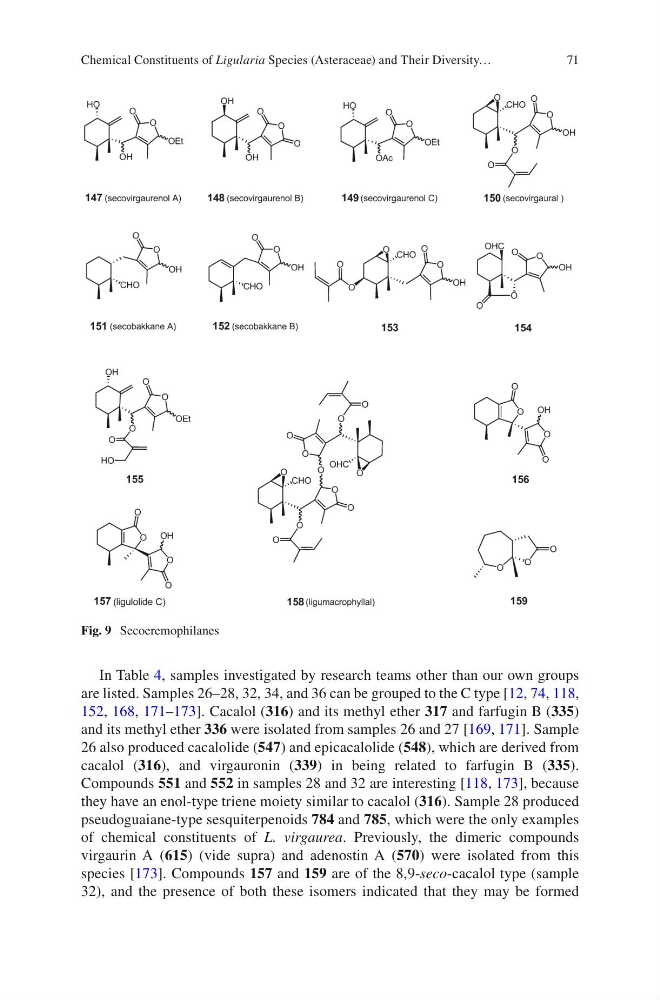
species [173]. Compounds 157 and 159 are of the 8,9-seco-cacalol type (sample
32), and the presence of both these isomers indicated that they may be formed
Fig. 9 Secoeremophilanes
Chemical Constituents of Ligularia Species (Asteraceae) and Their Diversity…
In Table 4, samples investigated by research teams other than our own groups
are listed. Samples 26–28, 32, 34, and 36 can be grouped to the C type [12, 74, 118,
152, 168, 171–173]. Cacalol (316) and its methyl ether 317 and farfugin B (335)
and its methyl ether 336 were isolated from samples 26 and 27 [169, 171]. Sample
26 also produced cacalolide (547) and epicacalolide (548), which are derived from
cacalol (316), and virgauronin (339) in being related to farfugin B (335).
Compounds 551 and 552 in samples 28 and 32 are interesting [118, 173], because
they have an enol- type triene moiety similar to cacalol (316). Sample 28 produced
pseudoguaiane- type sesquiterpenoids 784 and 785, which were the only examples
of chemical constituents of L. virgaurea. Previously, the dimeric compounds
virgaurin A (615) (vide supra) and adenostin A (570) were isolated from this
species [173]. Compounds 157 and 159 are of the 8,9-seco-cacalol type (sample
32), and the presence of both these isomers indicated that they may be formed
Fig. 9 Secoeremophilanes
Chemical Constituents of Ligularia Species (Asteraceae) and Their Diversity…