

64
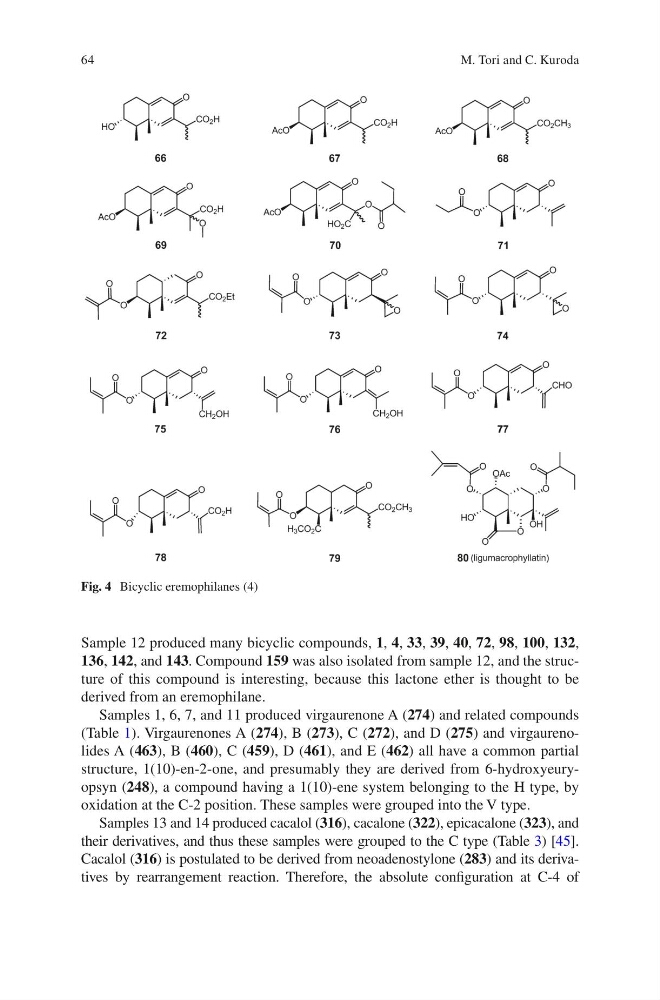
Sample 12 produced many bicyclic compounds, 1, 4, 33, 39, 40, 72, 98, 100, 132,
136, 142, and 143. Compound 159 was also isolated from sample 12, and the structure of this compound is interesting, because this lactone ether is thought to be
derived from an eremophilane.
Samples 1, 6, 7, and 11 produced virgaurenone A (274) and related compounds
(Table 1). Virgaurenones A (274), B (273), C (272), and D (275) and virgaurenolides A (463), B (460), C (459), D (461), and E (462) all have a common partial
structure, 1(10)-en-2-one, and presumably they are derived from 6-hydroxyeuryopsyn (248), a compound having a 1(10)-ene system belonging to the H type, by
oxidation at the C-2 position. These samples were grouped into the V type.
Samples 13 and 14 produced cacalol (316), cacalone (322), epicacalone (323), and
their derivatives, and thus these samples were grouped to the C type (Table 3) [45].
Cacalol (316) is postulated to be derived from neoadenostylone (283) and its derivatives by rearrangement reaction. Therefore, the absolute configuration at C-4 of
Fig. 4 Bicyclic eremophilanes (4)
M. Tori and C. Kuroda
Sample 12 produced many bicyclic compounds, 1, 4, 33, 39, 40, 72, 98, 100, 132,
136, 142, and 143. Compound 159 was also isolated from sample 12, and the structure of this compound is interesting, because this lactone ether is thought to be
derived from an eremophilane.
Samples 1, 6, 7, and 11 produced virgaurenone A (274) and related compounds
(Table 1). Virgaurenones A (274), B (273), C (272), and D (275) and virgaurenolides A (463), B (460), C (459), D (461), and E (462) all have a common partial
structure, 1(10)-en-2-one, and presumably they are derived from 6-hydroxyeuryopsyn (248), a compound having a 1(10)-ene system belonging to the H type, by
oxidation at the C-2 position. These samples were grouped into the V type.
Samples 13 and 14 produced cacalol (316), cacalone (322), epicacalone (323), and
their derivatives, and thus these samples were grouped to the C type (Table 3) [45].
Cacalol (316) is postulated to be derived from neoadenostylone (283) and its derivatives by rearrangement reaction. Therefore, the absolute configuration at C-4 of
Fig. 4 Bicyclic eremophilanes (4)
M. Tori and C. Kuroda