

62
Ligularol (161) was the major constituent of samples 4, 5, and 9 (L type)
(Table 2). However, lactone 344 and its ethyl ether 348 apparently are derived from
ligularol (161), and, hence, samples 2, 8, 10, and 12 are also grouped to the L type.
The epimers at C-11 of acid 33 were separated successfully by HPLC, and the absolute configurations were determined by the X-ray analysis of a crystalline pbromophenacyl derivative (vide infra) [22]. The interesting dimers 579 and 580
were isolated from samples 9 and 12, and their biogenetic formation has been discussed in the literature [86, 199, 277–280]. A simple lactone 441 (sample 12) was
assigned previously as having a 8β-H substituent by Bohlmann et al. [281]. However,
its configuration was revised to 8α-H using the results of a NOE experiment [27].
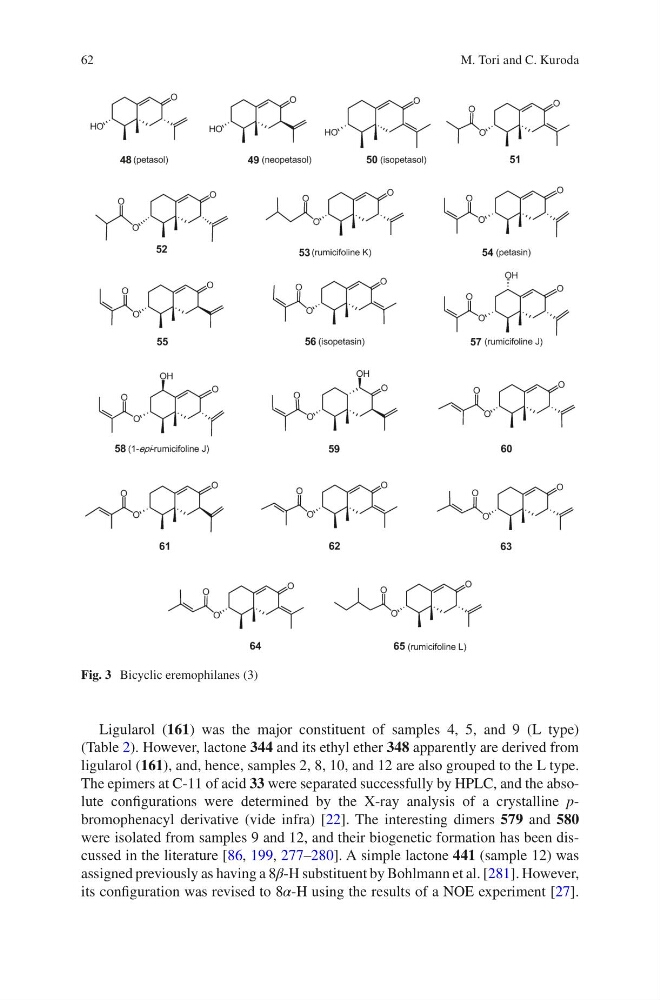
Fig. 3 Bicyclic eremophilanes (3)
M. Tori and C. Kuroda
Ligularol (161) was the major constituent of samples 4, 5, and 9 (L type)
(Table 2). However, lactone 344 and its ethyl ether 348 apparently are derived from
ligularol (161), and, hence, samples 2, 8, 10, and 12 are also grouped to the L type.
The epimers at C-11 of acid 33 were separated successfully by HPLC, and the absolute configurations were determined by the X-ray analysis of a crystalline pbromophenacyl derivative (vide infra) [22]. The interesting dimers 579 and 580
were isolated from samples 9 and 12, and their biogenetic formation has been discussed in the literature [86, 199, 277–280]. A simple lactone 441 (sample 12) was
assigned previously as having a 8β-H substituent by Bohlmann et al. [281]. However,
its configuration was revised to 8α-H using the results of a NOE experiment [27].
Fig. 3 Bicyclic eremophilanes (3)
M. Tori and C. Kuroda