

228
identical to 682. Then, the stereoselective synthesis of 1230b (= 682) was accomplished to establish the structure of the natural product. By supposing that the carbon skeleton of all bisabolane compounds from the same plant are formed via the
same biosynthesis pathways, the absolute configuration of compound 657, isolated
from L. lankongensis, may be depicted as in Scheme 30 [342, 343]. More detailed
syntheses of related compounds may be anticipated, in order to gain a better understanding of the absolute configurations of bisabolanes.
5.19 Synthesis of Nelumol A
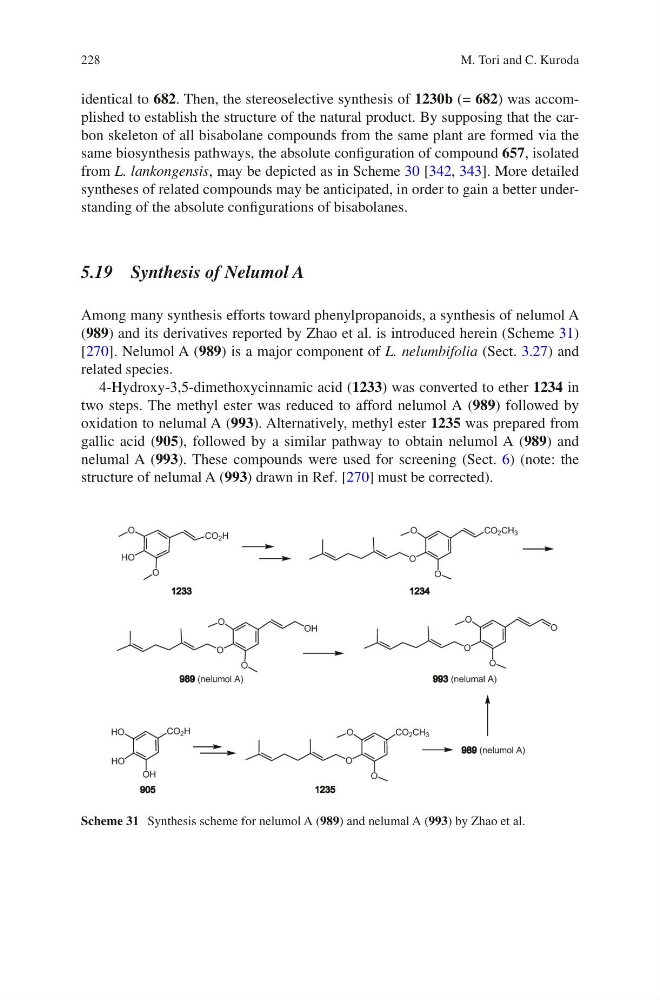
Among many synthesis efforts toward phenylpropanoids, a synthesis of nelumol A
(989) and its derivatives reported by Zhao et al. is introduced herein (Scheme 31)
[270]. Nelumol A (989) is a major component of L. nelumbifolia (Sect. 3.27) and
related species.
4-Hydroxy-3,5-dimethoxycinnamic acid (1233) was converted to ether 1234 in
two steps. The methyl ester was reduced to afford nelumol A (989) followed by
oxidation to nelumal A (993). Alternatively, methyl ester 1235 was prepared from
gallic acid (905), followed by a similar pathway to obtain nelumol A (989) and
nelumal A (993). These compounds were used for screening (Sect. 6) (note: the
structure of nelumal A (993) drawn in Ref. [270] must be corrected).
Scheme 31 Synthesis scheme for nelumol A (989) and nelumal A (993) by Zhao et al.
M. Tori and C. Kuroda
identical to 682. Then, the stereoselective synthesis of 1230b (= 682) was accomplished to establish the structure of the natural product. By supposing that the carbon skeleton of all bisabolane compounds from the same plant are formed via the
same biosynthesis pathways, the absolute configuration of compound 657, isolated
from L. lankongensis, may be depicted as in Scheme 30 [342, 343]. More detailed
syntheses of related compounds may be anticipated, in order to gain a better understanding of the absolute configurations of bisabolanes.
5.19 Synthesis of Nelumol A
Among many synthesis efforts toward phenylpropanoids, a synthesis of nelumol A
(989) and its derivatives reported by Zhao et al. is introduced herein (Scheme 31)
[270]. Nelumol A (989) is a major component of L. nelumbifolia (Sect. 3.27) and
related species.
4-Hydroxy-3,5-dimethoxycinnamic acid (1233) was converted to ether 1234 in
two steps. The methyl ester was reduced to afford nelumol A (989) followed by
oxidation to nelumal A (993). Alternatively, methyl ester 1235 was prepared from
gallic acid (905), followed by a similar pathway to obtain nelumol A (989) and
nelumal A (993). These compounds were used for screening (Sect. 6) (note: the
structure of nelumal A (993) drawn in Ref. [270] must be corrected).
Scheme 31 Synthesis scheme for nelumol A (989) and nelumal A (993) by Zhao et al.
M. Tori and C. Kuroda