

223
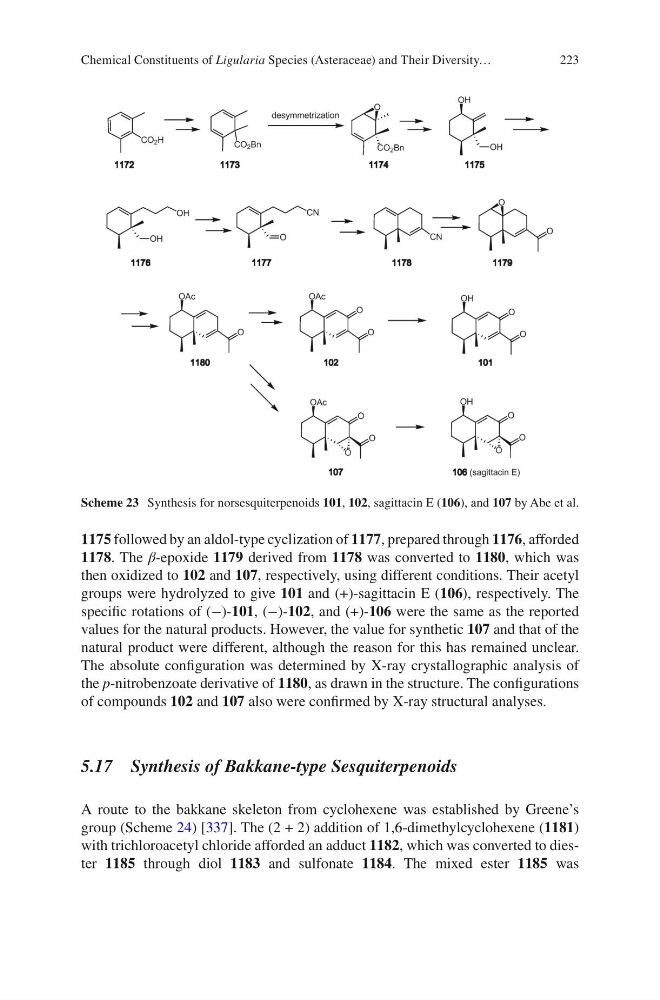
1175 followed by an aldol-type cyclization of 1177, prepared through 1176, afforded
1178. The β-epoxide 1179 derived from 1178 was converted to 1180, which was
then oxidized to 102 and 107, respectively, using different conditions. Their acetyl
groups were hydrolyzed to give 101 and (+)-sagittacin E (106), respectively. The
specific rotations of (−)-101, (−)-102, and (+)-106 were the same as the reported
values for the natural products. However, the value for synthetic 107 and that of the
natural product were different, although the reason for this has remained unclear.
The absolute configuration was determined by X-ray crystallographic analysis of
the p-nitrobenzoate derivative of 1180, as drawn in the structure. The configurations
of compounds 102 and 107 also were confirmed by X-ray structural analyses.
5.17 Synthesis of Bakkane-type Sesquiterpenoids
A route to the bakkane skeleton from cyclohexene was established by Greene’s
group (Scheme 24) [337]. The (2 + 2) addition of 1,6-dimethylcyclohexene (1181)
with trichloroacetyl chloride afforded an adduct 1182, which was converted to diester 1185 through diol 1183 and sulfonate 1184. The mixed ester 1185 was
Scheme 23 Synthesis for norsesquiterpenoids 101, 102, sagittacin E (106), and 107 by Abe et al.
Chemical Constituents of Ligularia Species (Asteraceae) and Their Diversity…
1175 followed by an aldol-type cyclization of 1177, prepared through 1176, afforded
1178. The β-epoxide 1179 derived from 1178 was converted to 1180, which was
then oxidized to 102 and 107, respectively, using different conditions. Their acetyl
groups were hydrolyzed to give 101 and (+)-sagittacin E (106), respectively. The
specific rotations of (−)-101, (−)-102, and (+)-106 were the same as the reported
values for the natural products. However, the value for synthetic 107 and that of the
natural product were different, although the reason for this has remained unclear.
The absolute configuration was determined by X-ray crystallographic analysis of
the p-nitrobenzoate derivative of 1180, as drawn in the structure. The configurations
of compounds 102 and 107 also were confirmed by X-ray structural analyses.
5.17 Synthesis of Bakkane-type Sesquiterpenoids
A route to the bakkane skeleton from cyclohexene was established by Greene’s
group (Scheme 24) [337]. The (2 + 2) addition of 1,6-dimethylcyclohexene (1181)
with trichloroacetyl chloride afforded an adduct 1182, which was converted to diester 1185 through diol 1183 and sulfonate 1184. The mixed ester 1185 was
Scheme 23 Synthesis for norsesquiterpenoids 101, 102, sagittacin E (106), and 107 by Abe et al.
Chemical Constituents of Ligularia Species (Asteraceae) and Their Diversity…