

216
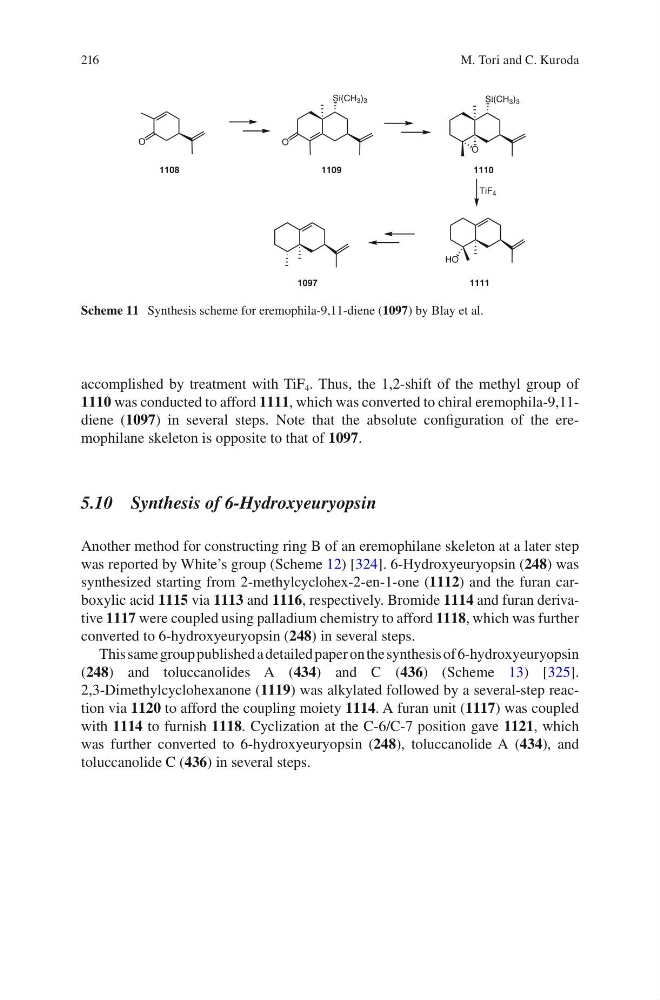
accomplished by treatment with TiF 4 . Thus, the 1,2-shift of the methyl group of
1110 was conducted to afford 1111, which was converted to chiral eremophila- 9,11diene (1097) in several steps. Note that the absolute configuration of the eremophilane skeleton is opposite to that of 1097.
5.10 Synthesis of 6-Hydroxyeuryopsin
Another method for constructing ring B of an eremophilane skeleton at a later step
was reported by White’s group (Scheme 12) [324]. 6-Hydroxyeuryopsin (248) was
synthesized starting from 2-methylcyclohex-2-en-1-one (1112) and the furan carboxylic acid 1115 via 1113 and 1116, respectively. Bromide 1114 and furan derivative 1117 were coupled using palladium chemistry to afford 1118, which was further
converted to 6-hydroxyeuryopsin (248) in several steps.
This same group published a detailed paper on the synthesis of 6- hydroxyeuryopsin
(248) and toluccanolides A (434) and C (436) (Scheme 13) [325].
2,3-Dimethylcyclohexanone (1119) was alkylated followed by a several-step reaction via 1120 to afford the coupling moiety 1114. A furan unit (1117) was coupled
with 1114 to furnish 1118. Cyclization at the C-6/C-7 position gave 1121, which
was further converted to 6-hydroxyeuryopsin (248), toluccanolide A (434), and
toluccanolide C (436) in several steps.
O
O
Si(CH 3 ) 3
Si(CH 3 ) 3
O
HO
TiF 4
1108
1109
1110
1111
1097
Scheme 11 Synthesis scheme for eremophila-9,11-diene (1097) by Blay et al.
M. Tori and C. Kuroda
accomplished by treatment with TiF 4 . Thus, the 1,2-shift of the methyl group of
1110 was conducted to afford 1111, which was converted to chiral eremophila- 9,11diene (1097) in several steps. Note that the absolute configuration of the eremophilane skeleton is opposite to that of 1097.
5.10 Synthesis of 6-Hydroxyeuryopsin
Another method for constructing ring B of an eremophilane skeleton at a later step
was reported by White’s group (Scheme 12) [324]. 6-Hydroxyeuryopsin (248) was
synthesized starting from 2-methylcyclohex-2-en-1-one (1112) and the furan carboxylic acid 1115 via 1113 and 1116, respectively. Bromide 1114 and furan derivative 1117 were coupled using palladium chemistry to afford 1118, which was further
converted to 6-hydroxyeuryopsin (248) in several steps.
This same group published a detailed paper on the synthesis of 6- hydroxyeuryopsin
(248) and toluccanolides A (434) and C (436) (Scheme 13) [325].
2,3-Dimethylcyclohexanone (1119) was alkylated followed by a several-step reaction via 1120 to afford the coupling moiety 1114. A furan unit (1117) was coupled
with 1114 to furnish 1118. Cyclization at the C-6/C-7 position gave 1121, which
was further converted to 6-hydroxyeuryopsin (248), toluccanolide A (434), and
toluccanolide C (436) in several steps.
O
O
Si(CH 3 ) 3
Si(CH 3 ) 3
O
HO
TiF 4
1108
1109
1110
1111
1097
Scheme 11 Synthesis scheme for eremophila-9,11-diene (1097) by Blay et al.
M. Tori and C. Kuroda