

203
344, 359, 490, and 491, were isolated [139, 178, 183]. These compounds are thought
to be derived from ligularol (161) by oxidation processes.
The Japanese L. hiberniflorum (Makino) Kitamura collected in 1979 at
Yakushima, Kagoshima Prefecture, Japan (sample 17), produced six eremophilanolides, 364, 384, 385, 386, 387, and 388 [186]. Compounds 384 and 385 are epimers
at C-8. The lactone 388 exhibited a methylthio group at C-3′ of an acryloyloxy
moiety at C-6β. The conformation of the molecule was investigated using the ECD
spectra, which depended on the configuration at C-8.
Sample 18 of L. kangtingensis S.W. Liu from Sichuan Province produced ligukangtinol (128), which is a noreremophilanetriol [109]. Liguhodgsonal (125), ligudentatin A (126), a bislactone (502), an oplopane (744), lupeol (828), oleanolic acid
(833), ursolic acid (848), two triterpenoids (847 and 852), two monoterpenes (865
and 866), and a eudesmane (801) were isolated from sample 19 (seemingly the
same source as sample 18) [103].
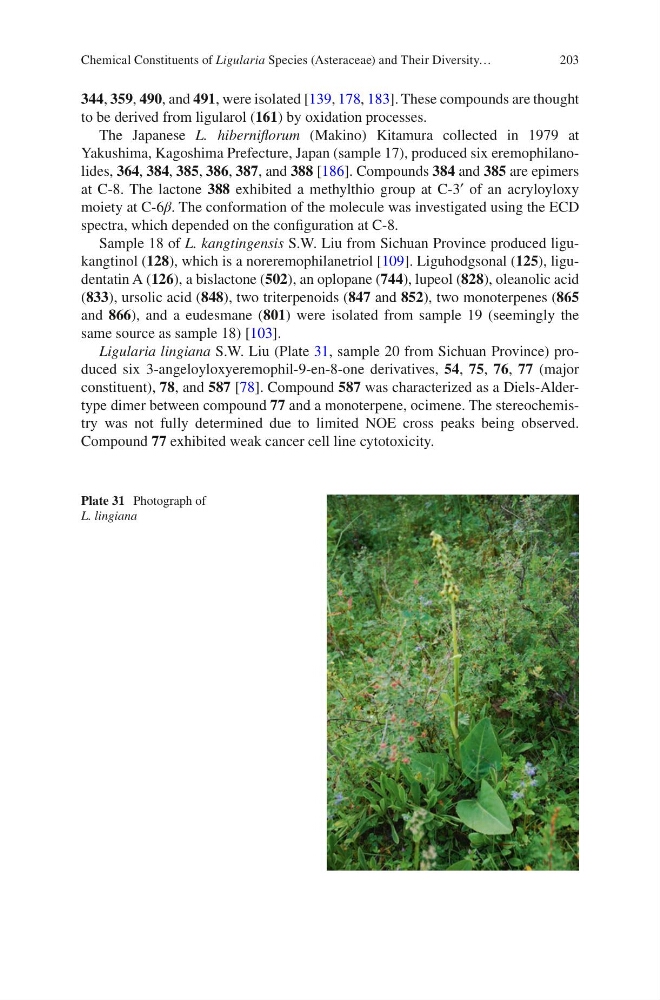
Ligularia lingiana S.W. Liu (Plate 31, sample 20 from Sichuan Province) produced six 3-angeloyloxyeremophil-9-en-8-one derivatives, 54, 75, 76, 77 (major
constituent), 78, and 587 [78]. Compound 587 was characterized as a Diels-Aldertype dimer between compound 77 and a monoterpene, ocimene. The stereochemistry was not fully determined due to limited NOE cross peaks being observed.
Compound 77 exhibited weak cancer cell line cytotoxicity.
Plate 31 Photograph of
L. lingiana
Chemical Constituents of Ligularia Species (Asteraceae) and Their Diversity…
344, 359, 490, and 491, were isolated [139, 178, 183]. These compounds are thought
to be derived from ligularol (161) by oxidation processes.
The Japanese L. hiberniflorum (Makino) Kitamura collected in 1979 at
Yakushima, Kagoshima Prefecture, Japan (sample 17), produced six eremophilanolides, 364, 384, 385, 386, 387, and 388 [186]. Compounds 384 and 385 are epimers
at C-8. The lactone 388 exhibited a methylthio group at C-3′ of an acryloyloxy
moiety at C-6β. The conformation of the molecule was investigated using the ECD
spectra, which depended on the configuration at C-8.
Sample 18 of L. kangtingensis S.W. Liu from Sichuan Province produced ligukangtinol (128), which is a noreremophilanetriol [109]. Liguhodgsonal (125), ligudentatin A (126), a bislactone (502), an oplopane (744), lupeol (828), oleanolic acid
(833), ursolic acid (848), two triterpenoids (847 and 852), two monoterpenes (865
and 866), and a eudesmane (801) were isolated from sample 19 (seemingly the
same source as sample 18) [103].
Ligularia lingiana S.W. Liu (Plate 31, sample 20 from Sichuan Province) produced six 3-angeloyloxyeremophil-9-en-8-one derivatives, 54, 75, 76, 77 (major
constituent), 78, and 587 [78]. Compound 587 was characterized as a Diels-Aldertype dimer between compound 77 and a monoterpene, ocimene. The stereochemistry was not fully determined due to limited NOE cross peaks being observed.
Compound 77 exhibited weak cancer cell line cytotoxicity.
Plate 31 Photograph of
L. lingiana
Chemical Constituents of Ligularia Species (Asteraceae) and Their Diversity…