

191
3.35 Ligularia tsangchanensis (Franchet) Handel-Mazzetti
We compared initially samples collected in Yunnan and Sichuan provinces in China
(Plate 29, Table 43). From the Sichuan sample (samples 2–4), the eremophilan- 8one derivatives 2, 3, and 54 were isolated, while from the Yunnan sample (sample
1), cacalol (316) and its derivatives, cacalone (322), epicacalone (323), and adenostin A (570), were obtained [35]. L. tsangchanensis is closely related taxonomically
to L. muliensis, and their main difference results from the length of the respective
raceme. However, a recent morphological study has led to a merging of L. muliensis
with L. tsangchanensis [303]. Prior to our study, noreremophilanes 97, 98, and 139a
(eremopetasinorol), eremophilan-12,8-olides 345, 349, 359, 362, and 378, the
eremophilan- 12,6-olide 558, the dimers 583, 585, and 586, and the monoterpenoids
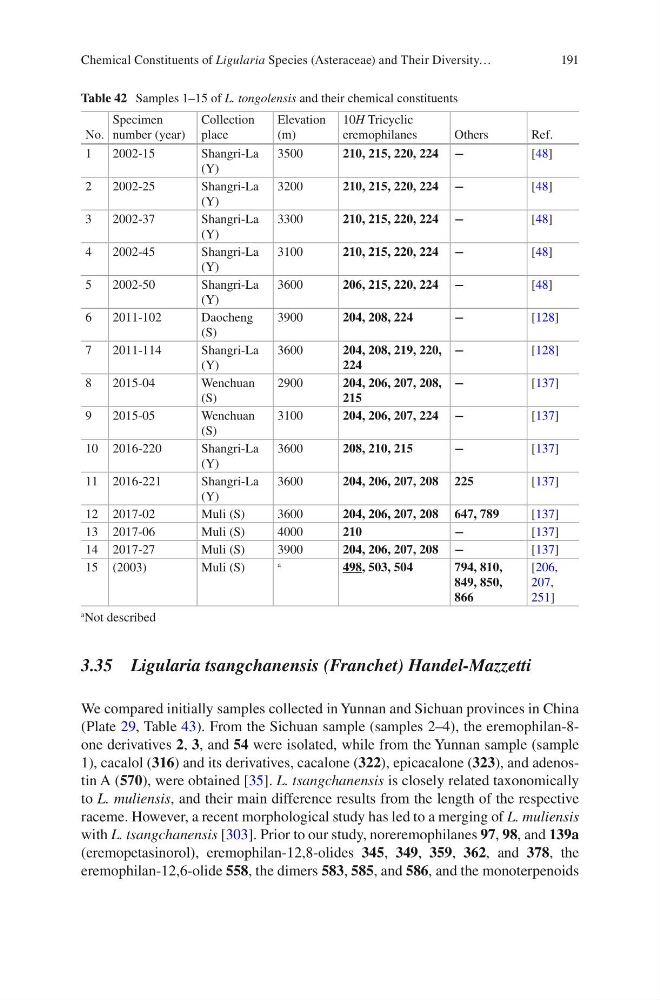
Table 42 Samples 1–15 of L. tongolensis and their chemical constituents
No.
Specimen
number (year)
Collection
place
Elevation
(m)
10H Tricyclic
eremophilanes
Others
Ref.
1
2002-15
Shangri-La
(Y)
3500
210, 215, 220, 224 −
[48]
2
2002-25
Shangri-La
(Y)
3200
210, 215, 220, 224 −
[48]
3
2002-37
Shangri-La
(Y)
3300
210, 215, 220, 224 −
[48]
4
2002-45
Shangri-La
(Y)
3100
210, 215, 220, 224 −
[48]
5
2002-50
Shangri-La
(Y)
3600
206, 215, 220, 224 −
[48]
6
2011-102
Daocheng
(S)
3900
204, 208, 224
−
[128]
7
2011-114
Shangri-La
(Y)
3600
204, 208, 219, 220,
224
−
[128]
8
2015-04
Wenchuan
(S)
2900
204, 206, 207, 208,
215
−
[137]
9
2015-05
Wenchuan
(S)
3100
204, 206, 207, 224 −
[137]
10 2016-220
Shangri-La
(Y)
3600
208, 210, 215
−
[137]
11 2016-221
Shangri-La
(Y)
3600
204, 206, 207, 208 225
[137]
12 2017-02
Muli (S)
3600
204, 206, 207, 208 647, 789
[137]
13 2017-06
Muli (S)
4000
210
−
[137]
14 2017-27
Muli (S)
3900
204, 206, 207, 208 −
[137]
15 (2003)
Muli (S)
a
498, 503, 504
794, 810,
849, 850,
866
[206,
207,
251]
a
Not described
Chemical Constituents of Ligularia Species (Asteraceae) and Their Diversity…
3.35 Ligularia tsangchanensis (Franchet) Handel-Mazzetti
We compared initially samples collected in Yunnan and Sichuan provinces in China
(Plate 29, Table 43). From the Sichuan sample (samples 2–4), the eremophilan- 8one derivatives 2, 3, and 54 were isolated, while from the Yunnan sample (sample
1), cacalol (316) and its derivatives, cacalone (322), epicacalone (323), and adenostin A (570), were obtained [35]. L. tsangchanensis is closely related taxonomically
to L. muliensis, and their main difference results from the length of the respective
raceme. However, a recent morphological study has led to a merging of L. muliensis
with L. tsangchanensis [303]. Prior to our study, noreremophilanes 97, 98, and 139a
(eremopetasinorol), eremophilan-12,8-olides 345, 349, 359, 362, and 378, the
eremophilan- 12,6-olide 558, the dimers 583, 585, and 586, and the monoterpenoids
Table 42 Samples 1–15 of L. tongolensis and their chemical constituents
No.
Specimen
number (year)
Collection
place
Elevation
(m)
10H Tricyclic
eremophilanes
Others
Ref.
1
2002-15
Shangri-La
(Y)
3500
210, 215, 220, 224 −
[48]
2
2002-25
Shangri-La
(Y)
3200
210, 215, 220, 224 −
[48]
3
2002-37
Shangri-La
(Y)
3300
210, 215, 220, 224 −
[48]
4
2002-45
Shangri-La
(Y)
3100
210, 215, 220, 224 −
[48]
5
2002-50
Shangri-La
(Y)
3600
206, 215, 220, 224 −
[48]
6
2011-102
Daocheng
(S)
3900
204, 208, 224
−
[128]
7
2011-114
Shangri-La
(Y)
3600
204, 208, 219, 220,
224
−
[128]
8
2015-04
Wenchuan
(S)
2900
204, 206, 207, 208,
215
−
[137]
9
2015-05
Wenchuan
(S)
3100
204, 206, 207, 224 −
[137]
10 2016-220
Shangri-La
(Y)
3600
208, 210, 215
−
[137]
11 2016-221
Shangri-La
(Y)
3600
204, 206, 207, 208 225
[137]
12 2017-02
Muli (S)
3600
204, 206, 207, 208 647, 789
[137]
13 2017-06
Muli (S)
4000
210
−
[137]
14 2017-27
Muli (S)
3900
204, 206, 207, 208 −
[137]
15 (2003)
Muli (S)
a
498, 503, 504
794, 810,
849, 850,
866
[206,
207,
251]
a
Not described
Chemical Constituents of Ligularia Species (Asteraceae) and Their Diversity…