

179
seco-eremophilane 154 (sample 14) [116], and monoterpenoids 893 and 895 were
also isolated (sample 15) [256]. The dimer 614 has an interesting [2 + 2] structure,
which was determined by X-ray diffraction analysis. From a sample collected in
Hubei (sample 12), the eremophilanes 68, 113, 140, 423, 427, 428, 430, and 433 were
isolated [80]. Five of these are 10-hydroxy derivatives. From another Hubei sample
(sample 10), 117, 123, and the eudesmane 794 were afforded [93]. Compound 117 is
a rare type of highly oxygenated 13- noreremophilane. From a European sample
(sample 1), liguhodgsonal (125), germacrene D (758), four highly oxygenated
germacranes 768, 769, 770, and 771, humulane (812), a monoterpene (875), and a
polyyne (883) were isolated by Bohlmann et al. [13]. These results suggest the
presence of geographically dependent diversity within this species.
3.29 Ligularia lamarum (Diels) C. C. Chang and Ligularia
subspicata (Bureau & Franchet) Handel-Mazzetti
These two species are very close to one another in morphology and are distinguished by the presence (L. lamarum) (Plate 22) or absence (L. subspicata) (Plate
23) of ray florets [2]. We collected 18 L. lamarum and 23 L. subspicata samples
and found that the two species could not be distinguished readily in terms of our
two indices, root chemical composition and ITS sequences (Tables 36 and 37).
Eremophilanes were isolated from all samples, including both bicyclic
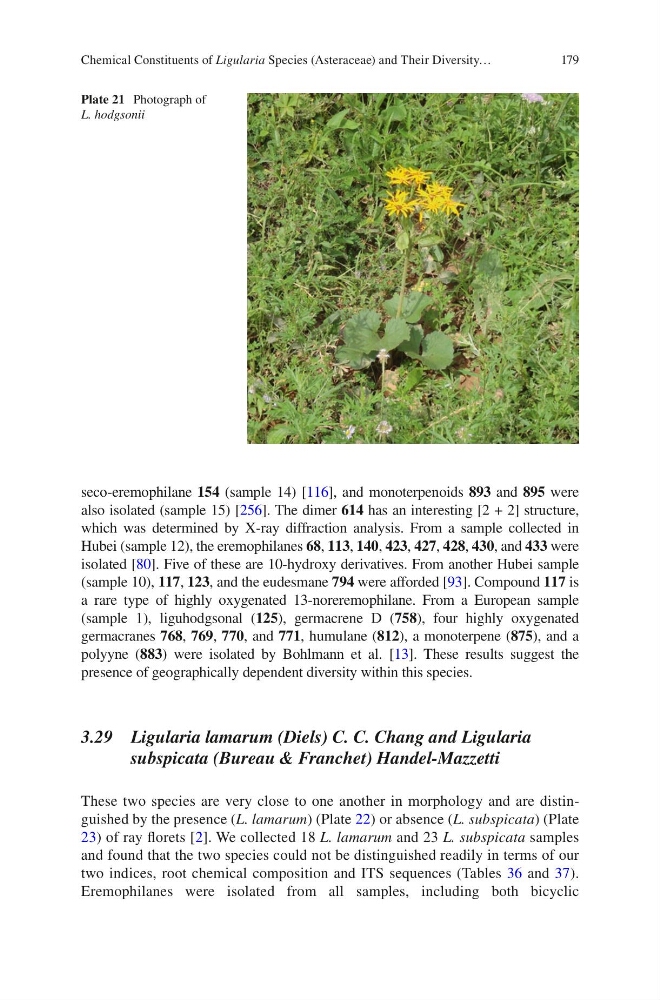
Plate 21 Photograph of
L. hodgsonii
Chemical Constituents of Ligularia Species (Asteraceae) and Their Diversity…
seco-eremophilane 154 (sample 14) [116], and monoterpenoids 893 and 895 were
also isolated (sample 15) [256]. The dimer 614 has an interesting [2 + 2] structure,
which was determined by X-ray diffraction analysis. From a sample collected in
Hubei (sample 12), the eremophilanes 68, 113, 140, 423, 427, 428, 430, and 433 were
isolated [80]. Five of these are 10-hydroxy derivatives. From another Hubei sample
(sample 10), 117, 123, and the eudesmane 794 were afforded [93]. Compound 117 is
a rare type of highly oxygenated 13- noreremophilane. From a European sample
(sample 1), liguhodgsonal (125), germacrene D (758), four highly oxygenated
germacranes 768, 769, 770, and 771, humulane (812), a monoterpene (875), and a
polyyne (883) were isolated by Bohlmann et al. [13]. These results suggest the
presence of geographically dependent diversity within this species.
3.29 Ligularia lamarum (Diels) C. C. Chang and Ligularia
subspicata (Bureau & Franchet) Handel-Mazzetti
These two species are very close to one another in morphology and are distinguished by the presence (L. lamarum) (Plate 22) or absence (L. subspicata) (Plate
23) of ray florets [2]. We collected 18 L. lamarum and 23 L. subspicata samples
and found that the two species could not be distinguished readily in terms of our
two indices, root chemical composition and ITS sequences (Tables 36 and 37).
Eremophilanes were isolated from all samples, including both bicyclic
Plate 21 Photograph of
L. hodgsonii
Chemical Constituents of Ligularia Species (Asteraceae) and Their Diversity…