

169
In contrast, Gao and co-workers obtained various bisabolane compounds (653,
658, 677, 683, 685, 686, 687, 688, 689, 691, 692, 693, 696, 705, and 707) from
samples obtained from Muli County, Sichuan, China (samples 3–5) [225, 229, 230].
However, from our own observations in field, L. cymbulifera and L. lankongensis
grow sympatrically in the same region where Gao et al. collected their samples.
Bisabolanes are the major components of L. lankongensis (Sect. 3.30). Since the
leaves of the two species are similar to each other, it is plausible that the bisabolane
compounds obtained by Gao’s group are components of L. lankongensis. According
to our own work, no bisabolane compounds were detected in L. cymbulifera.
3.26 Ligularia dictyoneura (Franchet) Handel-Mazzetti
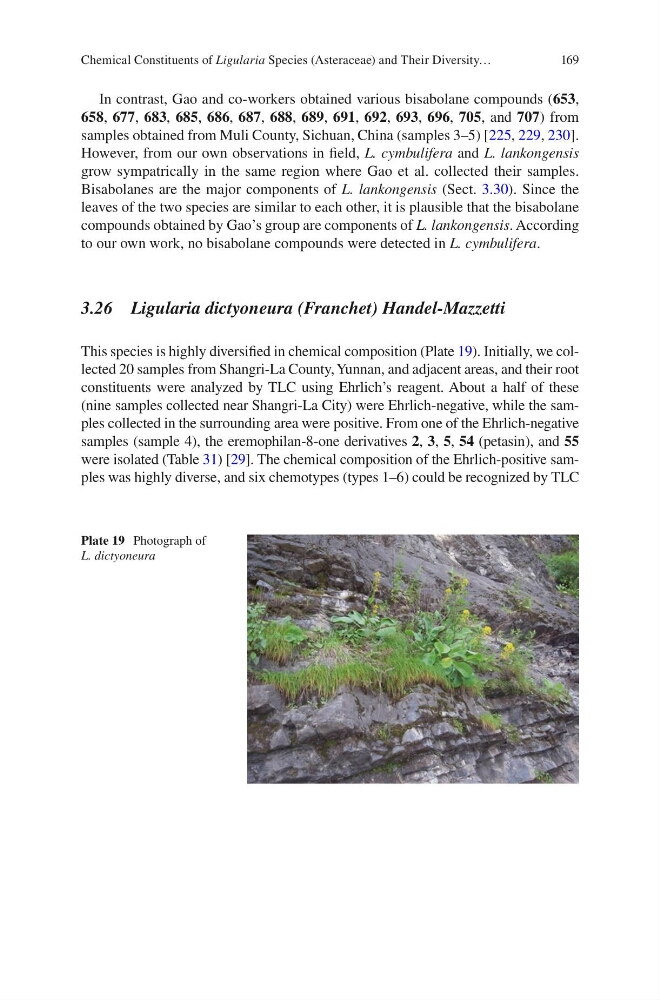
This species is highly diversified in chemical composition (Plate 19). Initially, we collected 20 samples from Shangri-La County, Yunnan, and adjacent areas, and their root
constituents were analyzed by TLC using Ehrlich’s reagent. About a half of these
(nine samples collected near Shangri-La City) were Ehrlich-negative, while the samples collected in the surrounding area were positive. From one of the Ehrlich- negative
samples (sample 4), the eremophilan-8-one derivatives 2, 3, 5, 54 (petasin), and 55
were isolated (Table 31) [29]. The chemical composition of the Ehrlich-positive samples was highly diverse, and six chemotypes (types 1–6) could be recognized by TLC
Plate 19 Photograph of
L. dictyoneura
Chemical Constituents of Ligularia Species (Asteraceae) and Their Diversity…
In contrast, Gao and co-workers obtained various bisabolane compounds (653,
658, 677, 683, 685, 686, 687, 688, 689, 691, 692, 693, 696, 705, and 707) from
samples obtained from Muli County, Sichuan, China (samples 3–5) [225, 229, 230].
However, from our own observations in field, L. cymbulifera and L. lankongensis
grow sympatrically in the same region where Gao et al. collected their samples.
Bisabolanes are the major components of L. lankongensis (Sect. 3.30). Since the
leaves of the two species are similar to each other, it is plausible that the bisabolane
compounds obtained by Gao’s group are components of L. lankongensis. According
to our own work, no bisabolane compounds were detected in L. cymbulifera.
3.26 Ligularia dictyoneura (Franchet) Handel-Mazzetti
This species is highly diversified in chemical composition (Plate 19). Initially, we collected 20 samples from Shangri-La County, Yunnan, and adjacent areas, and their root
constituents were analyzed by TLC using Ehrlich’s reagent. About a half of these
(nine samples collected near Shangri-La City) were Ehrlich-negative, while the samples collected in the surrounding area were positive. From one of the Ehrlich- negative
samples (sample 4), the eremophilan-8-one derivatives 2, 3, 5, 54 (petasin), and 55
were isolated (Table 31) [29]. The chemical composition of the Ehrlich-positive samples was highly diverse, and six chemotypes (types 1–6) could be recognized by TLC
Plate 19 Photograph of
L. dictyoneura
Chemical Constituents of Ligularia Species (Asteraceae) and Their Diversity…