

158
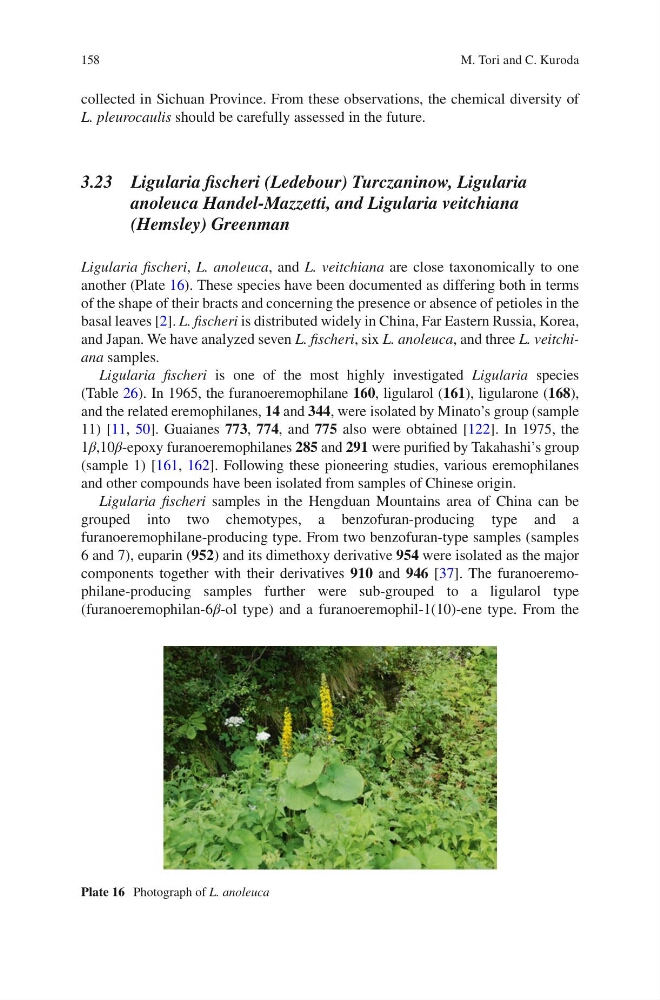
Plate 16 Photograph of L. anoleuca
collected in Sichuan Province. From these observations, the chemical diversity of
L. pleurocaulis should be carefully assessed in the future.
3.23 Ligularia fischeri (Ledebour) Turczaninow, Ligularia
anoleuca Handel-Mazzetti, and Ligularia veitchiana
(Hemsley) Greenman
Ligularia fischeri, L. anoleuca, and L. veitchiana are close taxonomically to one
another (Plate 16). These species have been documented as differing both in terms
of the shape of their bracts and concerning the presence or absence of petioles in the
basal leaves [2]. L. fischeri is distributed widely in China, Far Eastern Russia, Korea,
and Japan. We have analyzed seven L. fischeri, six L. anoleuca, and three L. veitchiana samples.
Ligularia fischeri is one of the most highly investigated Ligularia species
(Table 26). In 1965, the furanoeremophilane 160, ligularol (161), ligularone (168),
and the related eremophilanes, 14 and 344, were isolated by Minato’s group (sample
11) [11, 50]. Guaianes 773, 774, and 775 also were obtained [122]. In 1975, the
1β,10β-epoxy furanoeremophilanes 285 and 291 were purified by Takahashi’s group
(sample 1) [161, 162]. Following these pioneering studies, various eremophilanes
and other compounds have been isolated from samples of Chinese origin.
Ligularia fischeri samples in the Hengduan Mountains area of China can be
grouped into two chemotypes, a benzofuran-producing type and a
furanoeremophilane- producing type. From two benzofuran-type samples (samples
6 and 7), euparin (952) and its dimethoxy derivative 954 were isolated as the major
components together with their derivatives 910 and 946 [37]. The furanoeremophilane- producing samples further were sub-grouped to a ligularol type
(furanoeremophilan-6β-ol type) and a furanoeremophil-1(10)-ene type. From the
M. Tori and C. Kuroda
Plate 16 Photograph of L. anoleuca
collected in Sichuan Province. From these observations, the chemical diversity of
L. pleurocaulis should be carefully assessed in the future.
3.23 Ligularia fischeri (Ledebour) Turczaninow, Ligularia
anoleuca Handel-Mazzetti, and Ligularia veitchiana
(Hemsley) Greenman
Ligularia fischeri, L. anoleuca, and L. veitchiana are close taxonomically to one
another (Plate 16). These species have been documented as differing both in terms
of the shape of their bracts and concerning the presence or absence of petioles in the
basal leaves [2]. L. fischeri is distributed widely in China, Far Eastern Russia, Korea,
and Japan. We have analyzed seven L. fischeri, six L. anoleuca, and three L. veitchiana samples.
Ligularia fischeri is one of the most highly investigated Ligularia species
(Table 26). In 1965, the furanoeremophilane 160, ligularol (161), ligularone (168),
and the related eremophilanes, 14 and 344, were isolated by Minato’s group (sample
11) [11, 50]. Guaianes 773, 774, and 775 also were obtained [122]. In 1975, the
1β,10β-epoxy furanoeremophilanes 285 and 291 were purified by Takahashi’s group
(sample 1) [161, 162]. Following these pioneering studies, various eremophilanes
and other compounds have been isolated from samples of Chinese origin.
Ligularia fischeri samples in the Hengduan Mountains area of China can be
grouped into two chemotypes, a benzofuran-producing type and a
furanoeremophilane- producing type. From two benzofuran-type samples (samples
6 and 7), euparin (952) and its dimethoxy derivative 954 were isolated as the major
components together with their derivatives 910 and 946 [37]. The furanoeremophilane- producing samples further were sub-grouped to a ligularol type
(furanoeremophilan-6β-ol type) and a furanoeremophil-1(10)-ene type. From the
M. Tori and C. Kuroda