

150
3.21 Ligularia sagitta (Maximowicz) Mattfeld ex Rehder
& Kobuski
Chemical studies on L. sagitta have long been carried out (Plate 14). In 1992, the
first report on this plant (Gansu Province, China) documented the isolation of
liguhodgsonal (125) (major constituent), bakkenolide A (629), a cacalol-type compound (315), and the hetero-Diels-Alder-type dimeric compound 595 (sample 1,
Table 24) [105]. The structure of 595 was determined by X-ray structural analysis
[217]. This compound exhibits a complex structure derived from a 7,9-diene moiety
and 2-hydroxymethylpropenoic acid through a Diels-Alder reaction followed by
lactonization (Fig. 73). The previously assigned structure of 315 with a double bond
at C-2/C-3 was revised with this being present instead at C-1/C-2 by X-ray crystallographic analysis, as depicted in Fig. 20 [301]. From sample 2 (Gansu Province),
compound 595 and seven bicyclic eremophilanes (31, 32, 54 (petasin), 56
(isopetasin), 101, 102, and 107) were isolated [62]. Compound 32 is an enol acetate
of compound 31, and, as such, is quite rare as a natural product. Compound 44 was
afforded from sample 3 [71] and compounds 38 and 44 from sample 4 (Gansu
Province) [68]. Compound 38 corresponds to the ring opened and acetylated derivative of compound 44. Sample 5 (Gansu Province) produced two 8-methoxy eremophilanolides, farformolide B (397) and 404 [195].
From sample 6 (Gansu Province), six tricyclic eremophilanolides (395, 397 (farformolide B), 402, 403, 404, and 405), the two triterpenoids 828 (lupeol) and 848 (ursolic
acid), and a monoterpenoid (866) were isolated [194]. Compounds 402 and 403 are
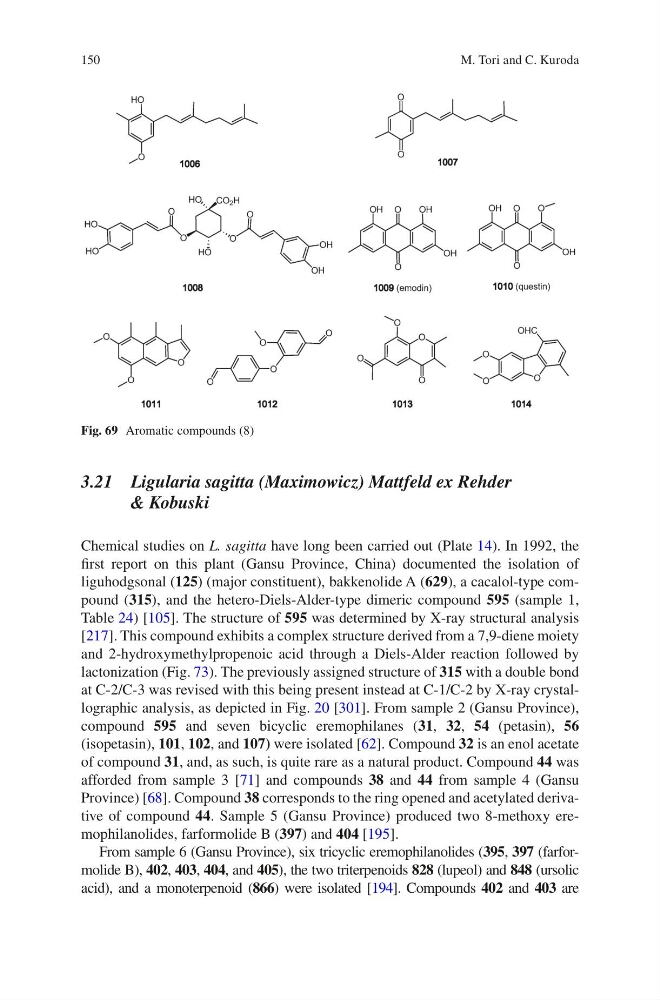
Fig. 69 Aromatic compounds (8)
M. Tori and C. Kuroda
3.21 Ligularia sagitta (Maximowicz) Mattfeld ex Rehder
& Kobuski
Chemical studies on L. sagitta have long been carried out (Plate 14). In 1992, the
first report on this plant (Gansu Province, China) documented the isolation of
liguhodgsonal (125) (major constituent), bakkenolide A (629), a cacalol-type compound (315), and the hetero-Diels-Alder-type dimeric compound 595 (sample 1,
Table 24) [105]. The structure of 595 was determined by X-ray structural analysis
[217]. This compound exhibits a complex structure derived from a 7,9-diene moiety
and 2-hydroxymethylpropenoic acid through a Diels-Alder reaction followed by
lactonization (Fig. 73). The previously assigned structure of 315 with a double bond
at C-2/C-3 was revised with this being present instead at C-1/C-2 by X-ray crystallographic analysis, as depicted in Fig. 20 [301]. From sample 2 (Gansu Province),
compound 595 and seven bicyclic eremophilanes (31, 32, 54 (petasin), 56
(isopetasin), 101, 102, and 107) were isolated [62]. Compound 32 is an enol acetate
of compound 31, and, as such, is quite rare as a natural product. Compound 44 was
afforded from sample 3 [71] and compounds 38 and 44 from sample 4 (Gansu
Province) [68]. Compound 38 corresponds to the ring opened and acetylated derivative of compound 44. Sample 5 (Gansu Province) produced two 8-methoxy eremophilanolides, farformolide B (397) and 404 [195].
From sample 6 (Gansu Province), six tricyclic eremophilanolides (395, 397 (farformolide B), 402, 403, 404, and 405), the two triterpenoids 828 (lupeol) and 848 (ursolic
acid), and a monoterpenoid (866) were isolated [194]. Compounds 402 and 403 are
Fig. 69 Aromatic compounds (8)
M. Tori and C. Kuroda